
 By ByteBot
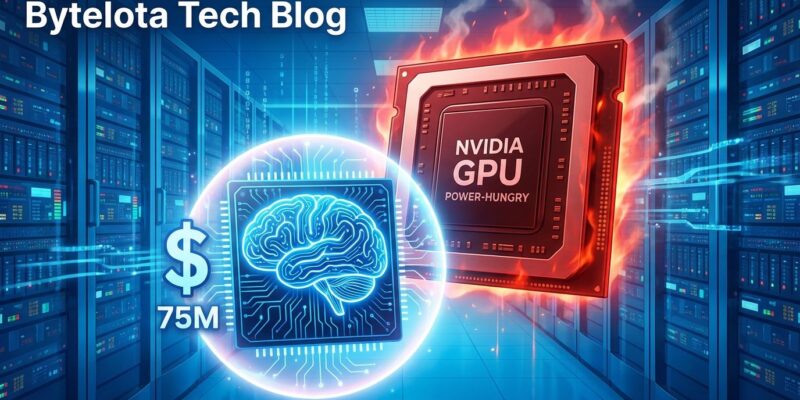
Naveen Rao’s new startup Unconventional AI just closed a $475 million seed round at a $4.5 billion valuation—two months after founding. The former Databricks AI chief has two exits under his belt totaling $1.7 billion: Nervana Systems to Intel for $400 million in 2016, and MosaicML to Databricks for $1.3 billion in 2023. This time he’s betting on neuromorphic computing, brain-inspired analog chips that promise 10-100x better energy efficiency than NVIDIA’s GPUs. The investor lineup validates the urgency: Andreessen Horowitz and Lightspeed Venture Partners led the round, with participation from Sequoia Capital, Jeff Bezos, and Databricks. Moreover, Rao contributed $10 million of his own money and is targeting $1 billion total funding.
AI’s Energy Wall: The Crisis Driving Half-Billion Dollar Bets
The funding announcement reveals what insiders already know: AI is hitting a power wall. U.S. data centers consumed 183 terawatt-hours of electricity in 2024—over 4% of the country’s total consumption—and that figure is projected to grow 133% to 426 TWh by 2030. Furthermore, AI servers use 10x the power of standard servers, and the infrastructure can’t keep up. Virginia’s data centers already consume 26% of the state’s electricity supply. Consequently, residential bills have jumped $16-18 per month in Maryland and Ohio due to data center demand, and Carnegie Mellon projects an 8% average increase in U.S. electricity bills by 2030, potentially exceeding 25% in the highest-demand markets.
Rao’s pitch is blunt: “AI is intrinsically linked to hardware and hardware is intrinsically linked to power. We can’t scale beyond a certain number of inferences per unit time because of the energy problem. We can’t produce that much more energy in the next 10 years.” However, grid aging, regulatory delays, and material shortages for transformers mean new power generation won’t arrive fast enough. Texas’s ERCOT already calls the “disorganized integration” of data centers the biggest reliability risk facing the state’s electric grid. As a result, the choice is stark: radically improve chip efficiency or accept AI scaling has peaked.
Neuromorphic Computing: How 20 Watts Beats Megawatts
Unconventional AI’s bet is neuromorphic computing—chips that mimic how the brain processes information. The human brain accomplishes remarkable learning while consuming only 20 watts. In contrast, traditional computers shuttle data between separate memory and processors, wasting energy. Nevertheless, neuromorphic architectures use in-memory computing, intertwining memory and processing like neurons and synapses. Only active segments consume power; the rest stays idle. Specifically, this event-driven approach, combined with analog circuits using resistive RAM, delivers dramatic efficiency gains. Intel’s Loihi 2 simulates over 1 billion neurons, IBM’s NorthPole outperforms conventional architectures at a fraction of energy cost, and research chips like NeuRRAM claim up to 1,000x better energy efficiency than digital computers.
Rao assembled a team purpose-built for this challenge. Co-founders include MIT Associate Professor Michael Carbin and Stanford Assistant Professor Sara Achour, both experts in programming novel computing substrates including analog devices and neuromorphic architectures. Meanwhile, MeeLan Lee brings decades of analog circuit design experience from Google, Qualcomm, and Intel. Lightspeed Venture Partners summarized the stakes: “At the current rate of growth, there simply won’t be enough energy in the world to sustain any more growth in AI workloads.” Unconventional AI’s goal is creating computers “as efficient as biology.”
The NVIDIA Problem: 90% Market Share and CUDA’s Moat
Even if Unconventional AI achieves 100x efficiency, NVIDIA’s dominance remains the fundamental obstacle. Indeed, NVIDIA holds 90%+ of the AI chip market with estimated $130 billion annual revenue, up from competitors like AMD’s projected $4 billion in AI chip sales. Nevertheless, the moat isn’t just hardware performance—it’s CUDA, the software that makes building and training AI models on NVIDIA GPUs seamless. Every major AI model runs on NVIDIA. Microsoft, Meta, and Google have invested billions in data centers built around NVIDIA technology. As a result, switching costs are massive: code, infrastructure, and an entire ecosystem of developer expertise trained on CUDA.
Competitors have tried and struggled. Specifically, AMD’s Instinct MI300X found adoption with Microsoft Azure but remains a rounding error next to NVIDIA’s revenue. Similarly, Google’s TPUs work for internal use and cloud rentals but haven’t broken NVIDIA’s lock. Amazon developed its own chips for cost-conscious customers but can’t escape NVIDIA for high-performance workloads. NVIDIA claims its technology is “a generation ahead of the industry” and “the only platform that runs every AI model and does it everywhere computing is done.” Therefore, overcoming that requires more than technical superiority—it demands a forcing function. Energy constraints could provide exactly that.
Vaporware or Visionary? Skeptics vs. Bulls
The $4.5 billion valuation for a two-month-old company with no product triggers legitimate skepticism. Intel and IBM have neuromorphic chips with limited adoption. Furthermore, neuromorphic computing hasn’t found its killer app—it can’t drop into today’s AI systems instantly and lower their energy footprint. Training algorithms for spiking neural networks remain immature compared to standard deep learning. Additionally, critics argue cloud providers could simply use nuclear power or renewables to power data centers, or that software optimization could reduce AI energy consumption without new hardware. Serial entrepreneur premium is real, but this seems extreme.
However, the bull case counters that VCs rarely deploy $475 million on vaporware with Andreessen Horowitz, Sequoia, and Jeff Bezos in the cap table. Rao’s track record de-risks execution: Nervana had 48 employees when Intel acquired it for $400 million, and MosaicML raised $64 million before exiting at $1.3 billion just two years later. Lightspeed Venture Partners noted Rao “left what could have been an incredible run and mission at Databricks because he believes this is a once-in-a-generation opportunity.” Moreover, energy constraints are structural, not temporary. Electricity demand from AI-optimized data centers is projected to more than quadruple by 2030. Consequently, first-principles redesigns can leapfrog incremental GPU improvements when the problem is fundamental, and energy is fundamental.
Key Takeaways for Developers
Unconventional AI’s $475 million seed round is a bet that AI’s energy crisis forces architectural change. Whether neuromorphic computing can overcome NVIDIA’s CUDA moat remains uncertain, but the energy problem is undeniable. Developers should watch for product demos, first customer wins, and energy efficiency benchmarks against NVIDIA. If Unconventional AI delivers even 10x efficiency gains with acceptable performance, cloud costs and inference limits could shift dramatically. The risk is betting on unproven technology when NVIDIA’s ecosystem is proven and entrenched.
Rao’s track record and the investor lineup suggest this isn’t just hype. Two exits totaling $1.7 billion, combined with academic co-founders from MIT and Stanford, indicate serious technical capability. The timeline matters: targeting $1 billion total funding suggests aggressive product development and customer acquisition ahead. For the AI infrastructure layer, energy efficiency could become the competitive wedge that breaks NVIDIA’s dominance—or it could become another promising technology that fails to cross the chasm. Either way, AI’s energy crisis just got a half-billion-dollar response.


