 By ByteBot
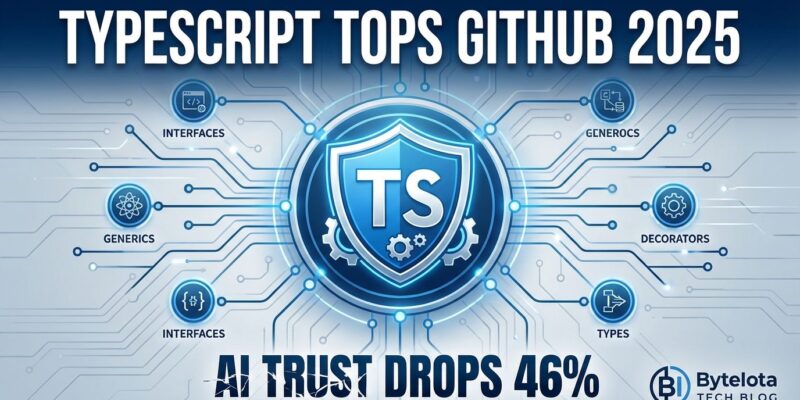
TypeScript just did something no language has done in over a decade on GitHub. In August 2025, it became the platform’s #1 language by contributor count—2.64 million monthly contributors—surpassing both Python and JavaScript. This isn’t just about one language winning. It signals three major shifts reshaping development: TypeScript’s framework-driven takeover, Python’s AI-fueled explosion, and a widening chasm between AI tool adoption (84%) and developer trust (33%).
TypeScript’s Framework-Driven Takeover
TypeScript’s rise to #1 on GitHub marks what the Octoverse report calls “the most significant language shift in more than a decade.” The numbers tell the story: TypeScript added over 1 million contributors in 2025 alone—a 66% year-over-year surge—finishing August with 2,636,006 monthly contributors. It edged out Python by roughly 42,000 contributors.
But developers didn’t choose TypeScript. Frameworks chose it for them.
Nearly every major frontend framework now scaffolds projects in TypeScript by default—Next.js 15, Astro 3, SvelteKit 2, Angular 18, Remix. Migration isn’t optional; it’s baked into the tooling. This isn’t organic adoption; it’s ecosystem pressure.
AI is accelerating the shift. Stricter type systems help AI code generators avoid errors. A 2025 study found that 94% of LLM-generated compilation errors were type-check failures. AI isn’t just speeding up coding—it’s influencing which languages developers use. As GitHub puts it: “AI is reshaping choices, not just code.”
Python still dominates AI and data science with 2.6 million contributors (+48% YoY), while JavaScript maintains 2.15 million. But JavaScript growth is slowing as developers migrate to TypeScript. If you’re working in frontend development in 2026, TypeScript isn’t optional—it’s the default.
The AI Trust Paradox: Used Daily, Trusted Never
Developers are using AI tools more than ever, but trusting them less than ever. That paradox, emerging from Stack Overflow’s 2025 survey, could undermine billions in AI development tool investments.
The numbers are stark. 84% of developers now use or plan to use AI tools, up from 76% in 2024. Over half (51%) rely on AI daily. But only 33% trust AI-generated code accuracy. Worse, 46% actively distrust AI outputs—up from 31% a year ago. Only 3% “highly trust” AI tools.
Trust is declining. Positive sentiment dropped from 70%+ in 2023-2024 to just 60% in 2025. Trust in accuracy fell from 40% to 29%.
The frustrations are specific. 66% of developers struggle with AI solutions that are “almost right, but not quite.” 45% say debugging AI code takes longer than writing it themselves. When asked why they’d still consult a human, 75% cited: “When I don’t trust AI’s answers.”
Experienced developers trust AI least. Only 2.6% of seniors “highly trust” AI tools; 20% “highly distrust” them.
AI tools do save time—90% report saving at least one hour weekly, 20% save eight-plus hours. But productivity gains don’t matter if teams don’t trust the output. Organizations investing in AI assistants face a credibility crisis: tools are adopted but not believed.
The takeaway? Use AI for boilerplate, verify anything critical manually. The gap between adoption and trust isn’t closing—it’s widening.
Python’s 7-Point Surge: Riding the AI Wave
Python’s adoption jumped 7 percentage points from 2024 to 2025. In a mature language ecosystem, that’s not growth—it’s a surge. And it’s driven almost entirely by AI and machine learning.
JetBrains found 41% of Python developers use it specifically for machine learning; 51% are in data processing. Python’s AI/ML libraries saw 40% YoY usage growth. On the job market, 1.19 million LinkedIn listings require Python skills—the most for any language.
Python’s AI dominance isn’t accidental. The ecosystem—NumPy, TensorFlow, PyTorch—is unmatched. Google, Microsoft, Tesla, Amazon, and NVIDIA rely on Python for mission-critical AI applications.
The risk? Python’s surge is tightly coupled to AI hype. If AI investment cools, Python could be over-indexed on one trend. Python also dominates web development and data science beyond ML, but the 7-point jump? That’s AI money talking.
For developers, Python remains the safest bet for AI/ML careers. Just don’t assume AI funding grows forever.
What This Means for Developers
TypeScript is no longer optional for frontend roles—frameworks decided that for you. Python dominates AI/ML, with 1.19 million job listings to prove it. And if you’re banking on AI tools to carry your productivity, remember: 46% of your peers don’t trust them.
Developers want to learn Go (11%), Rust (10%), Python (7%), Kotlin (6%), and TypeScript (6%) next. The broader trend? AI isn’t just speeding up development. It’s reshaping which languages developers choose, which tools they adopt, and how much they trust code they didn’t write. The ecosystem is in transition. Adaptation isn’t optional.