 By
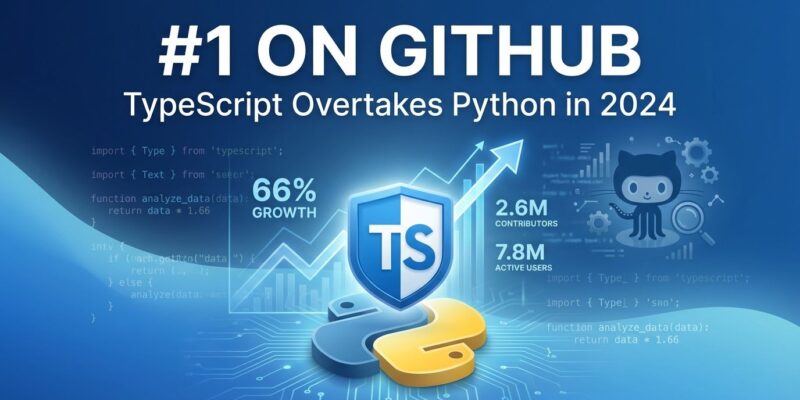
By TypeScript just dethroned Python as the most-used language on GitHub. In August 2025, TypeScript hit 2,636,006 monthly contributors, overtaking Python by approximately 42,000 users and ending Python’s 16-month reign at the top. With 66% year-over-year growth—adding over 1 million contributors—this marks the most significant language shift on GitHub in over a decade.
And it’s not a fluke. It’s a fundamental restructuring of how developers build software.
AI Coding Assistants Made Type Safety Mandatory
The primary driver isn’t developer preference or philosophical debates about static typing. It’s AI-assisted development. TypeScript won because AI coding tools require it to function reliably.
Here’s the reality: a 2025 study found that 94% of errors generated by LLMs in code are type-related. TypeScript catches these automatically before your code ever runs, creating a feedback loop that makes AI-assisted development significantly faster. The LLM proposes code, the TypeScript compiler flags type mismatches with precise error messages (like “type X is not assignable to Y”), and the model adjusts in the next iteration. Type-constrained code generation reduces compilation errors by more than half and increases functional correctness by 3.5% to 5.5%.
With 84% of developers using or planning to use AI tools, and 80% of new GitHub developers using Copilot within their first week, TypeScript has become the de facto language for AI-assisted coding. The compiler acts like a strict senior engineer that instantly checks every line—and LLMs respond to that feedback far better than vague runtime errors.
This isn’t about type safety philosophy. It’s about practical necessity. AI coding assistants work better with TypeScript, so TypeScript wins.
Why TypeScript Won: Frameworks Chose It for You
Developers didn’t choose TypeScript. Frameworks chose it for them.
Nearly every major frontend framework now scaffolds projects in TypeScript by default. Next.js 15, Angular, SvelteKit, Remix, Astro 3, Qwik, SolidStart—when you run npx create-next-app, you get TypeScript automatically. Vue 3 is deeply integrated with it. The default path is TypeScript. Opting out requires conscious effort.
Framework authors made this decision years ago. The 66% growth in 2025 is just the market catching up to what the ecosystem already decided. New developers learn TypeScript first, not JavaScript. Network effects compound. The choice was made before most developers even arrived.
This is how TypeScript won: not through advocacy or marketing, but by becoming the framework default. Individual preference is irrelevant when the tooling ecosystem has already decided.
Enterprise Adoption Hit Critical Mass
TypeScript isn’t a startup experiment anymore. It’s the enterprise standard.
According to Visual Studio Magazine, 90% of Fortune 500 companies with web-facing platforms have adopted or are transitioning to TypeScript-based architectures. That’s not hype—that’s 400% growth in enterprise adoption since 2020. Google, Microsoft, Meta, Airbnb, Slack, and Stripe are fully committed to TypeScript in production systems handling billions of requests.
The reason is straightforward: type safety prevents runtime errors before deployment. Compile-time checks catch entire classes of bugs. Production systems become more reliable and predictable at scale. When you’re managing codebases with hundreds of contributors, TypeScript’s enforced contracts reduce chaos.
The job market reflects this shift. TypeScript positions increased 50% from 2021 to 2023, and developers command a 10-15% salary premium. JetBrains’ new Language Promise Index ranks TypeScript #1 based on audience growth, stability, and adoption intentions. It’s not emerging—it’s established.
Python Isn’t Dying
Let’s be clear: TypeScript winning GitHub doesn’t mean Python is losing the developer world.
Python still grew 48% year-over-year, adding 850,000 contributors. It dominates AI and machine learning, data science, scientific computing, and backend scripting. GitHub is heavily frontend-focused. Python’s strength lies in data pipelines, research notebooks, and automation—work that often doesn’t live in public repositories.
This is specialization, not replacement. TypeScript won the web. Python owns the data layer. The JavaScript/TypeScript ecosystem is larger overall, but Python is irreplaceable in AI/ML workflows. Both languages are growing. The shift reflects different ecosystems maturing, not one language dying.
Avoid the “language wars” narrative. This isn’t a zero-sum game.
What This Means for Developers
The TypeScript overtake has immediate, practical implications.
First, new web projects should default to TypeScript unless there’s a specific reason to use JavaScript. The framework ecosystem has already made this choice. AI coding assistants work better with type constraints. Enterprise employers expect it.
Second, TypeScript skills are now table stakes for frontend and full-stack roles. It’s not a specialization—it’s baseline. The 73% developer satisfaction score (compared to JavaScript’s 61%) suggests developers prefer working in TypeScript once they adopt it.
Third, Python remains essential for AI, machine learning, and data-focused work. If you’re building web UIs, learn TypeScript. If you’re training models or analyzing data, Python is still king. Choose tools based on the problem domain, not language popularity contests.
The GitHub Octoverse 2025 report makes one thing clear: TypeScript’s rise is driven by AI-assisted development, framework defaults, and enterprise production needs. It’s not ideology. It’s infrastructure.
And infrastructure always wins.