 By ByteBot
In August 2025, TypeScript overtook Python to become the most-used programming language on GitHub by monthly contributors, marking the most significant language shift in over a decade according to GitHub’s Octoverse report. With 2.6 million monthly contributors and 66% year-over-year growth, TypeScript’s rise isn’t just about web development trends—it’s about how AI coding tools are fundamentally reshaping which languages developers choose, with type safety emerging as the critical differentiator in an AI-first development era.
The Numbers Behind TypeScript’s Historic Rise
GitHub’s data tells a clear story. TypeScript didn’t just edge past Python—it surged ahead with 2,636,006 monthly contributors in August 2025, representing a 66% year-over-year increase. That’s over a million new TypeScript developers in a single year. The language now powers 12.5 million public repositories, up 43% from the previous year.
But here’s what makes this shift remarkable: Python didn’t shrink. It actually grew 48% year-over-year, maintaining 2.6 million contributors of its own. This isn’t a story about one language beating another—it’s about massive expansion in both ecosystems, with TypeScript simply growing faster.
The broader context matters too. GitHub saw 518.7 million pull requests merged in 2025, a 29% increase year-over-year. With 180 million developers now using the platform, language choices reflect real trends in how software gets built at scale.
Why AI Coding Tools Favor TypeScript
The driving force behind TypeScript’s acceleration isn’t developer preference in isolation—it’s AI. A 2025 academic study revealed that 94% of LLM-generated compilation errors are type-check failures. Let that sink in: when AI tools like GitHub Copilot generate code, type errors are the overwhelming failure mode.
Type systems catch these errors at compile time, not in production. When you’re working with AI-assisted development—and 80% of new GitHub developers now use Copilot within their first week—that difference becomes critical. Types don’t just guide developers; they guide the AI itself, steering language models toward correct implementations.
As GitHub’s research puts it: “AI is reshaping choices, not just code.” Developers are gravitating toward typed languages not because they’re inherently better, but because they make agent-assisted coding more reliable in production. When a third of your codebase comes from AI suggestions, you need guardrails. TypeScript provides them.
The ecosystem has responded. With over 1.1 million repositories now using LLM SDKs—693,867 created in just the past year—the integration of AI into development workflows is no longer experimental. It’s infrastructure. And that infrastructure works better with types.
Framework Defaults Accelerate Adoption
TypeScript’s rise wasn’t just driven by AI tooling—it was amplified by framework defaults. Nearly every major frontend framework now scaffolds new projects with TypeScript by default. React (15+ million weekly npm downloads), Vue 3 (~5 million weekly downloads), and Angular (~2.5 million weekly downloads) all offer first-class TypeScript support, with Angular requiring it outright.
This creates a powerful feedback loop. New developers learn TypeScript because that’s what the framework generates. They get comfortable with types. They prefer them on their next project. The cycle repeats.
Framework authors made this choice deliberately. When you’re building complex applications with thousands of components, type safety isn’t optional—it’s essential. And when AI tools are generating those components, it’s non-negotiable.
Python’s Unshakeable Data Science Crown
Before the “TypeScript won” narrative gets out of hand, let’s be clear: Python isn’t losing. It’s dominating a different game.
In data science and machine learning, Python’s grip is absolute. 87% of data professionals use Python regularly. 41% of Python developers use it specifically for machine learning. The language led the TIOBE Index with a 25.87% share in June 2025, and LinkedIn shows 1.19 million job listings requiring Python skills.
Why the disconnect between GitHub contributors and actual usage? Because data science work often lives in private repositories, Jupyter notebooks, and research environments that don’t always make it to public GitHub. The TensorFlow, PyTorch, and scikit-learn ecosystems remain unmatched. If you’re training models or processing data pipelines, Python is still the only serious choice.
TypeScript’s GitHub dominance reflects web development’s massive scale and open-source culture, not Python’s decline. Different domains, different metrics, different winners.
Career Implications for Developers
The salary data tells an interesting story. TypeScript developers average $129,000 annually in the US according to October 2025 data, with top markets like Seattle and Santa Monica paying $170,000-$173,000. That’s a meaningful premium over the $111,000 average for JavaScript developers without TypeScript skills.
Python developers earn between $98,000 and $188,000 depending on specialization and experience, averaging around $112,000. The Stack Overflow 2025 survey showed 80% developer TypeScript adoption, while JetBrains called it “the most dramatic rise over the past five years.”
So which should you learn? The answer depends entirely on what you’re building. Choose TypeScript if you’re doing web development, working heavily with AI coding tools, or building enterprise frontend applications. Choose Python if you’re in data science, machine learning, backend systems, or want maximum job flexibility. And if you’re serious about a long-term development career, learn both.
Looking Ahead to 2026 and Beyond
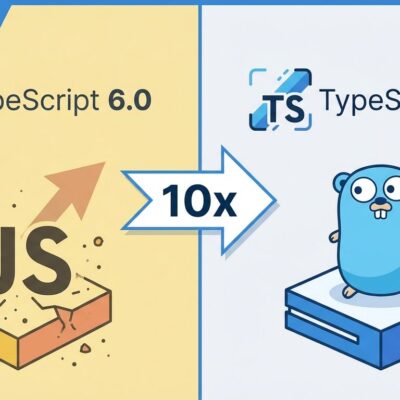
TypeScript will likely maintain its GitHub #1 position. Web development’s scale, combined with AI coding’s continued growth, creates structural momentum. Microsoft’s announcement of a new Rust-based TypeScript compiler promises even faster type checks and better AI integration, further solidifying the language’s advantages.
Python will keep its data science crown. The ecosystem moat—libraries built over decades, academic adoption, and domain-specific tooling—isn’t going anywhere. If anything, AI’s explosion makes Python more valuable, not less.
The real trend to watch is how AI reshapes language choice across the industry. As agent-assisted development becomes universal, type safety transitions from nice-to-have to infrastructure requirement. Languages that can’t provide compile-time guarantees will struggle in AI workflows.
For developers, the lesson is clear: understand the domain, not just the trend. TypeScript’s GitHub dominance matters immensely if you’re building web applications. It matters far less if you’re training neural networks. Choose your tools based on the problems you’re solving, not the headlines you’re reading.
Both languages are winning. They’re just playing different games.