 By ByteBot
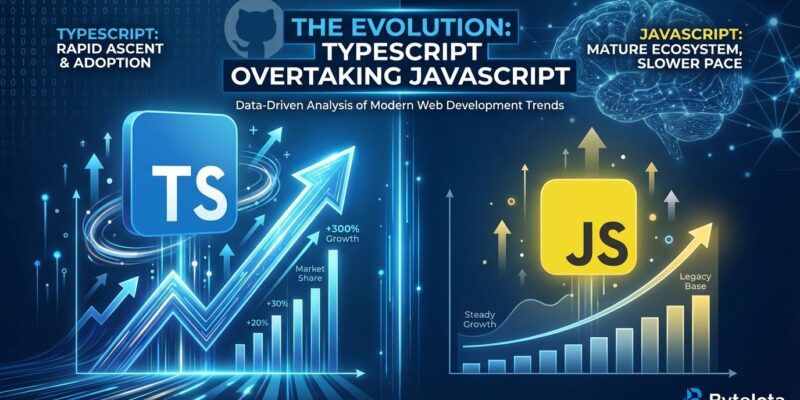
TypeScript officially overtook JavaScript to become the #1 most-used language on GitHub in August 2025, according to GitHub’s Octoverse report. For the first time since GitHub’s founding, JavaScript has been dethroned – marking a historic shift in web development. But this isn’t a story about developer preference. The data reveals something more fundamental: AI-driven development demands type safety, and TypeScript’s victory proves it.
The AI Connection
TypeScript’s growth correlates directly with AI tool adoption, and the numbers are striking. Developers using AI tools show 51.4% TypeScript adoption versus 48.8% among general professionals, according to Stack Overflow’s 2025 survey. More tellingly, research shows TypeScript demonstrates 90% fewer ID mix-up bugs and 3x faster LLM convergence compared to untyped code.
The reason is structural. TypeScript’s type system provides semantic checkpoints that guide AI models toward correct solutions. Without types, large language models work from vibes and patterns. With types, they work from contracts – turning AI assistants from hallucination generators into force multipliers. When 84% of developers are using AI tools in 2025 (up from 76% in 2024), that structural advantage becomes decisive.
The Numbers Don’t Lie
TypeScript gained over 1 million contributors in 2025 alone – a 66.63% year-over-year increase that dwarfed Python’s 48.78% and JavaScript’s 24.79% growth. The overtaking margin was just 42,000 contributors separating TypeScript from Python in August, but the trajectory is unmistakable.
With 180 million developers on GitHub pushing nearly 1 billion commits in 2025, TypeScript’s ascent represents the fastest absolute growth rate in the platform’s history. JavaScript isn’t dying – it added 427,000 contributors this year. But TypeScript is accelerating at nearly three times that pace.
Framework Ecosystem Sealed the Deal
Nearly every major frontend framework now scaffolds with TypeScript by default. React, Next.js, Angular, SvelteKit – they all present TypeScript as the presumed choice, not an opt-in. New developers in 2025 encounter TypeScript from day one.
This isn’t just adoption. It’s assumption. React 19 ships with improved TypeScript support. Next.js defaults to TypeScript scaffolding. Angular is built entirely in TypeScript. The framework ecosystem essentially decided: type safety is table stakes for modern development.
That infrastructure shift matters because it creates a self-reinforcing cycle. Frameworks default to TypeScript, so AI tools train on TypeScript code, so developers use TypeScript to get better AI assistance, so frameworks double down on TypeScript support. The flywheel is spinning.
Context Engineering Killed Vibe Coding
2025 saw the death of “vibe coding” – the loose, prompt-based approach where developers hoped AI would get it right. Collins Dictionary named it Word of the Year for 2025, but by September, Fast Company was reporting the “vibe coding hangover” as senior engineers experienced “development hell” with unreliable AI-generated code.
The industry shifted to “context engineering,” where teams systematically manage how AI systems process information. As MIT Technology Review documented, this paradigm change favors TypeScript decisively.
TypeScript thrives in context engineering because types provide the structure AI needs. Without types, AI forgets project conventions every session – the “context collapse” problem. With types, AI has semantic guardrails that prevent hallucinations and maintain consistency across sessions. The community consensus is clear: context engineering is 10x better than prompt engineering and 100x better than vibe coding.
What This Means for Developers
The job market speaks clearly. TypeScript developers average $130,000-$136,000 annually, with top markets like Seattle hitting $173,000. But the real signal isn’t salary – it’s that TypeScript has shifted from “nice to have” to “essential requirement.”
If you’re learning web development in 2025, starting with JavaScript is already outdated. TypeScript is the baseline. The 31.9% TypeScript adoption among learners versus 48.8% among professionals shows a gap that needs closing. Every month you delay learning TypeScript is a month your AI tools work less effectively and your resume looks less competitive.
For experienced developers, the message is equally clear: the combined JavaScript/TypeScript ecosystem still exceeds Python’s footprint, but growth is concentrating in the typed branch. JavaScript skills remain valuable – TypeScript compiles to JavaScript, after all – but type systems are where the industry is investing.
The Bottom Line
TypeScript’s victory proves that the future of coding isn’t just about what humans prefer – it’s about what AI can reliably generate. We’re not choosing TypeScript because we like it better. We’re choosing it because our AI tools need it to work reliably.
JavaScript is dead. Long live JavaScript – in its typed form. Welcome to the typed future.