 By ByteBot
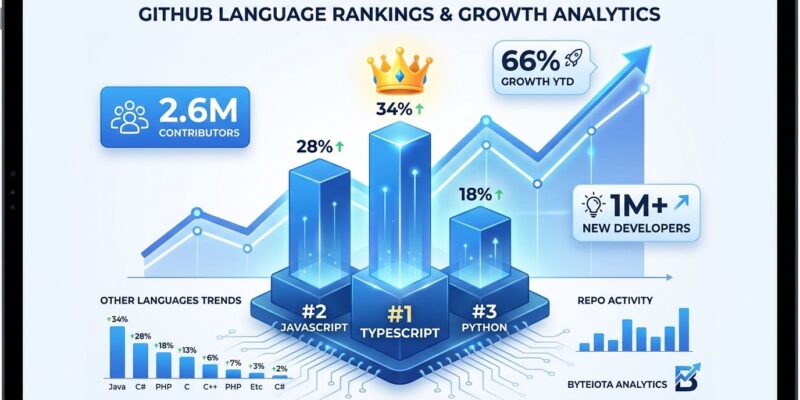
TypeScript became the most-used programming language on GitHub in August 2025, overtaking both JavaScript and Python for the first time. GitHub calls this “the most significant language shift in more than a decade.” The numbers tell the story: TypeScript grew 66% year-over-year to reach 2.6 million monthly contributors—over 1 million developers joined in 2025 alone. This isn’t just a milestone. It’s a market signal about where web development is heading.
The historic shift affects every JavaScript developer’s career trajectory. TypeScript skills now command 10-15% salary premiums, and enterprise adoption has crossed 85% for Node.js development. For developers evaluating their learning priorities, understanding why this happened matters more than the rankings themselves.
Why AI Era Demands Typed Code
TypeScript’s rise is directly tied to AI coding assistants. A 2025 study found that 94% of errors generated by AI code completion tools are type-related. As GitHub Copilot, Claude, and similar tools become ubiquitous, languages with type systems provide dramatically better AI assistance—TypeScript catches those errors at development time, not production.
Anders Hejlsberg, TypeScript’s lead architect, explained the dynamic: “Languages may end up competing less on syntax, and more on ecosystem leverage: package depth, tooling maturity, model familiarity, debugging ergonomics.” TypeScript’s type system makes AI coding assistants more reliable in production environments. The AI era isn’t just changing how developers code—it’s changing which languages win.
Related: AI Coding Assistants: 84% Adoption Meets 46% Distrust
Frameworks Choose TypeScript by Default
Nearly every major frontend framework now creates TypeScript projects by default. Next.js 15, Angular 18, SvelteKit 2, Astro 3, Remix, SolidStart, and Qwik all scaffold in TypeScript unless developers explicitly opt out. This isn’t developer preference driving the shift—it’s ecosystem momentum. When frameworks choose TypeScript-first, new projects inherit that decision automatically.
The data confirms this pattern: GitHub shows 5.4 million new TypeScript repositories were created in the past 12 months, while JavaScript repository creation has plateaued. The “new project” experience has fundamentally shifted. TypeScript is now the path of least resistance. JavaScript developers aren’t switching to TypeScript because they want to—they’re switching because new projects are TypeScript by default.
Career Impact: TypeScript Skills Command Premium
The job market has spoken clearly. TypeScript developers earn an average of $129,000 annually, representing a 10-15% premium over pure JavaScript positions. Over 85% of Node.js developers now prefer TypeScript for enterprise applications. This isn’t sentiment—it’s hiring economics. Companies like Slack, Airbnb, Microsoft, and Shopify have migrated major codebases to TypeScript, creating sustained demand for those skills.
Job market data shows a 50% increase in TypeScript-related positions from 2021 to 2023, with no plateau in sight. One major e-commerce platform reported a 40% reduction in runtime errors and marked improvement in code maintainability after migrating to TypeScript. The enterprise value isn’t theoretical—it’s measurable in production stability and developer productivity. For career positioning, TypeScript skills are becoming essential, not optional.
TypeScript vs Rust vs Go: The Promise Index
TypeScript leads the JetBrains “Promise Index” for future growth potential, outranking Rust, Go, and Kotlin. While Rust remains the most-loved language for the ninth year (83% admiration rate) and Go dominates cloud-native tooling (Kubernetes, Docker), TypeScript has seen the most dramatic real-world usage growth over the past five years.
GitHub’s year-over-year growth comparison illustrates the acceleration: TypeScript added 1.05 million contributors (+66%), Python grew by 850,000 (+48%), and JavaScript added 427,000 (+25%). TypeScript’s growth rate more than doubles its parent language—a remarkable dynamic given JavaScript’s massive installed base.
The languages serve different ecosystems: TypeScript owns web and full-stack development, Rust owns systems programming and WebAssembly, and Go owns cloud infrastructure. For developers choosing which language to invest in, TypeScript’s web development dominance is accelerating, not plateauing. The question isn’t whether TypeScript will continue growing—it’s how JavaScript developers will adapt.
What’s Next: TypeScript 7’s 10x Performance Boost
Microsoft is rewriting TypeScript’s compiler in Go (from JavaScript/Node.js), delivering 10x performance improvements. The TypeScript 7 native port compiles VS Code in 7.5 seconds versus 77 seconds previously. Anders Hejlsberg announced: “The native implementation will drastically improve editor startup, reduce most build times by 10x, and substantially reduce memory usage.”
This isn’t just faster builds. The performance gains unlock new capabilities: instant project-wide error checking, advanced refactorings that were previously too expensive to compute, and deeper AI-powered coding assistance. The native port addresses TypeScript’s biggest pain point—slow compilation on large codebases. This removes a major barrier to adoption and enables the next generation of AI-powered development tools.
The Go-based compiler will become the foundation for TypeScript 7, while the current JavaScript-based compiler continues as TypeScript 6. Microsoft will maintain both paths for the near future, giving teams flexibility in adopting the native implementation. The performance boost positions TypeScript for even greater adoption, with compilation speed no longer a limiting factor.
Key Takeaways
- TypeScript is now GitHub’s #1 language with 2.6 million monthly contributors (66% YoY growth), overtaking JavaScript and Python for the first time in August 2025
- AI coding tools drive typed language adoption—94% of AI-generated code errors are type-related, making TypeScript essential for reliable AI assistance
- TypeScript skills command 10-15% salary premium ($129K average) with 85% of Node.js developers preferring it for enterprise applications
- Major frameworks default to TypeScript—Next.js, Angular, SvelteKit, Astro, and Remix all scaffold TypeScript-first, making it the path of least resistance for new projects
- TypeScript 7’s native Go compiler delivers 10x performance (77s → 7.5s compilation), unlocking instant project-wide analysis and advanced AI-powered features
For JavaScript developers, the question isn’t if TypeScript—it’s when. The ecosystem has chosen, and the market has responded. TypeScript isn’t replacing JavaScript; it’s becoming the enhanced version developers expect for production code.