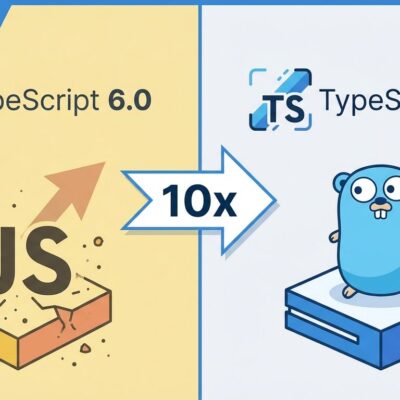
Microsoft released TypeScript 6.0 RC on March 6, 2026—the final version of the TypeScript compiler written in JavaScript. Moreover, starting with TypeScript 7.0 (already stable since January 2026), Microsoft abandoned self-hosting in favor of a native Go-based compiler delivering 10x faster builds. The RC serves as a bridge release, introducing new defaults that already provide 20-50% faster builds while preparing developers for the eventual migration to TypeScript 7.0’s architecture.
The End of Self-Hosting
For over a decade, TypeScript was self-hosted: the TypeScript compiler was written in TypeScript itself. Additionally, version 6 was compiled with TypeScript 5, version 5 with version 4, and so on back to the original JavaScript implementation. This dogfooding approach demonstrated the language’s maturity, but it hit fundamental performance limits.
Node.js and V8 can’t efficiently leverage multiple CPU cores for type-checking, and JavaScript’s garbage collection struggles with large-scale compilation tasks. Consequently, slow builds became TypeScript’s most common complaint. TypeScript 7.0 breaks the self-hosting tradition—pragmatism over purity.
TypeScript 6.0 RC: 20-50% Faster Builds Right Now
TypeScript 6.0 RC delivers immediate performance gains before the Go rewrite. The speedup comes from a single default change: types: [] instead of auto-loading all @types packages. Furthermore, Microsoft reports 20-50% build time improvements for many projects.
This isn’t a promise for the future—it’s shipping today. Developers upgrading to 6.0 RC see faster builds immediately, no migration to TypeScript 7.0 required. Moreover, the new defaults also include strict: true, module: "esnext", and target: "es2025", aligning with modern development practices.
TypeScript 7.0’s 10x Promise (Already Delivered)
TypeScript 7.0 shipped stable on January 15, 2026, and the performance benchmarks are real. Compiling Visual Studio Code’s 1.5 million line codebase dropped from 78 seconds to 7.5 seconds—a 10.4x improvement. In addition, Playwright and TypeORM showed similar 10-13x speedups.
The Go-based compiler also uses 3x less memory, critical for CI environments where resource constraints directly impact costs. Furthermore, multi-core parallelism via goroutines enables simultaneous type-checking across files, eliminating the single-threaded bottleneck that plagued Node.js implementations.
Why Go specifically? The language’s syntax resembles TypeScript closely enough to ease porting, goroutines provide built-in parallelism, and Go’s garbage collector handles memory management without custom allocation schemes. Therefore, Microsoft prioritized shipping performance over ideological consistency—and it worked.
Migration: Easier Than Expected
Despite new defaults and deprecated options, TypeScript 6.0 maintains 95% backward compatibility. Modern projects using ES modules migrate in under an hour. Notably, the ts5to6 migration tool automates the two most disruptive changes: baseUrl removal and rootDir inference fixes.
Breaking changes primarily affect legacy configurations: AMD/UMD modules, ES5 targets, and outFile concatenation all deprecated. However, for teams needing more time, an escape hatch exists: "ignoreDeprecations": "6.0" temporarily silences warnings (though these options vanish entirely in 7.0).
The friction is minimal for modern codebases. Projects already on strict mode, ES modules, and bundler-based workflows will upgrade smoothly. In contrast, legacy projects using namespaces and concatenated outputs face more work, but the migration tools handle most mechanical changes automatically.
Key Takeaways
TypeScript 6.0 RC marks the end of self-hosting and the beginning of TypeScript’s native performance era. Specifically, the release offers immediate 20-50% build time improvements while preparing developers for TypeScript 7.0’s 10x speedup—which is already shipping and stable.
Developers should consider upgrading: modern projects migrate in under an hour, and the performance gains compound across large teams and CI pipelines. Indeed, the 10x promise isn’t vaporware—it’s measurable, shipping, and transforming how quickly TypeScript codebases compile.