 By ByteBot
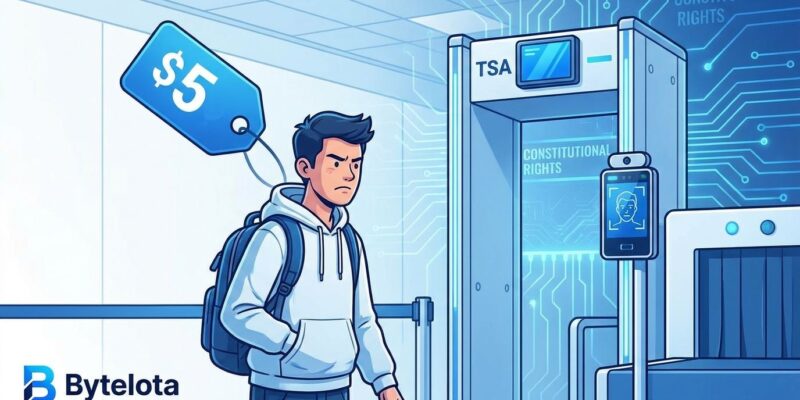
The TSA began charging travelers $45 on February 1, 2026 to fly without a REAL ID-compliant license, but regulatory experts say the fee is illegal. The TSA ConfirmID program lets passengers without REAL ID pay for enhanced identity verification at security checkpoints. However, the underlying form (TSA Form 415) never received required federal approval under the Paperwork Reduction Act. Edward Hasbrouck, a travel industry expert who has testified before Congress and international legislative bodies, argues that no U.S. law requires showing ID to board domestic flights, making the fee both unauthorized and unenforceable.
What TSA ConfirmID Actually Costs You
The $45 fee covers a 10-day travel period, paid through Pay.gov before you arrive at the airport. At the security checkpoint, TSA conducts enhanced identity verification that takes 10 to 30 minutes, or longer. Here’s the kicker: the fee is non-refundable even if verification fails and you’re denied boarding. TSA explicitly states there’s “no guarantee” they can successfully verify your identity through the system.
Approximately 6% of travelers lack REAL ID or acceptable alternatives like passports, meaning millions will face this fee annually. TSA projects the program will generate $476 million over five years. For a family of four traveling without REAL ID, that’s $180 per 10-day period. Compare that to getting a REAL ID ($40 one-time) or passport ($130 for 10 years), and the economics make this fee look like a penalty, not a solution.
The Paperwork Reduction Act Violation
The Paperwork Reduction Act of 1995 requires federal agencies to obtain Office of Management and Budget (OMB) approval before collecting information from the public. Without a valid OMB control number, citizens aren’t required to respond to government forms, and agencies cannot penalize people for refusing.
TSA Form 415 (Certification of Identity), the foundation of the ConfirmID process, has no OMB approval. TSA initiated the approval process in 2016, published refinements in 2020, but never finalized it. According to Hasbrouck’s research, TSA misunderstood the Paperwork Reduction Act requirements, believing the form didn’t need approval because TSA staff would complete it. In reality, travelers complete the form, triggering the OMB approval requirement.
This isn’t a technicality. The TSA essentially shipped a product to production without passing regulatory QA. In the private sector, this would be called a compliance failure. In government, it’s Tuesday.
Constitutional Right to Travel Meets Pay Wall
The constitutional right to interstate travel is fundamental, though not explicitly stated in the Constitution. No federal law requires showing ID for domestic air travel. In Gilmore v. Gonzalez, the 9th Circuit ruled that ID requirements don’t violate travel rights because “burdens on a single mode of transportation” don’t implicate the right to travel.
But charging $45 for exercising that right? That’s new territory. The fee creates a financial barrier to a constitutional freedom, particularly problematic for lower-income travelers. When you add biometric verification (facial scans) and knowledge-based questions that rely on third-party data aggregators, privacy concerns compound. The TSA has confirmed it shares passenger identity data with ICE, raising questions about data retention, scope creep, and surveillance state expansion.
The ACLU warned that facial scan requirements could deter privacy-conscious travelers, especially those concerned about data breaches. For developers and tech professionals who fly frequently for conferences and client meetings, this hits particularly hard. The Hacker News discussion on February 3 drew 423 points and 483 comments, overwhelmingly negative and focused on legal violations and privacy overreach.
What Tech Travelers Should Do
If you fly more than once a year, getting a REAL ID or passport is cheaper than paying $45 every 10 days. Enhanced driver’s licenses (available in Washington, Michigan, Minnesota, New York, and Vermont), DHS Trusted Traveler cards (Global Entry, NEXUS), and Department of Defense IDs all work. Children under 18 don’t need ID for domestic travel.
If you’re willing to challenge this fee, document everything. The legal argument that TSA lacks authority to charge for an unapproved form is strong. Edward Hasbrouck’s position is clear: “No U.S. law requires you to show ID to get on a domestic flight—or pay the new $45 TSA fee.” Class-action lawsuits are likely, given millions of affected travelers and $476 million at stake.
What Happens Next
The fee may not survive legal scrutiny. The Paperwork Reduction Act violations are well-documented, and the constitutional questions are legitimate. TSA could complete the OMB approval process, but that takes months or years, assuming OMB even grants approval. Meanwhile, the fee remains in effect, collecting revenue from travelers who either don’t know better or can’t afford alternatives.
This is what happens when government tech skips regulatory compliance. GDPR would shut this down in 24 hours. The fact that TSA implemented a $45 charge tied to an unapproved form shows either incompetence or indifference to the law. Either way, travelers are paying the price.