 By ByteBot
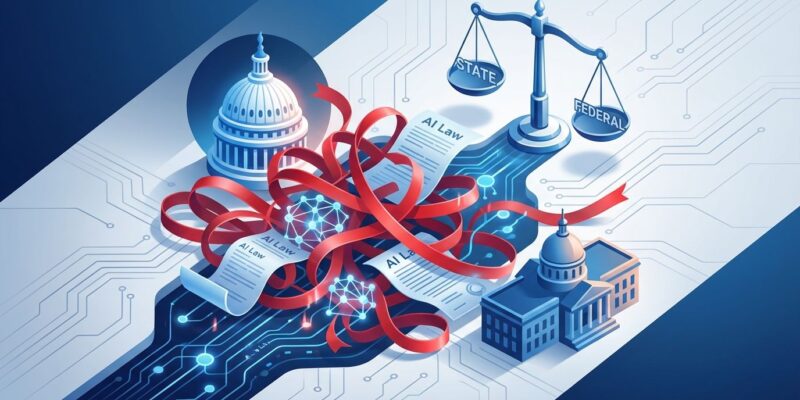
On December 11, 2025, President Trump signed an executive order promising to rescue AI startups from a “patchwork of 50 different regulatory regimes.” The reality? He just made things worse. While state AI laws remain fully enforceable, federal agencies gear up for years-long legal battles, leaving developers in regulatory purgatory. Instead of one rulebook, startups now navigate both state compliance requirements and federal uncertainty simultaneously.
What the Executive Order Actually Does
The executive order, titled “Ensuring a National Policy Framework for Artificial Intelligence,” directs multiple federal agencies to challenge state AI laws. Within 30 days, the Department of Justice must establish an AI Litigation Task Force to sue states over laws deemed onerous. Within 90 days, the Commerce Department will publish a list of problematic state regulations.
The FCC and FTC are directed to create federal AI standards that would preempt state rules. Colorado’s algorithmic discrimination law is explicitly called out as an example of regulations Trump wants eliminated. Colorado Attorney General Phil Weiser has already vowed to fight back in court.
The Problem: More Chaos, Not Less
Here’s the paradox: state laws remain enforceable until courts block them or states voluntarily pause enforcement. Startups face immediate compliance with state requirements while simultaneously dealing with federal legal uncertainty. The promised simplification becomes operational chaos.
“The executive order will backfire on AI innovation,” warns Andrew Gamino-Cheong, CTO of Trustible. “Only well-funded companies can absorb legal uncertainty. The ambiguity harms sales cycles, especially with risk-sensitive sectors like healthcare and finance.”
The timeline makes this worse. DOJ lawsuits take months to file and years to resolve. Appeals could drag state-federal battles to the Supreme Court. Meanwhile, every state introduced AI legislation in 2025, and over half enacted laws. The patchwork Trump claims to fix just got more tangled with an additional federal layer.
Legal Reality Check: This May Not Work
Legal experts are skeptical the executive order can accomplish what it promises. “They’re trying to find a way to bypass Congress with these various theories in the executive order,” says John Bergmayer of Public Knowledge. “Legally, I don’t think they work very well.”
Executive orders typically cannot override state legislation. True federal preemption requires Congressional action. Recent Supreme Court precedent supports state regulatory power, including a 2023 ruling that upheld California’s authority to regulate its pork industry despite interstate effects.
What Developers Should Do Now
The practical guidance is frustrating but clear: comply with state laws where you operate while monitoring federal developments.
Short term (now through mid-2026): State AI compliance requirements remain in force. If you’re deploying high-risk AI systems in Colorado, California, or other regulated states, budget for the complexity. Impact assessments, risk management policies, and consumer notifications aren’t optional just because a federal task force exists.
Medium term (6-18 months): Watch for the Commerce Department’s list in March 2026 and early DOJ lawsuits. Preliminary court rulings will signal whether federal preemption has legal legs. If you’re planning expansion into regulated states, hold off until the legal landscape clarifies.
Long term (18+ months): Three outcomes are possible. Congress could pass a uniform federal AI law (low probability given gridlock). Courts could block federal preemption entirely (most likely). Or federal preemption could succeed without replacement legislation, creating a regulatory vacuum that favors Big Tech.
The Bottom Line
Analysts warn the executive order creates legal limbo rather than clarity. For developers, the uncertainty is the worst part. “Startups lack robust regulatory governance programs and cannot afford expensive compliance infrastructure amid regulatory flux,” explains Hart Brown of Oklahoma’s AI Task Force.
The companies best positioned to weather this chaos are well-funded Big Tech firms with legal departments and compliance teams—exactly the ones the order claims to oppose. For startups already navigating a complex landscape, the executive order had one clear effect: it made AI regulation more uncertain, not less.