 By ByteBot
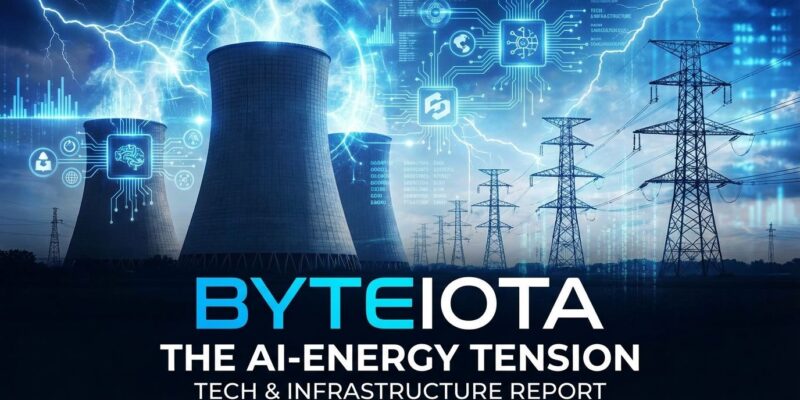
The Trump administration just forced Google, Microsoft, Meta, and Amazon to commit $15 billion for new power plants—even if they never use the electricity. On January 16, Energy Secretary Chris Wright and 13 governors signed a pact directing tech companies to bid on 15-year contracts in an emergency auction through PJM Interconnection, the nation’s largest grid operator serving 65 million people. Moreover, the unprecedented mandate aims to stop AI data centers from driving up your electricity bill, but the real question is whether tech companies will just pass the costs through anyway.
This isn’t abstract policy theater. Consequently, your electricity bill is already higher because of ChatGPT, and it’s about to get worse.
The PJM Energy Crisis: America’s Grid Is Breaking
PJM Interconnection, which powers 13 states from Virginia to Illinois, is facing an energy crisis entirely caused by AI data centers. For the first time in its history, PJM failed to meet demand at its capacity auction—they’ll be 6 gigawatts short in 2027, unable to generate 5.2% of needed electricity. That’s not a rounding error. In fact, that’s blackout territory.
Data centers now account for 40% of PJM’s auction costs: $21.3 billion of the $47.2 billion total. Furthermore, capacity prices exploded from $28.92 per megawatt in 2024 to $329.17 in 2026—a tenfold increase in one year. Nearly all the forecast peak load increase for 2027/2028 (5,100 MW of 5,250 MW) comes from data centers. Therefore, the grid infrastructure built for 20th-century electricity demand is snapping under AI’s weight.
Northern Virginia’s Loudoun County, the world’s largest data center market, shows where this leads. Data centers consume 24% of the county’s power—more than all residential homes combined at 18%. Statewide, Virginia data centers eat 25% of electricity today and are projected to hit 46% by 2030.
Your Wallet: The Hidden Cost of AI
The energy crisis isn’t just a grid operator’s problem. You’re paying for it. In PJM territories, the extra data center demand added $9.3 billion to 2025-2026 capacity costs. As a result, that translates to an extra $18 per month for the average Maryland household and $16 per month in Ohio. One Ohio couple saw their electricity rate spike from 11-12 cents per kilowatt-hour in 2020 to 19 cents in 2025—a 60% increase.
Here’s the math nobody mentions: a single ChatGPT query consumes 2.9 watt-hours of electricity, nearly ten times more than a Google search at 0.3 Wh. Similarly, AI computing racks draw 30-100+ kilowatts per rack, compared to traditional servers at 7-10 kW. Data centers currently consume 4.4% of U.S. electricity (2023) and are projected to reach 6.7-12% by 2028.
Most people using ChatGPT or Gemini have no idea they’re indirectly spiking their neighbors’ electricity bills. That’s AI’s dirty secret: the infrastructure cost is being socialized to regular consumers who never signed up for it.
The Mandate: Pay for Power You Don’t Use
Here’s how the emergency auction works. Tech companies must bid on 15-year contracts for new electricity generation through PJM—and pay for it whether they use the power or not. The auction, scheduled by September 2026, will fund $15 billion in new baseload power plants (likely natural gas or nuclear) capable of 24/7 generation, adding 7.5 gigawatts of capacity.
This is unprecedented. Fifteen-year contracts are extremely long for volatile energy markets. Limiting the auction to a single industry has never been done. Energy Secretary Chris Wright and Interior Secretary Doug Burgum joined governors from Maryland, Pennsylvania, Virginia, and ten other states to announce the pact. However, PJM itself has been notably silent. Spokesperson Jeffrey Shields: “We don’t have a lot to say on this.”
The mandate creates a bizarre scenario: Google might pay for 2 gigawatts of power for 15 years even if their data centers only need 1 gigawatt. It’s government-mandated infrastructure insurance. The administration says “leading tech companies have agreed to fund $15 billion,” but there are no specific public commitments from Google, Microsoft, Meta, or Amazon yet.
Election Year Politics: Why This Is Happening Now
AI data center electricity costs have created a rare bipartisan moment. Bernie Sanders and Ron DeSantis—about as politically opposed as you can get—both oppose the unchecked boom. When progressive socialists and conservative populists agree on something, politicians notice.
Microsoft, clearly reading the room, pledged that “consumers won’t pay more when the company sets up data centers near their communities.” That’s a defensive play. In addition, tech companies know what’s coming: 2026 is a major election year, and voters will see higher utility bills. Experts predict electricity affordability will become a key ballot box issue.
One analyst put it bluntly: “With a lot more elections in 2026 than 2025, every politician is going to be saying that they have the answer to affordability.” Consequently, the Trump administration is making its move early, forcing tech companies to commit before the election cycle heats up. Whether this actually protects consumers or just creates political theater remains to be seen.
The Open Question
The mandate raises a fundamental question: will this actually lower your electricity bill, or will tech companies just pass these $15 billion in costs through to users via higher cloud prices, subscription fees, or API costs?
The administration is betting that locking in 15-year contracts now prevents bigger price spikes later. On the other hand, critics argue that forcing companies to pay for unused capacity creates market distortions and might not address the root problem: AI’s energy consumption is growing faster than the grid can possibly scale.
What’s certain is this: AI’s energy needs are breaking America’s electrical infrastructure, and someone has to pay for the rebuild. The fight over who pays—tech companies, consumers, or some combination—is just beginning. The Trump mandate is the opening salvo in what will be a years-long battle over AI’s true cost.
Key Takeaways
- PJM Interconnection faces first supply shortfall in history: 6 GW short in 2027
- Your electricity bill is already up: +$18/month (Maryland), +$16/month (Ohio) due to data centers
- Trump mandate: $15 billion commitment from tech companies for 15-year power contracts
- Must pay even if unused—unprecedented government intervention in energy markets
- 2026 election issue: Electricity affordability headed to ballot box
- Open question: Will tech companies pass costs to users anyway?