 By ByteBot
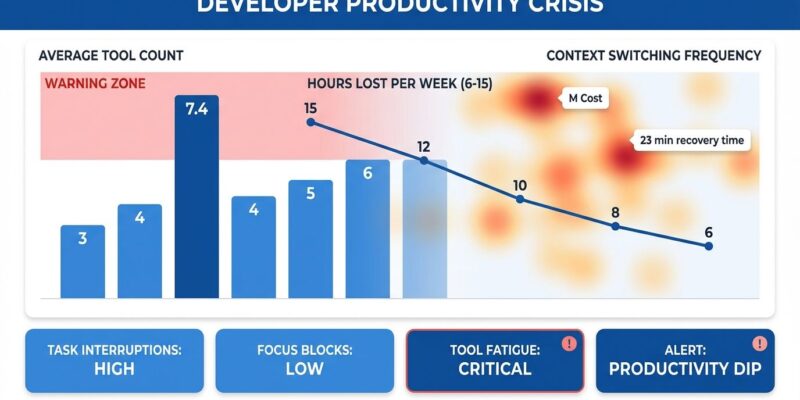
Tool sprawl is costing companies $1 million annually per development team, with 75% of developers losing 6-15 hours every week navigating an average of 7.4 disconnected tools to build applications. This isn’t about having multiple tools—it’s about the cumulative cognitive overhead created by constant context switching. Research shows it takes 23 minutes to regain focus after each interruption, and the American Psychological Association found that task switching consumes up to 40% of productive time. The problem is worse than most organizations realize: 94% of developers are dissatisfied with their toolsets, 55% don’t trust the data across fragmented systems, and only 22% can resolve engineering issues within one day.
The 23-Minute Context Switching Tax
Every time developers switch between tools—IDE to terminal to Git client to project management to Slack to monitoring dashboard—they pay a 23-minute recovery cost. UC Irvine researcher Gloria Mark found it takes an average of 23 minutes and 15 seconds to fully regain focus after an interruption or context switch. For developers working with complex code abstractions, mental residue lingers for 30-60 minutes.
The American Psychological Association research quantifies the damage: task switching consumes up to 40% of productive time due to mental blocks created when switching contexts. Recent studies show developers switch about 59% of their daily tasks, with 40% requiring context switching, and they never resume 29% of interrupted tasks. At average developer salary, this costs over $50,000 per developer annually—over $500,000 per year for a team of 10.
Moreover, the quality impact is equally brutal. Interrupted tasks take twice as long and contain twice as many errors compared to uninterrupted work. Research by Amoroso d’Aragona et al. found striking correlations between context switching and code quality degradation, revealing 25% more bugs introduced during fragmented work sessions and 40% additional time spent fixing context-switching-induced errors. Furthermore, Carnegie Mellon research shows that developers juggling five projects spend just 20% of their cognitive energy on real work—the rest bleeds into recovery and re-orientation overhead.
The $1M Tool Sprawl Crisis
A 2025 survey of 300 IT professionals in the U.S. and Western Europe found 75% lose 6-15 hours weekly to tool sprawl, navigating an average of 7.4 tools to build applications. However, 44% of teams juggle 10 or more DevOps tools, with many overlapping in functionality. This fragmentation costs companies approximately $1 million in lost productivity annually per team.
The real kicker is integration overhead: nearly 40% of engineering time is spent on integrations instead of feature development. Developers aren’t building products—they’re maintaining the plumbing between disconnected systems. Additionally, a separate survey of 135+ engineers found 52% flag context switching as a major productivity drain, while 56% report tool overload affects their performance every week. Consequently, workers toggle between apps an average of 33 times per day, creating workflow friction that slows work and introduces opportunities for essential information to slip through cracks.
Each new tool promises productivity but delivers fragmentation. Vendor interests push proliferation over consolidation—selling more tools, not fewer. Therefore, the result is teams that spend more time managing their technology stack than using it.
The Data Trust Crisis
Tool sprawl creates a second-order problem beyond just time lost: 94% of developers are dissatisfied with their current toolsets to some degree, and 55% don’t trust the veracity of data surfaced across tool repositories. Only 3% feel their metadata repository is completely trustworthy. When developers can’t trust their own infrastructure data, every decision requires manual verification across systems.
This trust deficit has real operational consequences. Only 22% can resolve engineering issues within one day, largely due to time spent hunting information across fragmented systems. There’s no single source of truth—service catalogs live in one tool, deployment status in another, logs in a third, metrics in a fourth. Consequently, by the time developers piece together the complete picture, the incident has aged from minutes to hours or days.
The hidden cost isn’t just productivity—it’s decision paralysis. Developers know their tools lie to them through data silos and stale metadata, so they waste cycles double-checking everything. In fact, trust erosion compounds the time tax.
Platform Engineering’s Counteroffensive
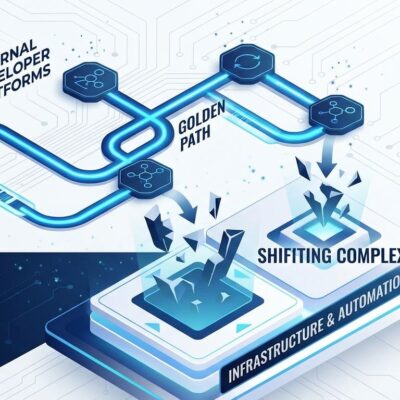
Platform engineering has emerged as the industry’s leading response to tool sprawl. Companies like Spotify, Netflix, and Google are implementing Internal Developer Platforms (IDPs) and “golden paths” to consolidate tooling and reduce cognitive load. IDPs consolidate tools, services, and documentation into a single searchable experience, allowing developers to find what they need in one place rather than switching between platforms or messaging different teams.
Golden paths are opinionated, well-documented procedures in the software development life cycle that developers can follow with minimal cognitive load. Red Hat defines them as “an opinionated, well-documented way of building and deploying software within an organization.” Spotify’s implementation shows the philosophy in action: golden paths that are optional (not forced), transparent (fully documented), extensible (customizable), and self-serviceable (no tickets required for provisioning).
GitHub is taking a different consolidation angle with Copilot Extensions, unveiled at Microsoft’s Build conference. The approach brings external tools into the IDE to minimize context switching—developers access deployment status, monitoring, and documentation without leaving their primary workspace. Furthermore, platform engineering is predicted to become the default operating model for 80% of enterprises by 2026 as companies realize tool sprawl is an organizational dysfunction, not a developer problem.
Related: AI Tools Hit 84% Adoption, But Sentiment Crashes to 60%
The Consolidation Debate: No Silver Bullet
Tool sprawl has reignited the consolidation versus best-of-breed debate, and the answer isn’t as clean as platform vendors suggest. Integrated platforms like GitLab, GitHub Enterprise, and Atlassian offer minimal integrations and consistent user experience, but they evolve slower than best-of-breed point solutions and risk vendor lock-in. All modules in an integrated platform are rarely best-in-class.
Meanwhile, best-of-breed tools offer cutting-edge capabilities and purpose-built functionality, but they create the integration overhead and context switching costs that tool sprawl exposes. Out-of-the-box integrations promise seamless workflows but often lack essential functionality, requiring custom development. No single vendor provides all necessary software development life cycle tools, which means some level of best-of-breed is inevitable.
However, evidence suggests a strategic hybrid approach works best: consolidate core functions like code repositories, CI/CD, and documentation while maintaining specialized tools where they add genuine value. The objective is not to adopt a single tool for all purposes, but to consolidate core functions into an integrated development environment. Modern IDEs with robust plugin ecosystems can connect to version control, CI/CD pipelines, and documentation without forcing developers to leave their primary workspace.
Nevertheless, hybrid approaches aren’t free. Some platforms add complexity instead of reducing it—if your “consolidation” solution requires extensive training and maintenance, you’ve just added another layer of tool sprawl. Additionally, the cost of switching is not just the price to install the new toolset, it’s the productivity dip from retraining entire teams. For a team swapping 10 best-of-breed tools for a single platform solution, the migration overhead can take months.
What Actually Works
Successful consolidation strategies focus on measurement and iteration, not mandates. Track “Context Switches per Day” and “Time Spent Searching for Information” as explicit developer productivity KPIs through tool-tracking data and developer surveys. This quantifies what developers feel but can’t measure and provides hard ROI data for platform investment.
Establish governance for tool adoption: for every new tool added, mandate removing one or proving it justifies the cognitive load cost. The “add one, remove one” policy prevents new sprawl and forces teams to question whether each tool’s value exceeds its integration and context switching overhead. Measure time-to-value, not feature count.
Moreover, optimize golden paths for day-2-50 operations, not just day-1 onboarding. Many platform teams over-optimize for onboarding new developers and under-optimize for daily workflows. Platform teams should pave golden paths that optimize processes for experienced developers’ ongoing work, not just initial setup.
Finally, match tool complexity to problem complexity. Don’t adopt tools because they’re popular or because competitors use them. Ask: Does this tool’s value exceed its cognitive load cost? Despite 31% of teams reporting active consolidation efforts, average tool stacks keep growing—indicating poor execution and lack of strategic thinking about which functions genuinely need specialized tools versus which should be consolidated.
Key Takeaways
- Tool sprawl costs $1M annually per team, with 75% of developers losing 6-15 hours weekly to context switching across an average of 7.4 tools—quantify this on your team by tracking “Context Switches per Day” and “Time Spent Searching for Information” as explicit KPIs
- Context switching costs 23 minutes of focus recovery per interruption and consumes 40% of productive time, resulting in tasks that take twice as long and contain twice as many errors—at average developer salary, this costs $50K per developer annually
- Data trust crisis compounds the time tax: 94% dissatisfied with toolsets, 55% don’t trust tool data, and only 22% resolve engineering issues within one day due to fragmented information across disconnected systems
- Platform engineering’s golden paths and Internal Developer Platforms offer consolidation, but only work when they’re optional, transparent, extensible, and customizable—forced consolidation onto inferior platforms destroys productivity instead of improving it
- Strategic hybrid approach wins: consolidate core functions (code, CI/CD, docs) while keeping specialized tools where they add genuine value—no single vendor provides all SDLC tools, so plan which to consolidate versus which to keep separate