 By ByteBot
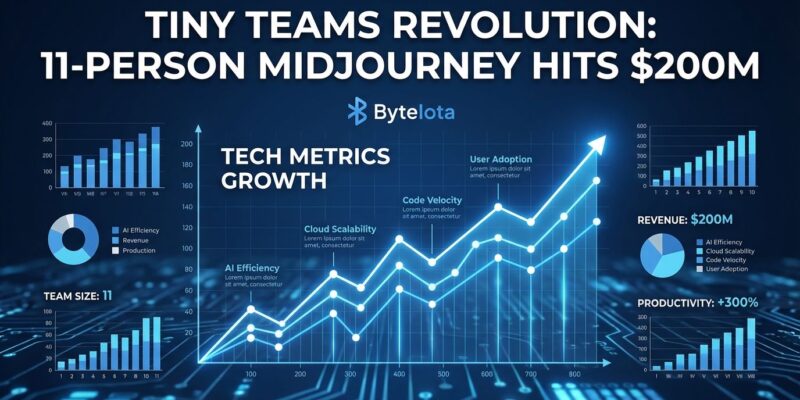
MidJourney generated $200 million in annual revenue in 2023 with just 11 employees. That’s $18 million per employee—compared to the traditional tech company average of $150,000 to $300,000. This isn’t a single outlier. Moreover, Cursor hit $100 million ARR in 12 months with fewer than 20 people. Gamma serves 50 million users with 30 employees. Additionally, Bolt.new went from zero to $20 million ARR in two months with 15 people.
The bottleneck in software development has shifted. It’s no longer technical execution—how fast you can write code. Instead, it’s trust and communication—how well small, AI-augmented teams can coordinate. Consequently, Gartner predicts that by 2030, 80% of organizations will evolve large engineering teams into smaller, more nimble teams powered by AI.
The Pattern: Five Companies Prove the Tiny Teams Model
Multiple companies have independently discovered the same efficiency formula. MidJourney started with 11 employees in 2022 and hit $200M ARR in 2023 with about 40 people—all while spending zero dollars on marketing. By September 2024, they had grown to 131 employees, still remarkably lean for their revenue.
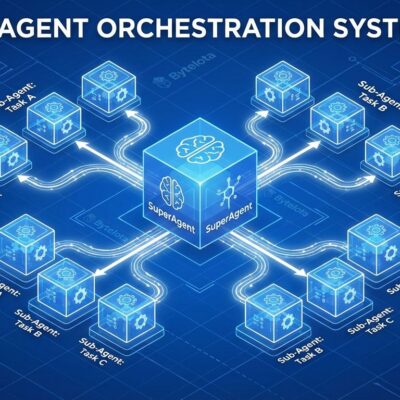
Cursor went from $1M to $100M ARR in 12 months, the fastest growing SaaS company ever, with a team of just 12 to 20 people. Furthermore, they now serve roughly 360,000 developers paying $20 to $40 per month. Each engineer on Cursor’s team manages a “fleet” of about five Devin AI agents to amplify their output.
Gamma reached $50 million ARR and 50 million users with 30 employees, remaining profitable for 15 consecutive months. They’ve had zero employee attrition. However, Grant Lee, Gamma’s co-founder, deliberately keeps the team at 50 people instead of 200, believing a focused team moves faster and builds better products.
Bolt.new by StackBlitz launched with a single tweet in October 2024 and hit $4 million ARR in the first month, $20 million in the second month, with a team of 15 to 20 people. Meanwhile, Cognition, the company behind Devin AI, has a 15-person engineering team where Devin now writes 25% of internal pull requests. They’re aiming for 50% by end of year.
These aren’t flukes. The revenue-per-employee ratios are 10 to 60 times traditional tech companies. Multiple teams have proven the model works.
Three Principles That Enable Small Engineering Teams
Gamma attributes their success to three organizational principles, and other tiny teams follow similar patterns. First: generalists over specialists. AI handles specialized tasks—frontend optimization, database queries, deployment scripts. Humans provide judgment, context, and architecture decisions. At Gamma, a quarter of the team are designers, an unusually high ratio. Additionally, senior engineers serve as functional leads without rigid hierarchies or lengthy approval chains.
Second: the player-coach model. Leaders both execute at about 50% capacity and guide the team. This eliminates traditional management layers and what Gamma calls “zero fidelity loss in communication.” Consequently, daily all-hands meetings keep everyone aligned. When everyone knows what everyone else is working on, coordination happens naturally.
Third: small tribe culture. Gamma prefers 50 employees over 200 because large teams fragment into subgroups, duplicate efforts, and face bottlenecks from slow consensus-building. In contrast, small teams stay nimble, focused, and maintain high trust. Grant Lee wanted every contributor to benefit meaningfully if Gamma succeeds, avoiding the pattern he saw at Optimizely where early employees ended up with minimal equity.
This isn’t just about using AI tools. It requires structural changes: flat organizations, generalist skillsets, and high-trust environments where human coordination becomes the priority as AI handles more execution.
The Bottleneck Shifted From Execution to Trust
The insight that makes tiny teams possible: “In an era where knowledge work can be augmented and automated on demand, inter-human trust and communication become the primary bottlenecks, not technical execution.” This comes from Latent.Space’s analysis of the tiny teams phenomenon.
Y Combinator’s Winter 2025 batch proves the point. A quarter of the startups have codebases that are 95% AI-generated. These aren’t non-technical founders—they’re highly skilled engineers who could build from scratch. However, why write boilerplate when AI handles it? The W25 batch grew at 10% per week, unprecedented for early-stage ventures. Furthermore, companies are reaching $10 million in revenue with fewer than 10 people.
The old bottleneck was technical execution: you needed more engineers to build more features. The new bottleneck is trust and communication: you need better coordination between humans and AI agents. Cognition’s engineers each manage about five Devin agents. Therefore, the challenge isn’t getting code written—it’s knowing what to build, reviewing what AI generated, and maintaining architecture coherence.
Research backs this up. Studies on human-AI teams show they require more coordination than all-human teams, not less. Moreover, trust in AI tends to decline over time as teams discover edge cases and limitations. Cognitive misalignment creates communication breakdowns. Consequently, small, high-trust teams minimize this new bottleneck while AI eliminates the old one.
Enterprise Adoption of AI-Native Development Accelerates
The tiny team model started with startups in 2023 and 2024. Enterprise adoption is beginning in 2026. On January 8, EPAM Systems announced a partnership with Cursor to bring AI-native development to their 50,000+ engineers globally. Dmitry Tovpeko, EPAM’s VP of AI-Native Engineering, acknowledged the challenge: “While most large enterprises have made some investment in AI coding tools, many teams struggle with full adoption and daily use.”
The EPAM-Cursor partnership combines Cursor’s AI-native IDE with EPAM’s delivery framework to move enterprises beyond pilots and into production. This signals the shift from startup experimentation to enterprise transformation. Moreover, Gartner’s forecast reinforces it: by 2030, 80% of organizations will evolve large software engineering teams into smaller, AI-augmented teams.
Platform engineering adoption is accelerating in parallel. Fifty-five percent of organizations adopted platform engineering in 2025, and Gartner predicts 80% will have platform teams by 2026. Furthermore, the job market is shifting too. Analysts expect 100,000+ platform engineer positions by mid-2026, with salaries matching or exceeding site reliability engineers at $150,000 to $200,000+ in major markets.
This isn’t just a startup phenomenon anymore. With EPAM bringing it to global enterprises and Gartner predicting mainstream adoption, developers and tech leaders need to prepare for structural changes in how teams are built and managed.
Challenges: Scalability, Productivity, and Skills
The tiny team model has proven revenue success, but scalability and sustainability remain open questions. MidJourney’s Discord-based platform is straining under 20 million+ users. Small teams have limited capacity for customer service, operational complexity, and 24/7 support. Furthermore, YC CEO Garry Tan warned that “AI-generated code may face challenges at scale and developers need classical coding skills to sustain products.”
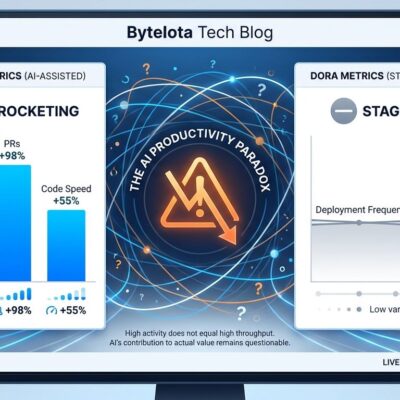
The productivity claims don’t match the evidence. Developers report 2x to 5x gains, and some claim 10x productivity boosts. However, measured studies show 20% to 30% improvements—meaningful but incremental. One randomized controlled trial found developers were 19% slower with AI tools, particularly experienced developers working on familiar codebases. Therefore, the reality: AI speeds up boilerplate and repetitive tasks, but not the entire development pipeline.
Skills and career concerns are legitimate. If 25% of Y Combinator startups have 95% AI-generated codebases, where do junior developers learn? Over-reliance on AI risks skills atrophy. The debate isn’t settled: does AI complement developers or replace them? For now, it’s complement—but the line keeps moving.
Enterprise adoption faces barriers beyond technical ones. Only 25% of AI initiatives deliver expected ROI. Less than 20% have been scaled across the enterprise. Moreover, cultural resistance to small team models is real, especially in organizations built on hierarchies and specialization. Compliance, regulatory requirements, and risk management often demand larger teams with defined roles.
Developers and leaders shouldn’t blindly adopt this model. It works for certain contexts: greenfield projects, consumer applications, startups optimizing for capital efficiency. However, it has limits: regulated industries, complex enterprise products, and situations requiring deep specialization. Classical coding skills still matter. Consequently, maintenance and long-term scalability are unsolved problems. But the trend is clear—and ignoring it means falling behind.