
 By ByteBot
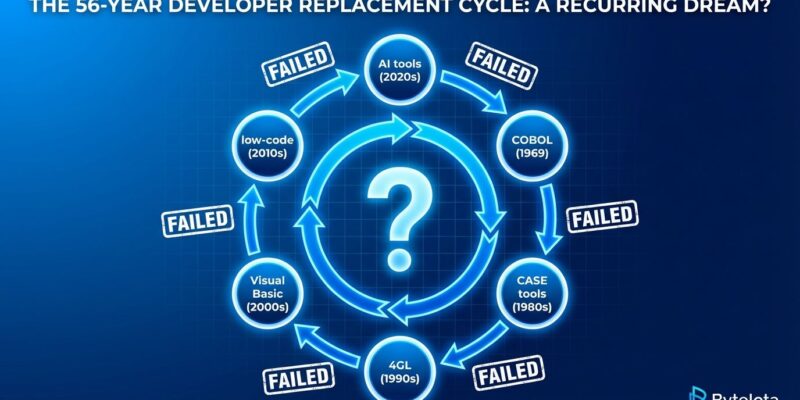
For 56 years—since COBOL promised to let business analysts write code in 1969—the tech industry has tried to replace developers with automation. CASE tools, 4GLs, Visual Basic, low-code platforms, and now AI coding tools have each promised to finally eliminate the developer shortage. Each wave failed. Yet the dream recurs every decade with remarkable consistency, revealing something fundamental about software work that we refuse to accept.
With 82% of developers now using AI coding tools and GitHub Copilot generating 41% of code, we’re in the latest iteration of this 56-year cycle. Understanding the pattern explains why AI won’t replace developers—but will change everything about how they work.
The Pattern Repeats: Six Waves, Six Failures
From COBOL (1969) through AI tools (2025), each technological wave has promised to democratize software creation and eliminate the need for specialized programmers. Each failed at replacement while succeeding at amplification.
COBOL promised business analysts could write code with “readable syntax.” Instead, it created a new class of COBOL programmers requiring specialized training. By the mid-1970s, COBOL accounted for 80% of commercial code. Today, those programmers are retiring irreplaceable—the “replacement” technology created a dependency crisis 50 years later.
CASE tools in the 1980s promised 10x productivity by generating code from diagrams. The market exploded from $4.8 billion in 1990 to $12.1 billion in 1995. Then reality hit. The US Government Accountability Office concluded in 1993: “Little evidence exists that CASE tools can improve software quality or productivity.” Of 53 surveyed companies, 73.5% never adopted CASE tools; five of the 14 who tried abandoned them. The generated code was unmaintainable, and the promised productivity gains never materialized.
Fourth-generation languages claimed “productivity gains of 3:1 to 10:1” through non-procedural specifications. They became another specialized programming tool requiring expertise. Low-code platforms in the 2010s promised citizen developers would build enterprise apps. By the mid-2020s, the approach has been “slowly abandoned” due to quality, scalability, and integration failures. Organizations are moving to hybrid models—admitting professional developers remain essential.
Why It Always Fails: Coding Isn’t the Bottleneck
The recurring dream assumes coding is the constraint. Wrong. The intellectual work is understanding ambiguous requirements, designing for edge cases, evaluating trade-offs, and making thousands of micro-decisions.
Consider a simple business requirement: “When a customer places an order, check inventory, calculate shipping, process payment, send confirmation email.” Sounds straightforward. However, the complexity emerges in questions tools can’t answer: What happens with concurrent orders depleting inventory? How should partial payments be handled? What if the email service fails? How many retries before giving up? What are the security implications? How does this scale to 10x traffic?
As one expert noted: “Software development is thinking made tangible. You can’t shortcut that reasoning any more than you can shortcut the reasoning required to design a building or diagnose a medical condition.” COBOL’s readable syntax, CASE tools’ code generation, and AI’s autocomplete don’t eliminate the thinking work. They shift where effort goes, but the judgment remains essential.
Why It Keeps Recurring: The Desperate Shortage
The dream persists because software demand vastly exceeds supply by orders of magnitude. The US will face a shortage exceeding 1.2 million developers by 2026, with 545,000 of the current workforce leaving the market. Universities produce 65,000 CS graduates annually while the market demands 180,000 AI-capable engineers. The global shortage could reach 85.2 million by 2030, resulting in $8.4 trillion in unrealized revenue.
The 2026 shortage will be 40% more severe than 2025. AI-driven demand requires 3X more ML engineers than exist. Senior engineer retirements will remove 18% of experienced developers. H-1B visa restrictions reduce the talent pool by 15%.
Every organization’s software backlog grows faster than teams can address it. This creates immense economic pressure to find shortcuts—making each generation receptive to promises of developer replacement. The pressure is real. The promise is seductive. But history shows the outcome.
The Current Iteration: AI Coding Tools Follow the Same Arc
AI coding tools are following the exact pattern of previous waves. Rapid adoption (82% of developers), initial productivity claims (26-39% gains for juniors), then reality check. Experienced developers work 19% slower on complex tasks using AI tools, despite believing they’re faster. GitClear’s 2025 research found 4x growth in code clones—developers copying AI patterns without sufficient customization. Sentiment is already declining from 70%+ positive to 60%.
The AWS CEO called replacing junior developers with AI “one of the dumbest ideas,” arguing it eliminates the “farm system” for training future seniors. Tool-specific limitations are emerging. GitHub Copilot excels at smaller, file-level tasks but struggles with larger codebases and multi-file changes. Multi-file refactoring requires manual copying and pasting. Cursor handles large codebases better but suffers performance issues and can’t integrate into CI pipelines. A METR study showed 19% slowdown for experienced developers using Cursor on their own long-term projects.
The pattern is clear: AI helps with boilerplate and repetitive tasks (where it succeeds) but struggles with system-level thinking, edge cases, and judgment calls (where developers remain essential). We’re watching the CASE tools arc ($4.8B → $12.1B → failure) play out in real-time with AI coding tools.
The Paradox: Better Tools Create More Demand
Each “failed” wave created genuine value by enabling developers to tackle more complex problems, not fewer developers tackling the same problems. COBOL enabled the modern business computing era. CASE tools advanced design thinking. Visual Basic expanded the developer population. Low-code platforms enable rapid prototyping. AI tools let solo developers build what previously required teams.
As one developer noted on Hacker News: “AI might write 90% of code, but the scope has exploded. Developers now crank out 1000 lines per day total instead of being replaced.” Better tools lead to more ambitious projects, which create higher complexity, which increases the need for experienced developers navigating that complexity.
This reframes the question. Instead of “Will AI replace developers?” ask “What new capabilities can developers unlock with AI?” The pattern suggests AI will expand the scope of what’s buildable, creating new demand rather than reducing existing demand.
What Leaders Should Ask Instead
Rather than asking “Will this eliminate our need for developers?” the right questions are: Will this help developers work more effectively on complex problems? Does this enable faster solutions for specific problem types? Does it free developers from repetitive work to focus on unique challenges? What new skills will the team need?
The AWS CEO’s warning about eliminating junior positions illustrates the risk: companies would be left with “no farm system and an ever-shrinking ring of seniors.” The IBM CEO similarly stated AI “won’t replace programmers anytime soon.” The successful approach is emerging from low-code’s evolution: hybrid models where AI handles boilerplate, junior developers tackle bounded problems, and experienced developers focus on architecture, edge cases, and judgment calls.
Key Takeaways
- The tech industry has attempted developer replacement six times over 56 years—COBOL, CASE tools, 4GLs, Visual Basic, low-code, and now AI. Each wave followed the same arc: initial enthusiasm, rapid adoption, reality check, specialization into professional tools.
- The recurring dream fails because coding isn’t the bottleneck—thinking is. Understanding ambiguous requirements, designing for edge cases, and making thousands of micro-decisions can’t be automated away.
- AI coding tools are already showing the familiar pattern: 82% adoption, but 19% slowdown for experienced developers on complex tasks, 4x growth in code clones, and declining sentiment (70%+ to 60%).
- The developer shortage (1.2 million by 2026 in the US, 85.2 million globally by 2030) creates economic pressure that makes each generation receptive to replacement promises, despite historical evidence.
- Better tools don’t reduce demand for developers—they expand the scope of what’s buildable, creating new complexity that requires even more experienced developers to navigate.
History doesn’t predict AI will fail at helping developers. It predicts AI will fail at replacing developers while succeeding at making them dramatically more capable. That’s not a bug—it’s the pattern.


