
 By
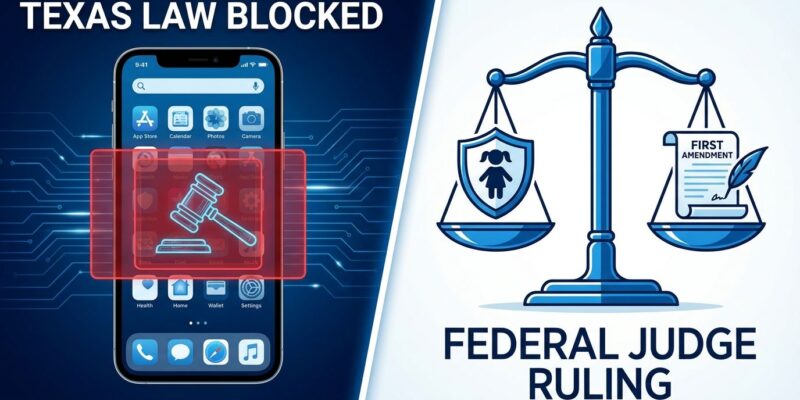
By Judge Pitman’s preliminary injunction found SB2420 “unconstitutionally vague” and “exceedingly overbroad.” The vagueness stems from undefined “commercially reasonable” age verification methods—app stores and developers would be guessing what qualifies. Moreover, the overbroad issue is more fundamental: the law applies to all apps, not just age-restricted content.
In his ruling, Pitman wrote: “These consequences are substantial, and the Court recognizes the broad support for protecting children when they use apps, but the means to achieve that end must be consistent with the First Amendment.” The bookstore analogy highlights the absurdity: imagine needing ID and parental permission to enter Barnes & Noble, then again for each book purchase. That’s essentially what SB2420 mandated for app stores.
The law’s author, State Sen. Angela Paxton (R-McKinney), defended the approach: “Unlike brick and mortar stores which must verify a consumer’s age before the purchase of age-restricted products such as alcohol and cigarettes, minors are currently able to navigate through the digital world without such parameters.” However, the judge’s comparison exposes the flaw—liquor stores verify age for restricted products, not for entering the building or buying groceries.
## What the Law Required: A UX NightmareSB2420’s requirements were comprehensive and burdensome. App stores would verify age for every user using “commercially reasonable methods” (undefined), categorize users into four age groups (child under 13, younger teen 13-15, older teen 16-17, adult 18+), create parent accounts linked to minors, and obtain parental consent for each download, purchase, or in-app purchase.
That last requirement is crucial: parents must prove identity and give consent with every download—not just account setup. Consequently, every TikTok update, every game trial, every free app requires parental approval. Senator Paxton framed this as “putting parents back in the driver’s seat,” but it’s more like requiring parents to personally approve every turn.
Furthermore, there’s the privacy paradox. A law designed to protect children would require extensive identity data collection from both minors and parents—age verification, parental identity proof, account linking. This creates new privacy and security risks in the name of child safety.
## Developer Impact: $20K-$280B Compliance CostsRelated: Google CC AI Agent Reads Your Email: Privacy Tradeoff
Small businesses face a minimum $20,000 each in compliance costs, according to Trusted Future estimates. At the aggregate level, small U.S. developers could face up to $280 billion if similar laws go federal. Amazon Audible called compliance “costly and burdensome,” noting that content ratings for over 1 million titles that constantly change would be “impracticable.”
Developers would need to build systems to receive encrypted age data from app stores, validate it, use it only for compliance purposes, transmit it securely using industry-standard encryption, and delete it after verification. Additionally, the “commercially reasonable” vagueness means developers can’t know if their implementation complies until regulators or courts decide later.
Then there’s the multi-state fragmentation nightmare. Four states have passed different app store age verification laws with different requirements and staggered effective dates: Texas (January 1, 2026, now blocked), Utah (May 6, 2026), Louisiana (July 1, 2026), and California (January 1, 2027). More than a dozen other states are considering similar bills. Developers building for multiple states face conflicting compliance requirements with no unified standard.
## What’s Next for Texas SB2420 and Age Verification LawsThis preliminary injunction blocks the law temporarily, not permanently. Senator Paxton expressed confidence the law will “ultimately prevail” in court, signaling Texas will appeal. If the appeal succeeds, the law could take effect mid-2026. The CCIA lawsuit, filed in October 2025, argues SB2420 violates the First Amendment by restricting app stores from offering lawful content, the Fourteenth Amendment through unconstitutional vagueness, and the Commerce Clause by regulating interstate commerce.
Similar lawsuits are expected in Utah, Louisiana, and California as their effective dates approach. Meanwhile, the tech industry is unified in opposition—Apple, Google, and Amazon coordinating legal challenges through trade associations. The pattern is clear: as each state law advances, expect constitutional challenges citing this Texas ruling as precedent.
Federal legislation could eventually create a unified national standard and preempt state-by-state fragmentation, but that requires Congress to act. Until then, the legal battles will continue state by state, with the Supreme Court possibly weighing in on the First Amendment versus child protection balance.
## Key Takeaways- Federal judge blocked Texas’s app store age verification law on December 23, 2025, ruling it likely violates the First Amendment through unconstitutional vagueness and overbreadth
- The law’s “bookstore at the door” problem: requiring age verification for all app downloads, not just age-restricted content, fails constitutional scrutiny
- Developers avoided immediate compliance scramble, but face potential $20K-$280B costs if similar laws survive legal challenges and go nationwide
- Four states (Texas, Utah, Louisiana, California) have passed different age verification laws with conflicting requirements—multi-state fragmentation creates compliance nightmare
- Texas will likely appeal; similar lawsuits expected in other states; Supreme Court may eventually decide First Amendment vs child protection balance


