
 By
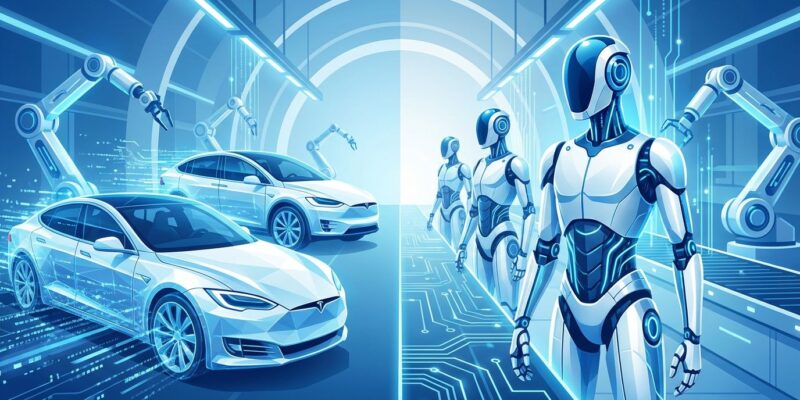
By Tesla is killing off the Model S and Model X. On January 28, 2026, CEO Elon Musk announced that production of both vehicles will end by Q2 2026—an “honorable discharge,” he called it. The Fremont, California factory space currently producing these flagship models will convert to manufacturing Optimus humanoid robots instead, targeting an ambitious 1 million units annually.
This isn’t product rationalization. It’s strategic sacrifice. Tesla is abandoning proven revenue for unproven robotics, betting the company’s future on “autonomy” over automotive heritage.
Model S and X: When 3% of Sales Can’t Justify Factory Space
The business case is brutal. Model S, Model X, and Cybertruck combined delivered just 11,642 units in Q4 2025—3% of Tesla’s total deliveries. Meanwhile, Models 3 and Y dominated with 406,585 units, accounting for 97% of sales.
Tesla delivered 1.64 million vehicles in 2025, an 8.6% decline from 2024, marking the company’s first annual revenue decline on record. China’s BYD surpassed Tesla as the global EV leader with 2.26 million units sold (+28% growth). Model S and X sales have been declining for years. Kelley Blue Book reported “steep declines” across 2025 for Tesla’s most expensive offerings.
When your premium vehicles represent 3% of deliveries and you’re losing global market leadership, radical pivots make business sense. But this also signals something uncomfortable: Tesla can’t win on automotive alone anymore.
The Optimus Bet: 1 Million Robots vs 50,000 Cars
Here’s what Tesla is betting on. The same Fremont factory space that produced roughly 50,000 Model S and X vehicles annually will produce 1 million Optimus humanoid robots annually. That’s a 20x increase in unit volume from identical square footage.
Optimus Gen 3 entered mass production on January 21, 2026. The robot features 22 degrees of freedom in its hands for human-level precision, a 45-pound hauling capacity, and an 8-hour battery life. Tesla has demonstrated the robot opening cabinets, folding laundry, handling factory components, and walking with a heel-to-toe gait. Musk targets a $20,000-$30,000 price point—”less than a new car.”
The economics are compelling on paper. Even at the low end, 1 million robots at $20,000 each equals $20 billion in annual revenue potential. Tesla plans to produce 50,000 Optimus units in 2026, scaling to 1 million by late 2026 according to Musk’s stated goals.
But can Tesla actually ramp from 50,000 units to 1 million in months? That production curve is unprecedented even for a company known for “production hell.” More critically, humanoid robots have zero proven commercial market. This is a pure bet on a future that doesn’t exist yet.
Boston Dynamics and Figure AI Got There First
Tesla isn’t pioneering humanoid robotics the way it pioneered EVs. It’s entering a crowded, fast-moving market against established leaders and well-funded competitors.
Boston Dynamics began Atlas production in 2026 after decades of R&D investment. The company plans to deploy tens of thousands of Atlas units at Hyundai Motor Group facilities, starting with the Savannah, Georgia plant in 2028. Figure AI raised $675 million and already has Figure 01 and Figure 02 robots working shifts at BMW factories, priced between $30,000 and $150,000. Agility Robotics deployed its Digit robots at Amazon warehouses for box-picking operations. Chinese manufacturer Unitree shipped over 5,500 humanoid robots in 2025, representing more than 80% of the 16,000 global humanoid robot installations.
Tesla’s competitive advantages are real: vertical integration, AI training infrastructure (Dojo), and an aggressive $20,000-$30,000 price target compared to competitors charging $150,000+. But those advantages didn’t prevent BYD from overtaking Tesla in EVs. Can they secure dominance in robotics?
The FSD Credibility Gap
The Hacker News discussion (431 points) reveals deep skepticism in the developer community. Top comments criticized Tesla for “wasting its first-mover advantage despite commanding a $1.5T valuation” and positioning Optimus as “investor relations tools” rather than viable commercial products.
The pattern is familiar. Full Self-Driving has been “coming next year” since 2016. It’s 2026, and FSD still isn’t Level 5 autonomous. Cybertruck faced years of delays. When Musk promises 1 million Optimus robots by late 2026, developers see vaporware designed to justify stock prices, not realistic production targets.
The counterpoint is equally valid: Tesla eventually did deliver EVs at scale, even if timelines slipped. FSD, while imperfect, exists and improves incrementally. Dismissing Optimus entirely may be premature. But trust has to be earned back after each missed deadline, and Tesla’s credibility bank account is overdrawn.
What’s at Stake
If Optimus succeeds, Tesla transforms from an automotive company into a Physical AI leader. Robotics and AI jobs will explode. Factory automation, warehouse logistics, and household services become software problems. For developers, this signals where the tech industry is heading—away from automotive engineering toward embodied AI.
If Optimus fails, there’s no fallback. Model S and X production lines will be gone. Tesla will have sacrificed proven premium vehicles for speculative robotics. The company’s valuation, already dependent on future promises rather than current automotive performance, will face a reckoning.
Musk gave Model S and Model X an “honorable discharge.” The verdict on whether that was strategic brilliance or costly hubris won’t come until late 2026, when we see if those Fremont factory lines are producing robots at scale—or sitting idle while Tesla scrambles to explain another missed target.
For now, if you want a Model S or Model X, order by June 2026. After that, they’re history.









[…] Tesla Ends Model S and X: Fremont Converts to Optimus Robot Production | byteiota […]