
 By ByteBot
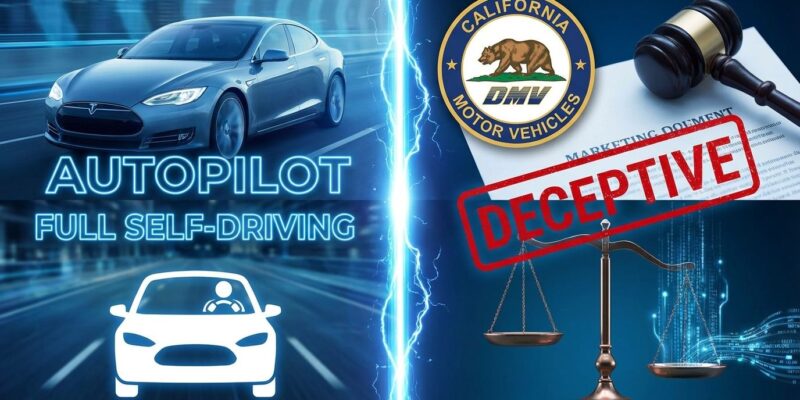
California Administrative Law Judge Juliet Cox ruled December 16-17, 2025 that Tesla engaged in deceptive marketing for its “Autopilot” and “Full Self-Driving Capability” systems, violating state law. The California DMV gave Tesla 60 days to fix its marketing claims—or face a 30-day sales suspension in California, Tesla’s largest EV market representing 31% of all US electric vehicle sales. Tesla responded defiantly: “Not one single customer came forward to say there’s a problem.”
This is the first major enforcement action against AI capability marketing in automotive. The ruling sets precedent for how companies can market AI features versus actual capabilities—directly affecting developers building ADAS features and any AI product promising capabilities not yet delivered.
Judge: “Misleading Both Technologically and Legally”
Judge Cox didn’t mince words. Her ruling states that “a reasonable consumer likely would believe that a vehicle with Full Self-Driving Capability can travel safely without a human driver’s constant, undivided attention.” The problem? “This belief is wrong—both as a technological matter and as a legal matter—which makes the name Full Self-Driving Capability misleading.”
The case originated from 2022 DMV accusations alleging Tesla made “actually, unambiguously false and counterfactual” claims. Historical Tesla marketing stated: “The system is designed to be able to conduct short and long-distance trips with no action required by the person in the driver’s seat.” The technical reality tells a different story. Both Autopilot and Full Self-Driving are SAE Level 2 ADAS—partial automation requiring constant driver supervision, hands on wheel, eyes on road.
The judge applied a “reasonable consumer” test: If average buyers believe your product name means autonomous driving when it actually requires constant human supervision, you’re violating California law. Marketing crossed the line from aspirational to deceptive.
California Market Critical, Tesla Defiant
California represents 31% of all US EV sales—Tesla’s largest market and a critical revenue source. A 30-day sales ban carries serious consequences. Yet Tesla’s response signals it may not comply. The company called it a “consumer protection order” where “not one single customer came forward to say there’s a problem” and vowed “sales in California will continue uninterrupted.”
Tesla’s market position in California has weakened significantly. Its market share dropped to 43.9% in Q1 2025, down from 55.5% a year prior and over 70% in 2022. Registrations fell 21.5% year-over-year while non-Tesla EV sales grew 14%. The company is betting regulators will blink first rather than ban sales in its most important market.
The DMV modified penalties to avoid manufacturing disruption—Tesla’s factory operations continue regardless. However, if the company doesn’t fix marketing materials by the February 2026 deadline, it faces a 30-day dealer license suspension. That’s the clash between Silicon Valley’s “move fast” culture and regulatory accountability.
Level 2 Reality vs “Full Self-Driving” Marketing
Tesla’s “Full Self-Driving Capability” is SAE Level 2 ADAS—partial automation, not autonomous driving. Level 2 requires constant driver supervision: hands on wheel, eyes on road, ready to take control immediately. The driver remains legally responsible for vehicle operation at all times. Driver monitoring systems track attention through steering wheel torque sensors and cabin cameras.
Compare this to Mercedes-Benz Drive Pilot, California’s only certified Level 3 system. Level 3 allows truly hands-off driving in limited conditions—under 40 mph, on specific mapped highways, in good weather. Crucially, liability shifts to the manufacturer during Level 3 operation. That’s the difference between actual conditional automation and supervised assistance.
The gap between Tesla’s product name and technical reality is the violation. “Full Self-Driving” creates expectations of Level 3-4 autonomy when delivering Level 2 assistance. For developers building ADAS features, the lesson is stark: You can’t market Level 2 as “full self-driving” no matter how sophisticated the technology. Product names create dangerous misconceptions that lead to misuse.
Precedent for AI Marketing Accountability
This ruling extends beyond automotive. Any company marketing AI capabilities must ensure product names and claims match technical reality. The “reasonable consumer” test applies broadly: If a reasonable person would believe your AI can do something it can’t based on your marketing, that’s deceptive under California law.
Other industries are watching. AI coding tools claiming to “write production code,” AI assistants promising to “handle tasks autonomously,” and services marketing “autopilot” features in non-automotive domains all face scrutiny. The pattern is clear—AI trust has hit all-time lows with 46% distrust, and regulators are responding to inflated capability claims across sectors.
For developers, this creates tension between marketing promises and engineering reality. You’re building Level 2 systems while marketing calls them “full self-driving.” The ruling establishes that marketing language is now a liability risk. The era of “fake it till you make it” AI marketing is ending. Developers need to push back when marketing outpaces capabilities—before regulators do.
What Happens Next
Tesla has until approximately February 2026 to change its marketing materials—website copy, advertisements, in-vehicle disclaimers. Three scenarios emerge. First, Tesla complies by rebranding “Autopilot” and “Full Self-Driving” with conservative language and heavy disclaimers. Second, Tesla appeals the ruling, dragging out the legal process. Third, Tesla defies the order and faces a 30-day sales suspension in March 2026.
The company has signaled defiance, but the stakes are high. Losing sales access to 31% of the US EV market for a month would cost tens of millions in revenue during a period of declining market share. Meanwhile, competitors watch closely. If Tesla successfully defies this ruling, expect more aggressive AI capability claims industry-wide. If Tesla complies or faces suspension, expect an industry pullback to conservative marketing.
The outcome shapes AI marketing for years. For developers, the message is clear: The gap between what you build and what marketing promises is now a regulatory liability. Time to close it.
Key Takeaways
- California judge ruled Tesla’s “Autopilot” and “Full Self-Driving” marketing violates state law by creating false expectations about Level 2 ADAS capabilities
- Tesla has 60 days (until ~February 2026) to fix marketing or face 30-day sales ban in California, representing 31% of US EV market
- The “reasonable consumer” test establishes precedent: If your product name misleads average buyers about AI capabilities, you’re violating California law
- Ruling affects all AI products—marketing language is now a liability risk when it outpaces technical reality
- For developers: You’re caught between marketing promises and engineering capabilities. Push back before regulators do.


