
 By ByteBot
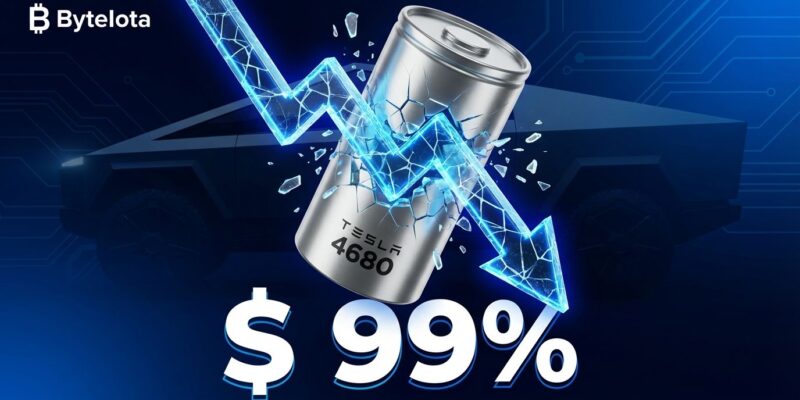
South Korean battery supplier L&F Co. just wrote down its Tesla supply contract from $2.9 billion to $7,386. That’s not a typo—a 99% collapse announced in regulatory filings on December 29, 2025. This wasn’t a contract renegotiation. It’s the effective cancellation of one of the largest battery material deals in EV history, exposing the catastrophic failure of Tesla’s ambitious 4680 battery program. The contract supplied high-nickel cathode materials exclusively for the Cybertruck’s 4680 batteries. No Cybertruck demand equals no battery demand, equals supplier wipeout.
Cybertruck’s Demand Disaster
Tesla built production capacity for 250,000 Cybertrucks annually. In 2025, they’re selling roughly 20,000 units—less than 10% capacity utilization. The numbers tell a brutal story: 50,000 units sold in 2024, projected 20,000 in 2025. That’s a 60% year-over-year decline. Q2 2025 deliveries hit just 4,300 units, down 51% from the prior year. The order backlog dropped to zero on November 24, 2024—customers can now order and receive a Cybertruck same-day.
Why did demand collapse? High pricing without corresponding build quality. Towing and payload capacity fell short of marketing claims. Real-world battery range disappointed. The polarizing design limited mass-market appeal. Competition intensified—Ford’s F-150 Lightning outsold the Cybertruck in Q2 2025 despite its own 26% year-over-year decline.
Here’s the critical detail: the Cybertruck is the only Tesla vehicle using 4680 battery cells. No Cybertruck sales means no 4680 battery orders. When L&F Co. projected $2.9 billion in cathode material deliveries for January 2024 through December 2025, they assumed Tesla would ramp Cybertruck production aggressively. Instead, Tesla pulled workers off the Cybertruck line and reassigned them to Model Y production. The supply chain collapsed because the product it supported never materialized at scale.
Musk’s Rare Admission: The Technology Bet Failed
At Tesla’s 2025 annual shareholder meeting, Elon Musk made a rare public admission: “I regret pursuing the dry battery electrode process and made a mistake when I pushed for it.” This acknowledgment matters because the dry electrode manufacturing process was the cornerstone promise of the 4680 program—50% cost reduction, 90% less manufacturing energy, revolutionary simplicity.
Tesla acquired Maxwell Technologies in 2019 specifically for dry electrode technology. The problem? Maxwell developed the process for supercapacitors, not batteries. Musk thought adapting it to batteries was a “tiny detail.” It wasn’t. Five years later, Tesla still uses a hybrid approach—dry-coated anode combined with traditional wet-slurry cathode. The fully dry process remains impossible to manufacture at scale.
The manufacturing problems are severe. Cathode rolling machines break repeatedly because cathode material is significantly harder than anode material. Each breakdown triggers 45 days of downtime. Yield rates stay problematic. In July 2024, Musk issued an ultimatum to the battery team: fix the dry coating technology or abandon it. As of December 2025, it’s still broken.
Performance didn’t deliver either. The 4680 cells hold less energy than the previous-generation 2170 cells. They charge more slowly. Heat builds up during charging sessions. Industry analysts cite the 4680 as the “main reason the Cybertruck failed miserably.” IEEE Spectrum described Tesla as stuck in “production hell” with the 4680 program—a phrase Tesla hoped it had left behind years ago.
Vertical Integration’s Double-Edged Sword
Tesla controls roughly 80% of its supply chain, making it one of the most vertically integrated automakers in the world. The strategy works when demand is steady and technology is mature—Tesla achieved a 15% production cost reduction over two years through vertical integration. But the 4680 program exposes the dark side of this approach.
When companies rely on external battery suppliers like LG, CATL, or Panasonic, demand collapses translate into contract renegotiations or cancellations. Tesla just did exactly that to L&F Co. But when you are the supplier—when you’ve built the Gigafactory, hired the engineering team, and sunk billions into R&D—you can’t cancel yourself. Vertical integration concentrates risk internally instead of distributing it across suppliers.
Tesla is stuck with 4680 Gigafactory capacity designed for 250,000 Cybertrucks annually while selling 20,000 units. That’s an 8% capacity utilization rate. The factory, equipment, and specialized workforce represent sunk costs that can’t be easily repurposed. Ford, GM, and Rivian partnered with proven battery suppliers and maintain flexibility to pivot when market conditions shift. Tesla bet on revolutionary manufacturing technology combined with aggressive vertical integration. When Cybertruck demand failed to materialize and dry electrode manufacturing couldn’t scale, both bets amplified the failure instead of containing it.
Lessons for the Tech Industry
The L&F contract writedown is more than an EV industry story. It’s a cautionary tale about demand forecasting, technology risk, and vertical integration strategy. Demand forecasting matters more than technology prowess. The 4680 could theoretically be the best battery cell in the world—but if the Cybertruck sells 20,000 units instead of 250,000, battery performance is irrelevant.
Vertical integration requires proven demand plus mature technology. Tesla pursued it with unproven manufacturing processes and wildly optimistic demand projections. The result: massive overcapacity, sunk R&D costs, and a supplier contract reduced to $7,386. Revolutionary manufacturing claims often fail to scale from lab to production. What works for supercapacitors doesn’t automatically work for batteries. What achieves “breakthrough” status in a patent filing doesn’t guarantee commercial viability.
Finally, supplier partnerships provide flexibility that in-house production doesn’t. When external suppliers fail to deliver, you switch vendors. When internal teams fail, you’re locked in. Tesla’s 4680 program will likely be quietly scaled back to match actual Cybertruck demand while the company returns to external suppliers for high-volume products. The L&F writedown signals this shift is already underway. Elon Musk’s admission that dry electrode was a mistake came five years too late—but at least it came.


