 By ByteBot
Long-running workflows fail. Networks drop, services crash, APIs timeout. Developers respond by writing endless retry logic, state machines, and timeout handlers—what the Temporal community calls the “reliability boilerplate trap.” Temporal, an open-source durable execution platform with 19.3K GitHub stars, eliminates this entire category of work. Built by former AWS SWF and Azure Durable Functions architects, Temporal lets you write multi-step business logic as straightforward code while guaranteeing execution to completion despite failures. Companies like Netflix reduced deployment failures from 4% to near-zero using Temporal in production.
What Temporal Actually Does: Durable Execution
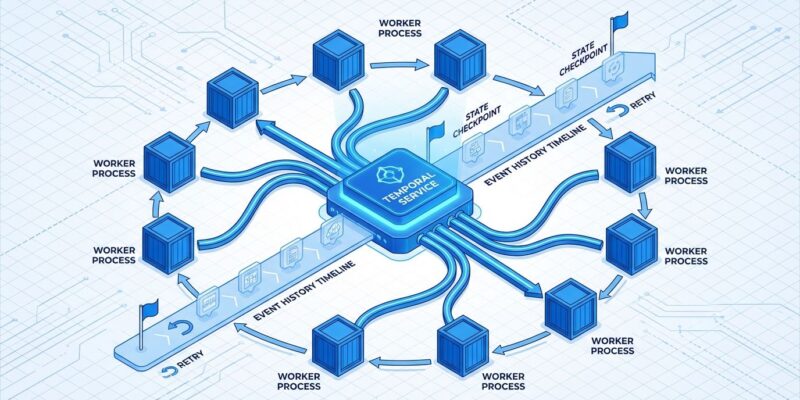
Temporal persists workflow state at every step through event history replay. When failures occur—worker crashes, network issues, service restarts—Temporal replays the event history on a new worker, resuming execution from the exact stopping point with no lost state. This is fundamentally different from traditional retry logic or queue-based systems.
Every workflow step becomes an event in Temporal’s history. Crash recovery isn’t manual—it’s automatic replay. As one 2026 guide puts it: “If you’re building anything that spans multiple services, takes longer than a single request-response cycle, or needs to survive failures gracefully, this is the most important infrastructure decision you’ll make this year.”
The architecture has three core components: Workflows (deterministic functions defining business logic), Activities (non-deterministic operations like API calls with built-in retries), and Workers (your application processes executing workflows). Temporal never runs your code directly—it orchestrates Workers through a central service that persists state.
Consider the difference. Without Temporal, you write retry logic for each API call, store workflow state in a database, handle crash recovery manually, implement timeout handling, build custom task queues, and create monitoring infrastructure. That’s 10,000 lines of boilerplate. With Temporal, you write business logic as workflow code—500 lines—and Temporal handles retries, state, crashes, timeouts, queues, and monitoring. The value proposition is stark.
When You Actually Need Temporal (And When You Don’t)
Temporal is ideal for workflows spanning multiple services, processes taking longer than single request-response cycles, and scenarios requiring fault tolerance and state management. However, it’s overkill for simple CRUD APIs, high-throughput event streaming (millions/second), sub-millisecond latency requirements, and basic async task queues.
Decision criteria are straightforward. Multi-service coordination? Temporal fits. Long-running workflows (>30 seconds)? Temporal handles this well. Failures must retry gracefully? That’s Temporal’s core strength. Simple queue-based async tasks? Use Celery or Redis instead—Temporal’s complexity overhead isn’t justified.
If your team values quick iteration with code and IDE tools, Temporal feels natural. Nevertheless, Temporal isn’t the right fit for simple ETL or teams without strong software engineering experience. The complexity overhead isn’t justified for basic automation tasks. Be honest about your needs before committing to durable execution infrastructure.
Real-World Production Use Cases
Temporal powers mission-critical workflows at scale. Netflix reduced deployment failures from 4% to near-zero. Deployments were failing due to transient Cloud Operation failures, and complex pipelines could take days. A failed operation mid-deployment meant re-running the entire pipeline from scratch. Temporal retries transient failures without restarting the entire pipeline, bringing failures to near-zero. That’s measurable impact in a domain every developer understands.
Datadog uses Temporal for incident management workflows that run hours or days. Incident response involves escalation, notification, and status tracking with complete state lifecycle management. The workflows survive across shifts and service restarts with a complete audit trail.
Replit migrated their AI agent control plane to Temporal for reliability at massive scale. Furthermore, AI workflows are long-running, multi-step, and require state management across code generation, testing, review, and deployment steps. Other AI platforms use Temporal to automate thousands of call transcriptions daily with increased speed and accuracy while minimizing downtime.
E-commerce order fulfillment is another natural fit: payment processing, inventory reservation, shipping label creation, and customer notifications. The workflow state persists even if services crash mid-order, and automatic retries handle failed payment API calls without manual intervention.
Temporal vs Airflow vs AWS Step Functions
Choose based on use case. Temporal takes a code-first approach where workflows are written in application code (Go, Java, TypeScript), giving full programming power and version control benefits. Airflow uses a DAG-based model built for scheduled batch pipelines, dominating data engineering with 60+ pre-built providers for AWS, GCP, Databricks, and Snowflake. AWS Step Functions is a fully managed serverless service where workflows are JSON state machines with tight Lambda, EventBridge, and DynamoDB integration.
The trade-offs are clear. Temporal excels at complex logic in code but has a learning curve around deterministic execution rules. Airflow has the best data engineering ecosystem but tasks are stateless and rely on database or external storage for context. Step Functions is simple and fully managed but locked to AWS and JSON configuration.
Use Temporal for multi-step business logic and fault tolerance. Use Airflow for ETL and data pipelines. Use Step Functions if you’re AWS-native and building serverless architectures. Consequently, the choice depends on your stack and use case, not which tool is “best.”
Getting Started: Fresh 2026 Resources
Recent tutorials make Temporal more accessible. OneUpTime published a Kubernetes deployment guide on February 9, 2026, showing production-ready infrastructure patterns. Baeldung covered Spring Boot integration on January 26, 2026, making it easier for Spring-based microservices to adopt Temporal. Official SDKs exist for seven languages: Go, Java, TypeScript, Python, .NET, PHP, and Ruby.
Deployment options split between self-hosted and managed. Self-hosting requires managing seven components with 24/7 operational coverage and recommended 512 shards for production clusters. In contrast, Temporal Cloud offers a fully managed service with 99.99% SLA, eliminating infrastructure overhead. Most teams without dedicated operations staff should default to Temporal Cloud—self-hosting operational complexity is non-trivial.
Production Gotchas to Know
Common pitfalls from production teams offer valuable lessons. Non-deterministic workflows break replay—using system time, random numbers, or direct API calls in workflow code causes failures. Always use Temporal’s deterministic APIs: workflow.Now(), workflow.Random(), and activities for API calls.
Large payloads hit unexpected limits. Chronosphere learned this with deployment manifests containing sensitive data. Their solution: encrypt manifests, store in object storage, and pass path references instead of full payloads. This pattern applies to any large data blobs in workflows.
Workflow versioning was historically challenging when two processes run different code versions. Moreover, the new Worker Versioning feature (2026) solves this by guaranteeing each workflow runs on a single code version, virtually eliminating version compatibility problems. Use it—versioning is critical for workflows queried after closing or stored for extended periods.
Key Takeaways
- Temporal eliminates reliability boilerplate – No more custom orchestration layers with queues, databases, and schedulers
- Durable execution via event replay – Workflows survive crashes, restarts, and failures automatically
- Proven at scale – Netflix, Datadog, and Replit use it in production with measurable impact
- Not for everything – Skip it for simple APIs, basic queues, or high-throughput streaming
- Choose based on use case – Temporal for business logic orchestration, Airflow for data pipelines, Step Functions for AWS-native
- Fresh 2026 resources available – Kubernetes deployment and Spring Boot integration tutorials published February-March 2026
If you’re building multi-service workflows that need to survive failures gracefully, Temporal is worth serious evaluation. If you’re building simple request-response APIs, stick with standard web frameworks and save yourself the complexity.