 By ByteBot
US companies are investing $190 million annually in digital technology—more than any other region—yet 56% can’t fund new innovation because they’re drowning in technical debt remediation costs. That’s the stark finding from KPMG’s 2026 Annual US Technology Survey released January 22, revealing a crisis that should alarm every CTO and developer: the percentage of firms with “fully mature” technology implementations just collapsed from 25% to 10% year-over-year. The bill for “move fast and break things” is now due, and it’s blocking the AI revolution everyone claims to want.
More Money, Less Maturity
The paradox is brutal. American firms are outspending the global average ($174M) on digital technology, yet fewer than one in ten can describe their implementations as “fully scaled and continually evolving.” That’s a 60% collapse in maturity from last year. Meanwhile, 40% of companies still experience weekly IT glitches from legacy systems that should have been retired years ago.
McKinsey research explains the trap: technical debt accounts for 40% of IT balance sheets, and companies pay an additional 10-20% on top of every project just to navigate around it. McKinsey’s metaphor is apt: “The principal is all the work that must be done to modernize the entire technology stack, while the interest is the complexity tax that every project pays today.” It’s like trying to fill a bathtub with the drain open. Pour faster, and you’re still losing water.
This isn’t an engineering problem anymore. It’s a C-suite ROI crisis. Investors and boards expect returns on $190 million annual investments. Instead, the money vanishes into keeping legacy systems alive while innovation teams can’t secure budget because maintenance already consumed it.
The AI Collision Nobody Wants to Discuss
Here’s where it gets uncomfortable. KPMG found that 92% of US organizations believe AI will shift from an efficiency tool to a revenue driver by the end of 2026. Yet 56% of those same companies can’t invest in new technology—including AI—because technical debt remediation costs are blocking the budget.
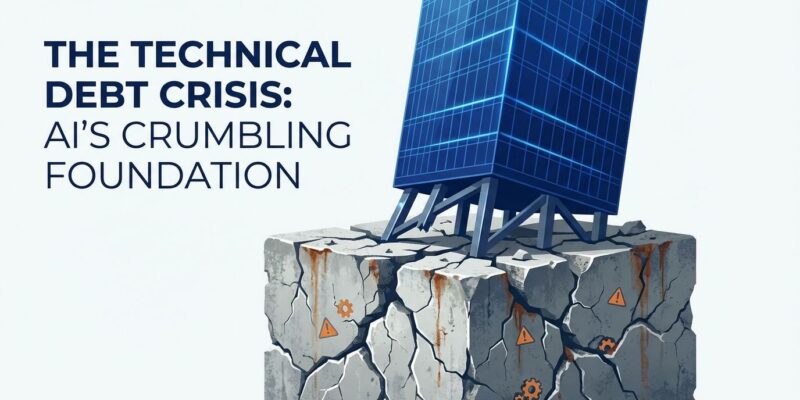
You can’t build the future on a crumbling foundation. Gartner predicts that by 2026, 80% of technical debt will be architectural, not superficial code quality issues. That means you can’t just patch it with a refactoring sprint. The rot is structural.
Consider the federal government’s predicament: seven of eleven critical legacy systems are operating with known cybersecurity vulnerabilities. Four have unsupported hardware or software. Eight use outdated languages. These aren’t edge cases—they’re warnings. When KPMG notes that “AI has increased productivity, but it hasn’t fundamentally changed the way companies do business yet,” this is why. You can’t transform a business when 40% of your IT budget disappears into keeping the lights on.
For developers, the collision is visceral. Leadership demands modern AI/ML pipelines while the infrastructure beneath can’t support basic stability. Data sits trapped in legacy databases with COBOL interfaces, maintained by programmers whose average age is 55 and who are retiring at 10% annually. You’re asked to innovate on a stack that glitches weekly. Good luck with that.
The “Move Fast” Reckoning
Facebook famously abandoned “move fast and break things” in 2014, pivoting to “move fast with stability.” The reason? Stability issues and technical debt were disrupting core functionalities. What sounded like a cultural triumph—ship fast, iterate later—turned into an operational nightmare. One day of “we’ll fix it later” compounded into years of engineering bandwidth lost to maintenance.
The pattern repeats across startups and enterprises. Prioritize velocity over sustainability. Accept shortcuts for short-term wins. The debt compounds silently until it doesn’t. CodeScene estimates developers now spend 42% of their time dealing with technical debt instead of building new features. Sonar’s 2026 survey of 1,149 developers found that even with AI coding tools, toil remains constant at 23-25% of time—it just shifts from manual coding to correcting what AI generates.
Here’s the kicker: McKinsey analyzed 220 companies and found that firms in the 80th percentile for technical debt management have 20% higher revenue growth than those in the bottom 20th. Slowing down to fix foundations actually accelerates business outcomes. The companies that resisted the “move fast” peer pressure are now pulling ahead.
On Hacker News, engineers share war stories about convincing product managers to prioritize debt. The 10% tech debt budget rule gets corrupted: teams design solid systems, then throw non-essential features into the debt backlog to ship a barely-functional MVP. The budget becomes a dumping ground instead of genuine improvement. Cool projects get canceled because maintenance consumed the budget. The cycle feeds itself.
This isn’t just an engineering failure. It’s a cultural reckoning. VCs and C-suites pushed the “move fast” gospel for years. Now the bill is due, and it’s blocking the very innovation those same executives claim to prioritize. Who’s accountable?
The Discipline Premium
There is a path forward, but it requires something the tech industry historically dislikes: discipline.
Gartner projects that by 2027, GenAI tools could cut legacy modernization costs by up to 70%. By 2028, organizations using structured methods for managing infrastructure technical debt will report 50% fewer obsolete systems than those flying blind. McKinsey’s data already proves the ROI: top-tier debt managers grow 20% faster.
But discipline is the prerequisite. Treating technical debt like financial debt—tracking principal and interest, planning paydown, measuring progress—works. Error budgets, delivery metrics, operational stability frameworks work. Stopping the cycle of rewarding velocity over sustainability works.
The problem? Forty-seven percent of firms surveyed by KPMG expect to reach “full maturity” by the end of 2026. That’s wildly optimistic unless there’s a fundamental shift from AI experimentation to execution on foundations. AI tools can accelerate modernization, but only if companies use them to fix infrastructure instead of stacking more experiments on top of rotting systems.
KPMG also found that employees feeling “left behind” by technology dropped from 67% to 40% year-over-year. When technical debt is managed, morale improves. When teams can build instead of perpetually maintain, engagement returns. Developers want to create. Give them infrastructure that allows it.
Fix Foundations or Watch Competitors Pull Ahead
The 2026 question for every technology leader is simple: Will you pause AI experiments to fix foundations, or will you keep stacking new technology on crumbling infrastructure until something breaks catastrophically?
The data is unambiguous. Companies investing $190 million annually are achieving less maturity than last year despite spending more. The majority can’t fund innovation because debt remediation consumes the budget. The AI transformation everyone expects by year-end requires solid foundations that most organizations don’t have.
Meanwhile, the companies that slowed down to fix technical debt are growing 20% faster. That’s not a rounding error. That’s a strategic moat.
The bill for “move fast and break things” is due. Pay it now with discipline and GenAI-assisted modernization, or pay it later with obsolescence and competitive disadvantage. The choice belongs to C-suites, but developers will live with the consequences either way.