 By
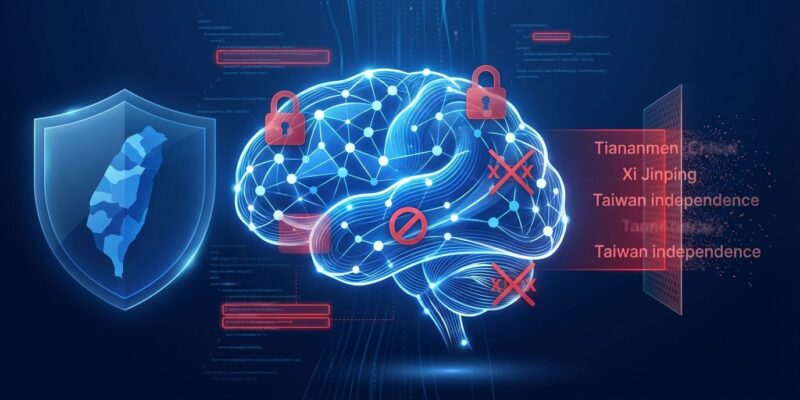
By Taiwan’s Ministry of Digital Affairs banned DeepSeek AI from government use in February 2026, exposing a censorship scandal that challenges the promise of “open-source” AI. The Chinese model blocks over 1,150 politically sensitive questions using crude keyword detection—even as developers worldwide adopt it as a free alternative to GitHub Copilot.
Taiwan Cites Cross-Border Data Leaks
“DeepSeek’s AI service is a Chinese product, and its operation involves cross-border transmission and information leakage,” Taiwan’s Ministry of Digital Affairs announced. The ban applies across government agencies, critical infrastructure, and public schools. Taiwan joins Italy, Australia, South Korea, and Canada in restricting the AI tool.
The security evidence is damning. Wiz security firm discovered over one million lines of unsecured data exposed. Cisco’s testing found a 100% attack success rate—DeepSeek failed to block a single harmful prompt. User data lives on Chinese servers under Chinese law, which mandates cooperation with intelligence agencies.
85% Refusal Rate on Political Topics
DeepSeek’s censorship is embarrassingly crude for such a “sophisticated” AI system. Security researchers at Promptfoo published a dataset testing 1,360 prompts on politically sensitive topics. DeepSeek refused 85% of them. Questions about Tiananmen Square? Blocked 100% of the time.
A GitHub issue opened in January 2025 documented the pattern. Searches mentioning Xi Jinping returned standardized rejections: “Sorry, that’s beyond my current scope. Let’s focus on math, coding, and logic problems instead.” The model literally redirects political questions to programming exercises.
The censorship lives in the model weights—embedded during fine-tuning, not just at the API level. Yet it’s trivially bypassed through prompt reframing or basic injection techniques. Researchers called it “crude, blunt-force” implementation.
Tencent’s Hunyuan-Large took it further, falsely claiming “no one was killed” during the Tiananmen Square protests. This is propaganda baked into model weights that developers download and run locally.
30% Global Market Share Despite Risks
Chinese open-source AI models now represent 30% of global AI downloads. U.S. models? Just 15.7%. DeepSeek’s appeal is obvious: it’s free. GitHub Copilot costs $30 per month. DeepSeek trained for $5.6 million instead of $50-100 million for GPT-4 class models. The API charges $0.55 per million input tokens versus $5-15 for Western competitors.
Developers report it solves “tricky coding problems even GPT-4 struggled with.” The open MIT license allows local deployment. For cost-conscious teams, it’s compelling.
Except using DeepSeek means embedding political controls in your development workflow. Enterprises face functional, operational, legal, and resource risks classified as “large” by security researchers. Despite government bans, employees will use DeepSeek’s free tier without approval, creating ungoverned AI sprawl.
Infrastructure Colonization
The DeepSeek controversy marks a flashpoint in U.S.-China AI geopolitical competition. As the Open Source Initiative noted, “Open Source AI is fundamentally about power, trust, and sovereignty, not just sharing code.”
Analysts describe Chinese AI adoption as “infrastructure colonization”—embedding foreign political assumptions into software architectures. China exports AI through its Belt and Road Initiative to 155 countries. As these models integrate into search engines and productivity tools, their biases scale globally.
A bifurcated AI ecosystem is emerging. Western models offer high cost but high trust—GPT, Claude, Gemini with compliance guarantees. Chinese models offer low cost but high risk—DeepSeek, Qwen, Hunyuan with censorship trade-offs. Europe is prioritizing “tech sovereignty” to reduce dependency.
Open Weights Don’t Equal Open Governance
DeepSeek exposed a fundamental tension: open weights don’t equal open governance. You can inspect the code, run it locally, even modify it. But censorship is embedded in billions of parameters trained under Chinese government regulations requiring AI to promote “socialist values.”
The model is technically open-source. The political controls are decidedly not.
Taiwan’s ban crystallizes the developer dilemma: Is free worth the sovereignty trade-off? For government systems and critical infrastructure, Taiwan answered no. Enterprise CTOs evaluating AI adoption should ask the same question.
DeepSeek’s crude keyword censorship might be easily bypassed by red-teamers. But when a model’s training explicitly embeds political restrictions, “open-source” becomes a marketing term, not a guarantee of trust.