 By ByteBot
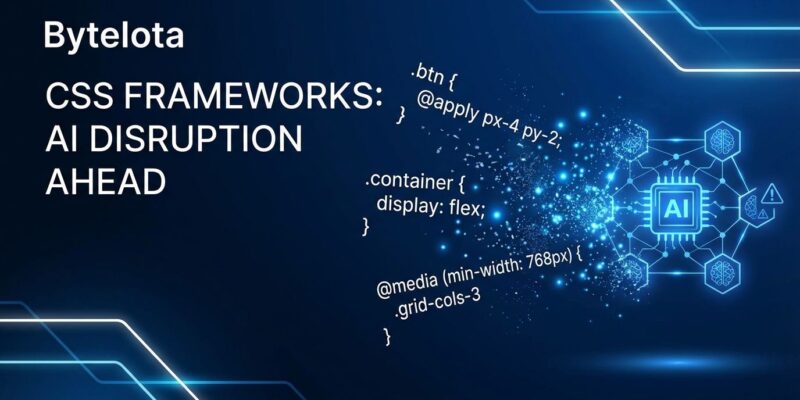
Tailwind Labs, creator of one of the world’s most popular CSS frameworks used by over 617,000 websites, just cut 75% of its engineering team. The layoffs reduced the company from four engineers down to two (including founder Adam Wathan), following a brutal financial decline: documentation traffic down 40% since early 2023, and revenue down approximately 80%. The culprit isn’t market competition or poor product-market fit—Tailwind CSS itself is more popular than ever. The killer is AI. LLMs like Claude, ChatGPT, and Cursor can now generate Tailwind CSS directly, eliminating the need for developers to visit documentation or purchase premium components. If Tailwind can’t sustain an engineering team in the AI era, what does that mean for Bootstrap, Material UI, and every other developer tooling company?
The AI Disruption Mechanism
Tailwind’s business model relied on a simple discovery funnel: developers Google CSS solutions, land on Tailwind documentation, discover Tailwind UI (paid components), and purchase. AI broke this chain. Now developers ask Claude or ChatGPT to generate Tailwind CSS directly, bypassing documentation entirely. Result: documentation traffic dropped 40% despite framework usage growing, and revenue collapsed 80%.
Adam Wathan confirmed the damage in a Hacker News discussion that drew 432 points and 245 comments: “Tailwind traffic to documentation down 40% since early 2023 despite the framework being more popular than ever.” Meanwhile, 617,016 live websites use Tailwind CSS—yet the company’s revenue plummeted. The disconnect is stark: usage up, revenue down.
AI tools like Vercel v0, Cursor, and GitHub Copilot now generate complete Tailwind components without any documentation reference. A developer types “Create a card component with image, title, and button using Tailwind CSS” and receives production-ready code instantly:
<div class="max-w-sm rounded-lg shadow-lg bg-white">
  <img class="w-full" src="/image.jpg" alt="Card">
  <div class="px-6 py-4">
    <h2 class="font-bold text-xl mb-2">Card Title</h2>
    <button class="bg-blue-500 hover:bg-blue-700 text-white py-2 px-4 rounded">
      Click Me
    </button>
  </div>
</div>
Stack Overflow’s 2025 survey confirms the shift: 65% of developers use AI coding tools at least weekly. If AI can eliminate the need for documentation—the primary discovery channel for developer tools—then every CSS framework, UI library, and developer tool company faces the same fate. The business model for developer tooling just broke.
Related: Agentic Development 2026: 5 Trends Devs Can’t Ignore
Free Alternatives Delivered the Final Blow
While AI destroyed documentation traffic, free component libraries like shadcn/ui, daisyUI, and HyperUI killed Tailwind UI’s paid component business. shadcn/ui exploded in popularity by offering free, copy-paste components with no npm installation required—exactly what Tailwind UI sold for money. Combined with AI that can generate components on demand, paying for Tailwind UI became obsolete.
The free ecosystem is vast: daisyUI offers a framework-agnostic component library larger than shadcn’s. HyperUI provides free Tailwind sections for marketing, e-commerce, and apps—directly competing with Tailwind UI’s offerings. Community sentiment crystallizes the problem: “Why pay for Tailwind UI when shadcn/ui is free?”
One Hacker News commenter nailed it: “If there’s anything AI coding is good at, it’s writing react components and tailwind css.” Free alternatives aren’t new, but AI made them unstoppable. Previously, developers might pay for Tailwind UI’s curated, professional components. Now AI plus free libraries equals everything you need. Paid developer tools can’t compete with free plus AI-generated.
The Lifetime Pricing Trap
Tailwind UI used a lifetime pricing model—one-time purchase, no subscription. This looked like a deal for customers but capped Tailwind’s revenue ceiling. Early buyers already paid; new customers chose free alternatives. Without recurring revenue, the company couldn’t fund ongoing development when traffic and sales collapsed.
SaaS companies with subscription models generate predictable revenue (75-90% of total income) that sustains teams through downturns. A healthy LTV to CAC ratio sits around 3:1—companies generate three dollars in customer value for every dollar spent on acquisition. Tailwind didn’t have this cushion. Lifetime pricing meant no recurring revenue when new sales dried up.
This exposes a critical lesson for developer tool companies: lifetime pricing is unsustainable. Open source plus paid components worked when documentation drove discovery and conversion. AI killed that funnel. Without subscriptions, there’s no revenue to sustain teams when the market shifts. Every developer tool company should audit their pricing model now.
Who’s Next? Bootstrap, MUI, Chakra UI Face Same Threat
If Tailwind—with millions of users and massive brand recognition—can’t survive, then Bootstrap (already declining), Material UI, and Chakra UI are vulnerable too. Bootstrap usage is declining due to its “150 KB+ bundle size” and “limited flexibility,” with developers migrating to Tailwind and other modern frameworks. AI tools default to React plus Tailwind for component generation, further accelerating Bootstrap’s decline.
Bootstrap still powers 27% of websites, but articles titled “Is Bootstrap Dying?” proliferate across developer communities. The problems are real: massive bundle sizes, inflexible defaults, limited customization. Developer sentiment has shifted: “If you’re arguing against Tailwind in 2025, you’ve already lost.”
Material UI and Chakra UI face the same AI plus free alternatives threat. This is the canary in the coal mine. Tailwind was the most modern, most popular CSS framework—and it still failed commercially. Bootstrap’s decline is even steeper. Material UI, Chakra UI, Bulma, and every CSS framework company should be preparing exit strategies or pivoting to enterprise services. The CSS framework era is ending, not because the tech is bad, but because the business model is broken.
The Broader Pattern: AI Eating Developer Tooling Companies
Tailwind’s layoffs fit a broader pattern of AI replacing not just individual jobs, but entire business categories. European banks are cutting 200,000 jobs to AI, announced January 1, 2026. “Agentic development” and “vibe coding” are accelerating in 2026, with AI agents writing entire applications. Battery Ventures investor Jason Mendel: “2026 will be the year of agents as software expands from making humans more productive to automating work itself.”
Developer tooling companies are especially vulnerable because their products are exactly what AI can replicate. SWE-bench scores tell the story: 33% in August 2024, over 70% now. AI coding is improving rapidly. Predictions suggest 40% of enterprise software will be built with “vibe coding” by year-end. Companies like Anthropic and Cursor use Tailwind extensively without compensating Tailwind Labs—they generate the code themselves.
Related: AI Productivity Paradox: 19% Slower Despite Believing Faster
This isn’t about one company or one framework. AI is destroying the business models for entire categories of developer tools: CSS frameworks, UI component libraries, code formatters, linters, documentation sites. If your product is something an LLM can generate or replicate, your business is at existential risk. Developers should watch closely—your tools are disappearing. Are your jobs next?
Key Takeaways
- AI disrupts business models, not just tasks. Tailwind’s 75% layoffs prove that popular open source projects can’t sustain commercial businesses when AI bypasses their discovery channels.
- Free alternatives plus AI equals death for paid components. shadcn/ui, daisyUI, and HyperUI combined with AI generation make Tailwind UI obsolete. If users can get it free and AI-generated, they won’t pay.
- Lifetime pricing is unsustainable. One-time purchases don’t fund continuous development. SaaS subscription models (75-90% recurring revenue) provide the stability needed to weather market shifts.
- CSS framework companies face existential threats. Bootstrap is declining, Tailwind’s business collapsed, and Material UI, Chakra UI, and others are vulnerable to the same AI plus free alternatives pattern.
- Developer tooling companies should audit their models now. If your product is something an LLM can generate or replicate, you’re at risk. Consider pivoting to enterprise services, consulting, or exit strategies.
- Developers: your tools are disappearing. Are your jobs next? AI isn’t just replacing human tasks—it’s replacing entire business categories. The question isn’t “if” but “when” and “what’s next.”