 By ByteBot
London-based AI video startup Synthesia just raised $200 million at a $4 billion valuation—nearly doubling its worth in 12 months. Led by Google Ventures with backing from Nvidia’s NVentures, the Series E round validates what most AI startups struggle to prove: enterprise AI can deliver measurable business value. With $150 million in annual recurring revenue and 90% of Fortune 100 companies using its platform, Synthesia stands out in a market where MIT research shows 95% of generative AI projects fail to demonstrate returns within six months.
Enterprise AI’s ROI Reckoning
The funding comes as enterprise AI faces its most critical test. According to Kyndryl, 61% of CEOs report increasing pressure to show returns on AI investments, while 53% of investors expect positive ROI within six months. Yet Forrester research reveals only 15% of AI decision-makers report positive profitability impact in the past 12 months.
Synthesia’s metrics tell a different story. The company crossed $100 million ARR in April 2025, hit $150 million by year-end, and projects over $200 million for 2026. Fortune 100 penetration jumped from 70% to 90% in just months. Clients include Bosch, Merck, SAP, DuPont, Xerox, and Heineken. With 60,000 customers globally and 70% of revenue from enterprise deals, Synthesia proves AI can solve real business problems at scale.
“We see a rare convergence of two major shifts,” CEO Victor Riparbelli said. “A technology shift with AI agents becoming more capable and a market shift where upskilling and internal knowledge sharing have become board-level priorities.”
From Static Videos to Interactive Agents
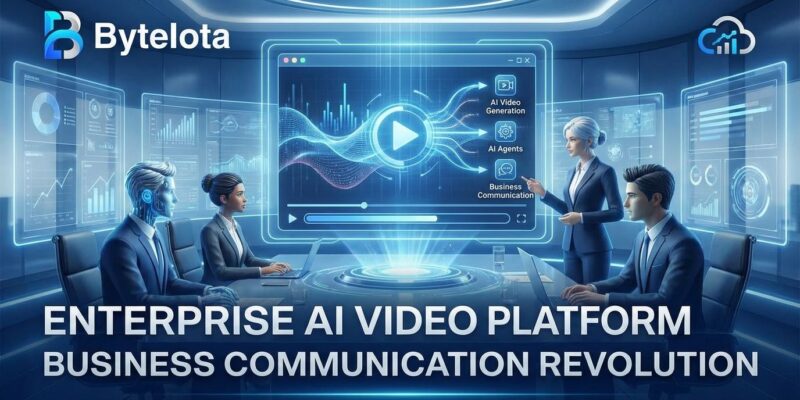
But Synthesia isn’t just riding current success. The company’s strategic pivot to “Video Agents” represents the next evolution in enterprise AI: from static content generation to real-time conversational experiences.
Video Agents transform traditional AI-generated training videos into interactive tutors. Viewers can ask questions, role-play scenarios, and receive dynamic responses—all in real time. The technology connects to enterprise knowledge bases like SharePoint, Google Drive, CRM systems, and LMS platforms, capturing data and feeding it back into business systems. Early 2026 rollout targets Enterprise customers first.
This shift mirrors broader industry trends. Gartner reports a 1,445% surge in multi-agent system inquiries from Q1 2024 to Q2 2025. By the end of 2026, 40% of enterprise applications will include task-specific AI agents, up from less than 5% in 2025. The pattern is clear: AI is moving from single powerful agents to orchestrated teams of specialists, and from passive content to active collaboration.
Lessons for Developers Building AI Apps
Synthesia’s success offers concrete lessons for developers building AI applications. First, enterprise AI demands reliability and compliance from day one. Synthesia maintains SOC 2 Type II, GDPR, and ISO 42001 certifications because Fortune 100 companies won’t deploy solutions that can’t pass security reviews.
Second, solve specific business problems with measurable impact. Synthesia targets corporate training, sales enablement, and internal communications—areas where companies can quantify ROI. The AI video generator market is projected to grow from $554.9 million in 2024 to $1.1 billion by 2032, with training and learning modules accounting for 34% of usage.
Third, build for scale. Supporting 160+ languages and 240+ AI avatars isn’t feature bloat—it’s what global enterprises need. Synthesia’s multilingual capabilities enable Fortune 100 companies to train thousands of employees across dozens of countries with consistent, compliant content.
The opportunity for developers is clear: agentic AI systems, real-time video processing, enterprise knowledge integration, and multilingual content generation are growth areas where real engineering work translates to real business value.
Why Google and Nvidia Invested
Google Ventures leading the round signals strategic alignment beyond financial returns. Synthesia’s enterprise customer base and proven business model validate Google’s broader AI ecosystem strategy. Nvidia’s participation makes sense too: real-time Video Agents require GPU-intensive compute, and enterprise AI adoption validates Nvidia’s AI platform investments.
The backing provides more than capital. Synthesia gains access to Google Cloud infrastructure and Nvidia’s GPU resources—critical advantages as AI video processing scales from thousands to millions of users.
The Bottom Line
As 2026 unfolds, enterprise AI is maturing beyond experimentation. Companies that prove measurable value with real revenue and Fortune 100 adoption attract serious investment. Those that can’t will join the 95% failure rate.
For developers, the message is direct: focus on solving real business problems with production-ready solutions. The age of impressive demos is over. The era of enterprise AI validation has begun.