
 By ByteBot
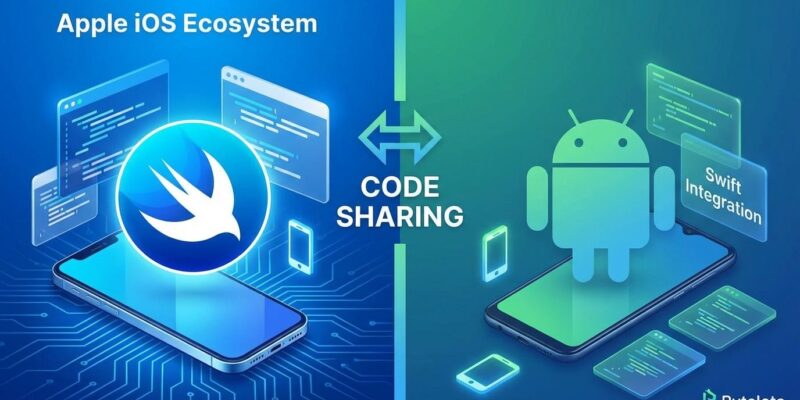
Apple officially released the Swift SDK for Android on October 24, 2025, enabling developers to build native Android apps using Swift for the first time. The preview release marks a major strategic shift—Apple’s flagship programming language, 11 years after its debut, now compiles to Android’s native code via the Android NDK. Over 25% of Swift packages already build for Android, and the announcement is trending on Hacker News today with 104 points and active discussion from the developer community.
This isn’t charity. Apple is playing defense against Kotlin Multiplatform and React Native, which have been stealing iOS-first teams by forcing them to build Android-first. By letting developers share Swift business logic between iOS and Android, Apple keeps its ecosystem primary while acknowledging the cross-platform reality most teams face.
Swift Android SDK Delivers Native Performance
Swift compiles directly to native Android machine code using the Android NDK, delivering performance comparable to C and C++. Unlike React Native’s JavaScript bridge or Flutter’s Dart VM, Swift apps run as true native binaries on Android with no runtime overhead. Moreover, the swift-java library automatically generates bidirectional bindings between Swift and Java code via JNI, enabling seamless integration with existing Android APIs.
The approach focuses on sharing business logic, data models, and algorithms—not UI code. This differs fundamentally from React Native and Flutter, which attempt to share entire UI layers across platforms. However, Swift for Android lets you reuse your authentication logic, networking stack, or payment processing while keeping each platform’s native UI frameworks intact. It’s a more pragmatic trade-off that acknowledges iOS and Android have different design languages.
Swift Package Index data shows 27.9% of packages (out of roughly 9,000 indexed) already build for Android. That’s remarkable considering many packages rely on Apple-specific frameworks that automatically exclude Android support. Furthermore, the ecosystem is further along than most developers realize.
Apple’s Cross-Platform Strategy: Ecosystem Control
Why would Apple enable its language on Google’s platform? Because cross-platform development is a fact of life, and Apple realized developers were choosing Android-first tools that made iOS secondary. Consequently, if teams standardize on Kotlin Multiplatform or React Native, they optimize for Android and treat iOS as an afterthought. Swift for Android reverses that calculus.
Apple has skin in this game beyond developer goodwill. Apple Music and other Apple services run on Android, and engineers would obviously prefer writing Swift instead of Kotlin or Java. Additionally, by positioning Swift as a “global development standard,” Apple expands Swift’s value beyond the Apple ecosystem. It’s the same playbook that made Swift open source in 2015 under the Apache License—make the language universally applicable so developer skills transfer across platforms.
The move also pressures Google. Kotlin Multiplatform has been JetBrains’ answer to cross-platform development, gaining production traction with companies like McDonald’s. Meanwhile, Apple offers iOS-first teams a native alternative, creating a mirror competition: Kotlin for Android-first, Swift for iOS-first.
Swift vs Kotlin Multiplatform vs React Native
Swift for Android directly competes with Kotlin Multiplatform—both share logic, not UI. Flutter and React Native are different animals entirely, attempting to share entire UI codebases with custom frameworks. The comparison matters because picking the wrong tool costs months of wasted effort.
Kotlin Multiplatform launched to production stability in 2025 and currently holds the advantage. Developer consensus on forums is blunt: “If you have to go multiplatform today, stick to KMP.” In fact, Kotlin is more mature, better documented, and officially backed by Google (Android’s steward). Swift for Android, still in nightly preview builds, “might need a couple more months in the oven” before production use, according to community reactions on Hacker News.
Flutter dominates the UI-sharing space with 46% market share, leveraging its custom rendering engine for visual consistency across platforms. React Native holds 35% market share, trading some performance for JavaScript ecosystem compatibility and a massive developer talent pool. However, both frameworks are mature and battle-tested, which Swift for Android is not—yet.
The decision tree is straightforward: iOS-first teams expanding to Android should watch Swift closely. Android-first teams adding iOS support should use Kotlin Multiplatform. Teams building from scratch or prioritizing shared UI should choose Flutter (for visual apps) or React Native (for teams with React expertise). Don’t bet your production app on Swift for Android in 2026.
Developer Community Reactions: Excited but Skeptical
The Hacker News discussion reveals the community’s split: enthusiasm about technical capabilities, skepticism about execution. Comments note “there doesn’t seem to be much interest from the Swift core team” in official Android support documentation. Therefore, developers worry Swift for Android is “quite heavy” and lacks the polish of first-class platforms.
The preview status shows. IDE integration with Visual Studio Code and Android Studio is still in progress. Debugger maturity lags. The vision document is under review, not finalized. Consequently, Swift’s Android support is real but rough around the edges—fine for experimentation, risky for production apps shipping to users.
Alternative frameworks like SwifDroid (announced this week on Hacker News) attempt to smooth the rough edges by handling Android lifecycle management and Gradle dependency automation. Nevertheless, the community is building around Swift for Android, which signals genuine interest beyond Apple’s official efforts.
Who Should Use Swift for Android (And Who Shouldn’t)
Swift for Android makes sense for a narrow use case: iOS-first teams with existing Swift codebases who need Android support and can tolerate platform-specific UI work. For example, if you’ve built a financial app in Swift with complex transaction logic, reusing that code on Android beats rewriting it in Kotlin. The 6-12 month timeline to production stability is acceptable if you’re planning ahead.
Everyone else should look elsewhere. Need a cross-platform solution today? Kotlin Multiplatform is production-ready now. Building from scratch? Flutter offers faster MVP development. Have a React team? React Native leverages existing skills. Don’t know Swift? Learning it just for cross-platform development makes no sense when Kotlin Multiplatform exists.
The honest assessment: Swift for Android is a strategic asset for Apple and iOS-first shops, not a general-purpose cross-platform solution. It won’t replace Kotlin Multiplatform, Flutter, or React Native. However, it doesn’t need to—it just needs to keep Swift developers in Apple’s orbit when they expand beyond iOS.
Key Takeaways
- Swift SDK for Android launched October 2025 in preview, enabling native Android development via NDK compilation
- Over 25% of Swift packages already build for Android; ecosystem is more ready than expected
- Apple’s strategic play: prevent Android-first tooling from making iOS secondary in cross-platform development
- Competes directly with Kotlin Multiplatform (logic-sharing), not Flutter/React Native (UI-sharing)
- Not production-ready yet—wait 6-12 months for stable release unless you’re an early adopter
- Best for iOS-first teams expanding to Android; use Kotlin Multiplatform for Android-first scenarios


