 By ByteBot
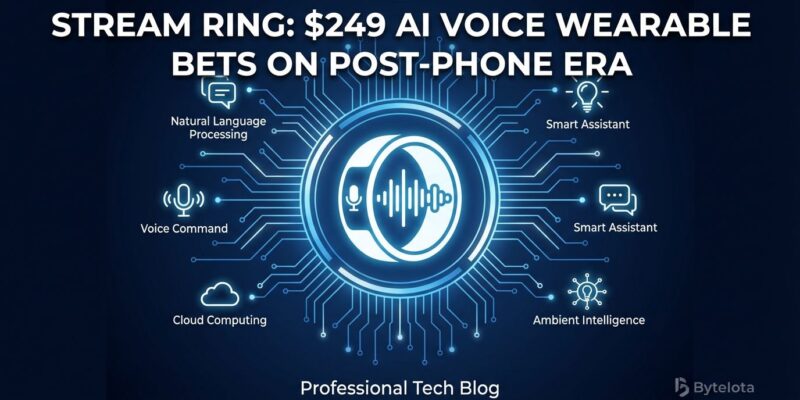
Sandbar, a startup founded by two former Meta engineers who worked on neural interfaces at CTRL-Labs (Meta’s $500M-$1B acquisition), launched the Stream Ring in November 2025—a $249 voice-first AI wearable that promises to replace smartphones with whisper-activated voice notes. Preorders opened last month, with shipping slated for summer 2026. The timing is notable: Humane’s $700 AI Pin just sold to HP for $116M, with all devices going offline February 28, 2026.
This tests whether AI wearables can succeed where Humane failed spectacularly. Stream Ring’s lower price ($249 vs $700), privacy-first approach (press-to-activate vs always-on), and phone-companion positioning (vs standalone) suggest the founders learned from Humane’s mistakes.
## Learning from Humane’s $700 Failure
Mina Fahmi and Kirak Hong aren’t first-time founders gambling on unproven tech. They worked on neural interface technology at CTRL-Labs before Meta acquired the startup in 2019 for an estimated $500M-$1B. Now they’ve raised $13M from True Ventures to build Stream Ring as Humane AI Pin’s catastrophic failure becomes official.
Humane’s numbers tell a brutal story. The AI Pin cost $700 plus $24/month, suffered 2-4 hour battery life, frequent errors, and overheating. HP bought Humane for $116M after the company raised $240M+—a massive write-down that left early customers holding soon-to-be-bricked devices. Stream Ring costs 65% less on hardware ($249-$299) and 58% less on subscription ($10/month).
More importantly, Stream Ring doesn’t try to replace your phone. Meta’s Ray-Ban smart glasses sold 1M+ units in their first year by being phone accessories, not standalone devices. Stream follows this playbook: pair with iPhone via Bluetooth, capture voice notes, sync to app, export to Notion. If Stream fails too, it signals AI wearables aren’t viable. If it succeeds, it validates the category.
## Privacy-First: Whisper-Activated, Not Always-On
Unlike Alexa or Siri (always listening) or the proposed Wizpr Ring ($199, no button required), Stream Ring only records when you press and hold the touchpad on your index finger. The microphone is whisper-sensitive, enabling discreet voice notes in public without broadcasting your thoughts to everyone nearby.
The workflow: raise finger to lips, press touchpad, whisper or speak, release, receive haptic confirmation. Transcription appears in the iOS app. Data gets encrypted at rest and in transit, then exported to Notion or other productivity apps. Sandbar calls it “mouse for voice”—you control exactly when it’s active.
For developers and tech professionals, this addresses the biggest privacy concern with AI assistants: who’s listening? Press-to-activate means you decide. However, Sandbar’s privacy policy remains unclear on a critical question: do they access transcriptions for AI training? The “privacy-first” claim needs scrutiny beyond press-to-activate mechanics.
## True Ventures Bets on Post-Smartphone Future
Jon Callaghan, True Ventures co-founder, predicts smartphones will lose their primary role in 5 years and “perhaps disappear altogether in ten years.” He calls smartphones a “lousy interface for human intelligence” because pulling out a phone disrupts natural flow. True Ventures invested in Sandbar as their post-smartphone bet.
This isn’t wishful thinking from a seed-stage fund. True Ventures manages ~$6B across 12 funds with proven wins: Fitbit, Peloton, and Ring (sold to Amazon). Their track record—63 exits, 7 IPOs—gives weight to Callaghan’s claim that “taking out a phone to send a text or email is prone to error and disrupts the natural flow of daily life and thought.”
But predictions aren’t products. If True Ventures is right, voice wearables like Stream Ring represent the next interface paradigm shift. If they’re wrong, Stream joins Humane in the tech graveyard alongside other ambitious failures. The market will decide in summer 2026.
**Related:** OpenAI Bets Big on Audio: Voice AI Device Due 2026
## Developer Use Case: Voice Coding Meets Thought Capture
Voice coding tools like Talon Voice and Wispr Flow already prove developers can code 4x faster with voice input—150 words per minute speaking versus 40 words per minute typing. Stream Ring targets a different use case: capturing architectural ideas, API design thoughts, and debugging notes while walking or commuting, times when pulling out your phone breaks flow.
The developer workflow makes sense on paper. Idea strikes while walking to coffee: raise finger, whisper “use event sourcing for audit trail, store commands in PostgreSQL,” release, check transcription later, export to Notion. No context switch to phone, no risk of checking email and losing the thought.
However, Stream Ring isn’t a replacement for Talon Voice or serious voice coding workflows—it’s too basic. Think complementary tool for thought capture, not primary development interface. The question remains: is $249 hardware plus $10/month subscription worth it for glorified voice memos? Or does whisper-activation plus Notion export plus “no phone distraction” justify the cost?
## Summer 2026 Launch Raises Questions
Stream Ring ships summer 2026 (six months away), iOS-only at launch with no Android timeline announced. The device requires a $10/month Pro subscription for unlimited AI interactions after a 3-month trial. Three-year total cost of ownership: $249 hardware plus $360 subscription (after trial) equals $609—compare that to Humane’s $1,420 over three years.
iOS-only limits the addressable market to roughly 27% of U.S. smartphone users, excluding Android developers entirely. The subscription model raises another concern: what happens if Sandbar shuts down? Humane users just learned this lesson the hard way when HP announced all devices go offline February 28.
Summer 2026 launch means six months of hype before anyone can actually test the device. Battery life remains unspecified—wearables typically manage 2-4 hours active use, which would be devastating for an all-day thought-capture tool. Will momentum sustain through a half-year wait? Or will the next AI wearable announcement steal Stream Ring’s thunder at CES 2026 next week?
## Key Takeaways
– Stream Ring ($249 + $10/month) costs 65% less than Humane AI Pin and positions as phone accessory rather than standalone replacement, learning from Humane’s $700 failure
– Press-to-activate whisper input addresses privacy concerns with always-on AI assistants, though Sandbar’s data handling policies need scrutiny
– True Ventures’ post-smartphone bet carries weight (Fitbit, Ring, Peloton exits) but remains a prediction, not proven product-market fit
– Developer use case makes sense for thought capture (architecture notes, API ideas) but doesn’t replace serious voice coding tools like Talon Voice
– iOS-only launch, unspecified battery life, and six-month wait until summer 2026 shipping raise practical adoption questions
The real test comes summer 2026 when developers can finally answer the central question: does a whisper-activated voice ring solve a problem worth $609 over three years, or is pulling out your phone still the better interface?