 By ByteBot
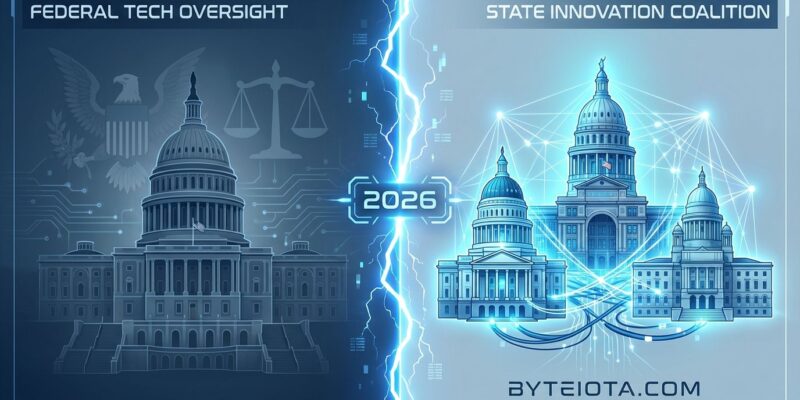
On January 1, 2026, dozens of state technology laws took effect across the United States, implementing comprehensive regulation of AI systems, data privacy, and consumer protection. Indiana, Kentucky, Rhode Island, Minnesota, Maryland, Oregon, and Tennessee activated laws covering everything from frontier AI safety reporting to data broker registration. This is the largest simultaneous rollout of tech regulation in US history—and it happened because Congress sat on its hands while states took the wheel.
With no federal legislation in sight, developers now navigate a patchwork of 20+ state compliance frameworks. Initial costs range from $50,000 for small businesses to $450,000 for medium-sized companies. Worse, the fragmentation continues: 38 states passed AI legislation in 2025 alone, and more are coming in 2026.
Six States Activate Privacy Laws on Day One
Indiana, Kentucky, Rhode Island, Minnesota, Maryland, and Oregon joined 14 other states with comprehensive consumer data privacy laws on January 1. These frameworks grant consumers rights to access, correct, delete, and obtain copies of personal data. They also mandate opt-out mechanisms for targeted advertising, data sales, and certain profiling activities.
Rhode Island stands out with the strictest rules. Its threshold of 35,000+ consumers or 10,000+ consumers with 20%+ revenue from data sales is far lower than Indiana and Kentucky’s 100,000+ requirement. Even more punishing: Rhode Island offers zero cure period. Fines up to $10,000 per violation hit immediately, while other states grant 30 days to fix compliance issues.
For developers, this means building state-specific data access, deletion, and opt-out mechanisms. Small firms face $50,000+ in initial setup costs; medium businesses with 100-500 employees pay $450,000 or more. These aren’t one-time expenses—quarterly compliance reviews and ongoing legal monitoring add up fast.
California’s Frontier AI Transparency Kicks In
California activated its Transparency in Frontier Artificial Intelligence Act (TFAIA) on January 1, targeting developers of large-scale AI models. Frontier AI models—those costing over $100 million to train or using more than 10^26 operations—must now report “critical safety incidents” causing death or injury within 72 hours. Companies also face requirements for incident response plans, safety audits, and model weight security to prevent unauthorized access.
Companion chatbot regulations took effect simultaneously. Platforms with actual knowledge of minor users must disclose every three hours that the chatbot isn’t human. They must also implement safeguards against generating sexually explicit content. Healthcare AI caught new restrictions too: AB 489 prohibits chatbots from impersonating doctors, nurses, or licensed professionals.
California also banned the “autonomous defense”—companies can no longer blame AI systems’ independent decision-making to deflect liability for harmful outcomes (AB 316). Meanwhile, law enforcement agencies must disclose when AI tools draft official police reports (SB 524). The state’s AI-generated content detection tool requirement (SB 942) was delayed to August 2, 2026, giving developers a few more months.
Multi-State Fragmentation Costs Developers $1 Trillion
According to a 2023 Deloitte survey, over 60% of US companies cite “state-level inconsistency” as their top privacy compliance challenge. The Information Technology and Innovation Foundation (ITIF) projects $1 trillion in total costs over the next decade. Startups pay $15,000 to $60,000 per additional state beyond initial compliance—expenses that favor large tech companies with legal teams and create brutal consolidation pressure.
Two strategies emerged. The “highest standard” approach applies the strictest state law—usually California’s—nationwide. Microsoft already extends CCPA-style rights to all US customers, trading higher upfront costs for long-term simplicity. The “minimum compliance” strategy implements state-by-state requirements, lowering initial expenses but multiplying complexity and legal risk.
States differ on personal data definitions, consent mechanisms, opt-out requirements, and sensitive data categories. Connecticut re-writes its privacy law annually, and three other states amended existing laws mid-2025. Developers must architect applications with state-specific feature flags, consent management platforms, and data handling logic. This infrastructure becomes a competitive moat for giants and a barrier for everyone else.
Related: Tech Layoffs 2026: Middle Management Cut First for AI
Trump EO Targets State Laws, But Preemption Unlikely
On December 11, 2025, President Trump signed an executive order establishing a DOJ AI litigation task force to challenge state AI laws through federal preemption. The task force, which started January 10, 2026, targets California’s TFAIA, Texas’s Responsible AI Governance Act, and Colorado’s AI Act (effective June 30, 2026). The order also conditions $42 billion in broadband infrastructure funding on states repealing “onerous” AI regulations.
The Commerce Department must evaluate state laws by March 11, 2026, identifying which merit referral to the task force. Exemptions exist for child safety, data center infrastructure, and government procurement. Civil rights groups warn that preemption undermines transparency and accountability in AI deployment.
Don’t bet on preemption succeeding. Constitutional challenges based on the 10th Amendment (states’ rights) and Commerce Clause limits are strong. Litigation could stretch through 2026-2028. Meanwhile, developers should implement state law compliance now rather than gambling on a federal rescue that may never arrive.
Why California Is the New National Standard
California is becoming the de facto US privacy and AI standard, mirroring how GDPR became the global baseline. Microsoft, Google, and other major tech companies extend California-style privacy rights to all US customers to avoid compliance complexity. California’s size—the world’s fifth-largest economy—forces national compliance even without federal mandates.
Legal analysts call California the “most ambitious testing ground for tech regulation.” The state’s comprehensive frameworks (CCPA for privacy, TFAIA for AI safety, companion chatbot rules for minors) set precedents other states follow. This “Brussels Effect” worked in Europe when GDPR went global. California’s pulling the same move domestically.
For developers, the path forward is clear: implement California’s strictest requirements nationwide. This “highest standard” approach trades higher upfront costs for reduced long-term complexity and creates a unified customer experience across states. Fighting the fragmentation with 20+ state-specific implementations makes no sense when one standard dominates.
Key Takeaways
- January 1, 2026 marked the largest simultaneous state tech regulation rollout in US history, with six states activating comprehensive privacy laws and California implementing frontier AI safety requirements
- Rhode Island poses the highest immediate enforcement risk with its 35,000-consumer threshold and zero cure period, while California’s frontier AI rules target models costing $100M+ to train
- Multi-state compliance fragmentation will cost businesses $1 trillion over the next decade, with small firms paying $50,000+ and medium companies $450,000+ in initial setup costs
- Trump’s executive order challenging state AI laws through federal preemption faces strong constitutional barriers—developers should implement state compliance now, not gamble on federal intervention
- California is becoming the de facto national standard, similar to GDPR globally; the smart move is implementing California’s strictest requirements nationwide to avoid managing 20+ state-specific variations
The age of federal tech regulation gridlock just handed the keys to 20+ states. Developers who treat this as temporary chaos will pay for it. Those who adapt to California as the baseline will navigate the fragmentation far better than competitors waiting for a federal rescue that isn’t coming.