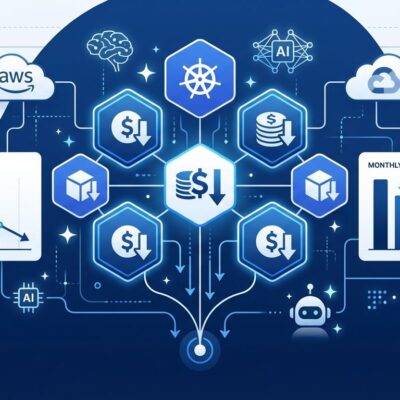
The State of FinOps 2026 report reveals that 98% of organizations now manage AI costs—up from just 31% two years ago. This represents the fastest adoption of any FinOps practice in history, according to the FinOps Foundation’s 6th annual survey of 1,192 organizations representing $83+ billion in annual cloud spend. The explosion in AI cost management isn’t optional anymore. Organizations are being asked to self-fund AI investments through optimization savings, forcing technology teams to manage costs they’ve never tracked before.
AI Cost Management Becomes Universal
AI cost management is now the #1 most desired skillset across all organization sizes, but adoption outpaces understanding. While 98% manage AI costs, 53.4% struggle with visibility into AI spending, and 40.1% can’t quantify AI value or ROI. As survey respondents put it: “Is your AI providing value? No one can answer that question yet.”
The challenge is that AI costs behave fundamentally differently from traditional cloud infrastructure. Unlike predictable VM hours, AI workloads spike unpredictably—inference for large language models can vary wildly depending on usage. Moreover, new metrics like cost-per-token, cost-per-inference, and cost-per-training-epoch replace familiar cloud billing. GPU scarcity adds pricing volatility. IDC predicts G1000 organizations will face up to 30% underestimated AI infrastructure costs by 2027.
This gap between adoption (98%) and competency (40% struggle with basics) signals immature practices scaling too fast. Consequently, nearly every organization manages AI costs, but only half can see where money goes, and fewer can justify ROI. That’s not sustainable.
FinOps Shifts from Finance to Technology Leadership
FinOps teams are migrating from CFO offices to CTO offices. Specifically, 78% now report to CTO/CIO, up 18 percentage points from 60% in 2023. Only 8% report to CFO. This organizational shift reflects FinOps 2026 becoming a technology capability requiring architecture, engineering, and platform expertise—not just financial reporting.
The impact is measurable. Teams with VP+ executive engagement show 2-4× more influence over technology decisions compared to Director-level engagement. For cloud service selection: 53% influence (VP+) versus 24% (Director). For cloud provider selection: 47% versus 16%. Consequently, when CTOs own budgets traditionally managed by finance, technology decisions and financial decisions merge.
The FinOps Foundation formalized this shift by updating its mission from managing “Value of Cloud” to managing “Value of Technology.” This isn’t just semantics—it signals that FinOps is an engineering competency, not a finance function. Engineering leaders must now justify spending, optimize costs, and demonstrate value.
Developer-Facing FinOps and the Shift-Left Problem
The top desired FinOps capability is pre-deployment architecture costing—giving developers financial context before infrastructure is provisioned, not after. This is shift-left FinOps: embedding cost accountability into engineering workflows. Specifically, tools like Infracost show the cost impact of infrastructure-as-code changes directly in pull requests, making architecture decisions economic decisions.
However, practitioners face an unsolved attribution problem. As one survey respondent explained: “Once you fix it, it’s gone. How do we give developers credit for shift-left activities?” Cost avoidance—preventing waste before it happens—is invisible in monthly savings reports. Therefore, developers who design cost-efficient architectures don’t get the same credit as engineers who shut down idle VMs. This disincentivizes proactive cost-aware architecture.
Another respondent captured the industry’s reactive past: “Dashboards are table stakes of yesterday—reactive. You have to move to proactive, real-time, automation.” The shift from post-deployment cost tracking to pre-deployment cost estimation requires new metrics, new tools, and new workflows. Notably, the attribution problem is real and unsolved.
FinOps Expands Beyond Cloud to Cloud+
FinOps scope has exploded beyond cloud VMs to manage SaaS (90%, up 25% year-over-year), licensing (64%, up 15%), private cloud (57%, up 18%), data centers (48%, up 12%), and even labor costs (28%, emerging). This “Cloud+” expansion reflects organizations realizing that optimizing AWS while ignoring $500K/year Databricks or Datadog spend is incomplete.
The most managed SaaS categories reveal where spending concentrates: data cloud platforms (37.8%), observability (33.2%), and AI services (31.0%). For example, a platform engineering team running on AWS, using Datadog for observability, Snowflake for data, and GitHub Copilot for AI assistance has costs spread across 4+ vendors. Managing only AWS misses 40-60% of tech spending.
Intersecting disciplines collaboration increased dramatically. ITFM (IT Financial Management): 66% collaborating with FinOps, up from 40% in 2023. Similarly, ITAM (IT Asset Management): 49%, up from 20%. ITSM: 56%, up from 24%. FinOps practitioners now coordinate across organizational boundaries that didn’t exist in job descriptions two years ago. The skillset expanded from “optimize EC2 instances” to “manage total technology value across cloud, SaaS, licensing, and sustainability metrics.”
FOCUS Data Standardization Accelerates
85.3% of organizations with $100M+ cloud spend have obtained or plan to adopt FOCUS-formatted cost data, up from 49.6% in 2025—a 36-percentage-point jump in one year. FOCUS (FinOps Open Cost and Usage Specification) is a standardized cloud cost data format enabling cross-provider comparisons. Notably, only 14.7% of large organizations have no FOCUS plans.
Without standardized data, comparing costs across AWS, Azure, and Google Cloud requires custom mapping of different billing formats, metrics, and terminology. FOCUS standardization means FinOps tools can process multi-cloud data without vendor-specific logic, similar to how containers standardized on OCI. This enables tool interoperability and reduces vendor lock-in on cost data.
Top expansion requests show where FOCUS needs to grow: AI workload support (16.5%), data center support (13.9%), and PaaS/SaaS expansion (13.6%). The industry has coalesced around FOCUS as the standard, but AI costs—the fastest-growing category—aren’t fully supported yet.
Related: Big Tech Pledges AI Power—But Who Really Pays the Bill?
Key Takeaways
- 98% of organizations manage AI costs (up from 31% in 2024), but 40% can’t quantify ROI—adoption outpaces competency
- FinOps shifted from finance-led to technology-led: 78% now report to CTO/CIO (up 18%), with 2-4× more influence on tech decisions
- Developers face cost accountability via shift-left FinOps, but the attribution problem is unsolved: “Once you fix it, it’s gone”
- Cloud+ expansion: FinOps now manages SaaS (90%), licensing (64%), private cloud (57%), not just cloud VMs—capturing 40-60% more spending
- FOCUS data standardization reached 85.3% adoption for large orgs, enabling tool interoperability across AWS, Azure, and Google Cloud
- Organizations self-fund AI via optimization savings, making FinOps a strategic enabler, not just cost control
FinOps went from niche to universal in two years. Ultimately, the question isn’t whether to adopt FinOps—it’s whether you can adopt it fast enough to keep pace with AI cost growth.