By ByteBot
A data visualization showing Stack Overflow’s question volume collapse is trending on Hacker News today with 1,365 points. The numbers are stark: Stack Overflow questions plummeted 90% from their 2014 peak to 2025, with May 2025 hitting 2009 launch levels. This isn’t a temporary dip. 84% of developers now use AI coding assistants like ChatGPT (82% adoption) and GitHub Copilot (68% adoption) instead of asking the community. But the real story isn’t that AI killed Stack Overflow—it’s what developers are losing that nobody’s talking about.
Stack Overflow Killed Itself Before AI Finished the Job
The narrative writes itself: ChatGPT launched in November 2022, Stack Overflow collapsed. Except the decline started eight years earlier. Question volume peaked in 2014, then began falling as moderators turned the platform into a hostile environment. The company changed moderation policies to close questions faster and remove “low quality” content more aggressively. What followed was textbook community self-destruction—moderators earned reputation by policing others, creating what observers called a “Stanford Prison Experiment” dynamic.
Questions got marked as duplicates without helpful links. Downvotes landed without explanation. Condescending comments like “read the documentation” replaced actual help. By June 2020—two years before ChatGPT—sustained decline had already begun. When founders Joel Spolsky and Jeff Atwood sold Stack Overflow to Prosus for $1.8 billion in June 2021, The Pragmatic Engineer called it “near-perfect timing” before terminal decline.
Then ChatGPT launched. Questions dropped 75% since November 2022. Year-over-year decline hit 40.2% in 2024 (42,716 questions in December 2023 to 25,566 in December 2024). AI didn’t kill Stack Overflow with better answers—it won with better experience: no judgment, no toxic moderation, no public humiliation through downvotes.
The irony cuts deep. AI models trained on Stack Overflow’s own data, built from 15 years of community knowledge sharing, then destroyed the community that created that knowledge.
The Apprenticeship Model Just Died
Stack Overflow was “one of the first tools picked up by junior developers,” according to the company’s own hiring philosophy. Software engineering is an apprenticeship industry. You don’t just learn syntax—you learn from reading others’ questions and answers, discovering patterns, understanding common mistakes before making them yourself.
AI can’t replace five critical things Stack Overflow provided:
Multiple solutions with trade-offs. Stack Overflow showed five ways to solve a problem. Comments debated pros and cons. You learned WHEN to use each approach, not just HOW. AI gives one answer with no trade-off discussion.
Edge cases and gotchas. Community wisdom revealed unexpected problems. “This works but fails when X happens” warnings appeared in comments. Real-world experience, not theoretical completeness. AI doesn’t know what you don’t know.
Peer review culture. Answers got vetted by community upvotes. Bad advice got downvoted and corrected. Best practices emerged through consensus. AI has no peer review, just confidence scores.
Learning from others’ questions. The apprenticeship happened passively: “I didn’t know to ask this, but seeing it taught me something.” You discovered problems before facing them. AI only answers YOUR questions, not everyone’s.
Public knowledge creation. Stack Overflow answers were indexed, searchable, permanent. Future developers found them via Google. Cumulative knowledge base grew for 15 years. AI creates private, ephemeral conversations. Knowledge dies with the chat session.
Junior developers entering the field today miss this entirely. They get instant AI answers without the community learning that shaped the previous generation of developers.
The Training Data Paradox Nobody’s Solving
Here’s the cycle: AI models trained on Stack Overflow’s public data. Developers used AI instead of Stack Overflow. Stack Overflow died from lack of new questions and answers. Future AI has no new training data.
The feedback loop breaks.
Stack Overflow’s CTO Jody Bailey sees it coming. The company is pivoting to “AI data provider” with content deals similar to Reddit’s $200 million arrangements. The vision: AI agents will query Stack Overflow when they hit knowledge gaps. The problem: if developers stop asking questions, what data exists to sell?
Industry analysis warns “the data used to train models has been largely exhausted.” Public knowledge creation is dying. Developers get private AI answers instead of public Stack Overflow answers. Future developers can’t learn from “past questions” because those questions were never asked publicly.
Stack Overflow created searchable, permanent knowledge that improved over time through community edits and updates. AI creates disposable conversations that vanish when you close the window.
Developers Don’t Trust AI But Use It Anyway
The Stack Overflow 2025 Developer Survey (49,009 respondents, released December 29) reveals a striking paradox: usage up, trust down.
84% of developers now use AI tools, up from 76% in 2024. But positive sentiment dropped from 70%+ in 2023-2024 to just 60% in 2025. Only 33% trust AI accuracy. 46% actively distrust it. Just 3% “highly trust” AI output.
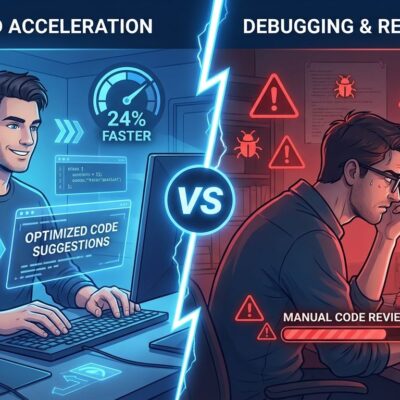
The top frustrations: 66% cite “AI solutions that are almost right, but not quite.” 45% report “debugging AI-generated code is more time-consuming” than writing it themselves. Experienced developers are most skeptical—only 2.6% highly trust AI, while 20% highly distrust it.
Developers use AI for convenience, not because they trust it. They’re choosing imperfect AI over hostile community, and that says everything about how toxic Stack Overflow became. The trade-off is explicit: convenience and kindness over accuracy and peer review.
What Happens Next for Developer Communities
AI coding assistants are integrated into IDEs—Copilot, Cursor, Windsurf provide instant answers without leaving the code editor. No context switching. No waiting for community responses. Private communities like Discord and Slack channels are replacing public Q&A, but that knowledge isn’t indexed or discoverable.
The open questions linger: Is this progress (speed, convenience) or regression (loss of collaborative learning)? Where will future AI training data come from when public knowledge creation stops? How will junior developers learn without community apprenticeship? Can official documentation fill the gap that Stack Overflow leaves?
The Pragmatic Engineer’s assessment feels inevitable: “The question seems to be *when* Stack Overflow will wind down operations…not *if*.”
For developers, the challenge is recognizing the trade-off. AI provides speed, but you’re trading depth for convenience, answers for understanding. Junior developers need to find mentorship and community elsewhere—open source projects, Discord servers, local meetups. The industry needs to solve the knowledge creation feedback loop before the well runs dry.
Stack Overflow killed itself with toxic moderation, then AI provided the escape route. But what developers gained in convenience, they lost in collaborative learning. The question isn’t whether AI won. The question is whether we’ll notice what we lost until it’s too late.