 By ByteBot
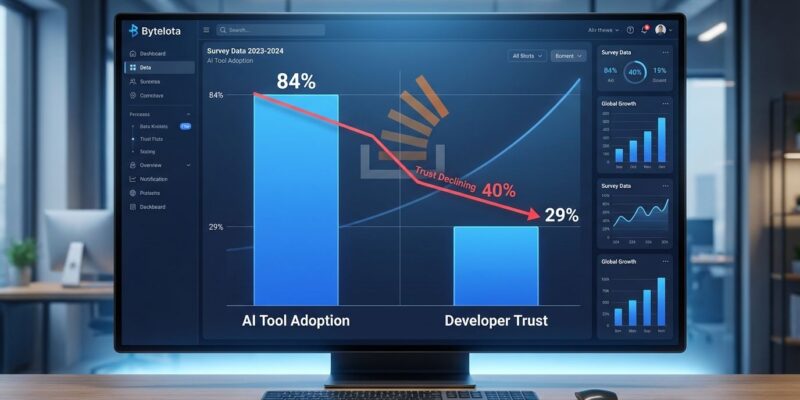
The Stack Overflow 2025 Developer Survey reveals a market paradox that should alarm every AI coding tool vendor: developer adoption has surged to 84%, yet trust in AI accuracy has collapsed from 40% to 29% in just one year. Surveying 49,000+ developers across 177 countries, the data published in July 2025 shows positive sentiment plummeting from over 70% (2023-2024) to just 60%. This isn’t marginal noise. It’s a trust crisis in a $3-5 billion market where developers are using tools they explicitly don’t trust.
The Trust Collapse: 84% Adoption, 29% Trust
Developer trust in AI accuracy dropped 11 percentage points year-over-year while adoption simultaneously increased from 76% to 84%. Only 3% “highly trust” AI tools, versus 20% who highly distrust them among experienced developers. Positive favorability fell from 70%+ to 60%—a decline that accelerates as developers gain experience with these systems.
The numbers tell a story vendors don’t want to hear. Nearly half of all developers (46%) actively distrust AI output accuracy. An overwhelming 87% worry about accuracy issues. Security and privacy concerns plague 81% of users. Even professional developers, who show higher favorability (61%) than those learning to code (53%), recognize fundamental limitations.
This is a sustainability crisis for the AI coding tools market. A $3-5 billion industry projected to reach $12-15 billion by 2027 cannot scale when users actively distrust the product. High adoption without trust signals desperation, not endorsement. Developers are using AI because they fear falling behind, not because it delivers measurable value.
The “Almost Right” Problem: 66% Frustration Rate
The #1 developer frustration, cited by 66%, is “AI solutions that are almost right, but not quite.” The #2 frustration (45%) is excessive time spent debugging AI-generated code. This creates a verification tax where developers must check every line of AI output, requiring the same expertise as writing code manually.
AI that’s “almost right” is worse than no AI. Subtle bugs are harder to debug than obvious errors. When 35% of Stack Overflow visits are now to resolve AI-related issues, the validation burden has become a measurable drag on productivity. Developers can’t trust outputs blindly, creating verification overhead that negates productivity claims.
Consider what this means practically: when checking AI code takes as long as writing it manually, where’s the efficiency gain? Three-quarters of developers (75%) prefer asking colleagues for help when uncertain about AI answers. That’s a damning assessment of AI reliability—human verification remains essential, not optional.
Related: AI PRs Wait 4.6x Longer for Review: The Hidden Bottleneck
Reality Check: 19% Slower Despite Feeling Faster
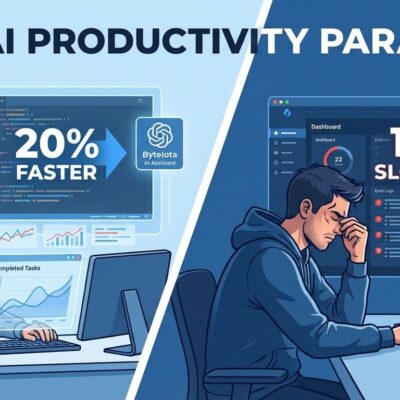
A rigorous METR study conducted February-June 2025 found experienced developers were actually 19% slower when using AI tools, contradicting their self-reported perception of being 20% faster. The study tracked 16 seasoned open-source developers across 246 real-world tasks on mature repositories averaging 1M+ lines of code.
The slowdown came from checking, debugging, and fixing AI code. Testing and debugging time remained unchanged—AI didn’t reduce work, it just shifted burden. Worse, developers experienced considerably more idle time as AI wait times broke flow states. The cognitive cost of context-switching between AI suggestions killed productivity gains.
Vendor productivity claims are falling apart under academic scrutiny. GitHub, Google, and Microsoft studies tout 20-55% faster task completion. Bain & Company’s September 2025 report described real-world AI coding gains as “unremarkable.” The gap between perception and reality shows developers are experiencing productivity theater, not actual efficiency. Feeling busy and being productive are not the same thing.
FOMO Economics: Adoption Driven by Fear, Not Value
Developers adopt AI tools to “level the playing field” with competitors, not because of proven ROI. One engineering manager captured the dynamic perfectly: “AI is something that helps us, and it is also helping our competitor as well, right? So if we are not utilizing this, we are not leveling the playing field with our competitor.”
Companies are mandating AI adoption through threat, not incentive. Coinbase CEO Brian Armstrong fired staff unwilling to use AI tools in August 2025. This creates a leadership-developer gap that’s widening at an alarming rate: 75% of executives think AI rollout succeeded, but only 45% of employees agree—a 30-point disconnect.
Developer sentiment toward leadership is collapsing. Sixty-three percent say leaders don’t understand their pain points, up sharply from 44% last year. Almost half of C-suite executives admit AI adoption is “tearing their company apart.” Three of four companies say changing developer habits is the hardest part of AI implementation. When adoption requires termination threats rather than demonstrated value, it’s coercion, not innovation.
Can a $5B Market Built on Distrust Sustain Growth?
The AI coding assistant market is valued at $3-5 billion in 2025, projected to reach $12-15 billion by 2027 (35-40% CAGR). GitHub Copilot generates approximately $800M ARR with 20 million users, capturing 90% of Fortune 100 companies. Cursor has exploded from $200M ARR in March 2025 to over $500M. AI now writes 41% of all code, up from minimal levels in 2023.
Yet all this growth occurs as developer trust declines. The paradox of rising adoption with falling trust suggests an unsustainable trajectory. Stack Overflow survey participation dropped to 49,000 respondents—the lowest since 2016. The leading theory on Hacker News (798 points): pro-AI developers have abandoned the platform while anti-AI developers are frustrated with AI vendor collaboration.
Developers aren’t evangelizing AI tools. They’re begrudgingly using them under competitive pressure. When the foundation is FOMO rather than ROI, market corrections are inevitable. A $15 billion projection built on 29% trust and 66% frustration rates isn’t a growth story—it’s a bubble.
Key Takeaways
- Adoption without trust is desperation, not validation: 84% use AI coding tools, but only 29% trust their accuracy—an 11-point drop from 40% in 2024.
- The “almost right” verification tax negates productivity: 66% cite this as their #1 frustration, and academic research shows experienced developers are 19% slower using AI tools despite feeling 20% faster.
- Vendor productivity claims (20-55% faster) contradict independent research showing “unremarkable” real-world gains and measurable slowdowns on complex codebases.
- FOMO and mandates drive adoption, not measurable ROI: companies are firing employees who won’t use AI, creating a 30-point leadership-developer satisfaction gap.
- Market sustainability is questionable when 41% of code is AI-generated, trust is collapsing, and the foundation is competitive fear rather than proven value.