
 By
By SpaceX Bails Out xAI in $1.25T Merger, Promises AI Data Centers in Space
SpaceX acquired xAI in a $1.25 trillion merger announced February 2, creating the most valuable private company on Earth with plans to launch the most ambitious computing infrastructure off it. Elon Musk’s memo claims space-based AI data centers are the only way to meet global electricity demand for AI “without imposing hardship on communities.” Translation: His AI startup was burning $1 billion monthly while his rocket company profits $8 billion annually. The merger solves xAI’s cash crisis and positions SpaceX for the largest IPO in history.
This isn’t just a merger. It’s a financial rescue disguised as breakthrough innovation. Bloomberg reports xAI burned $1 billion per month with no clear path to profitability, while SpaceX generated $8 billion in profit on $15-16 billion revenue in 2025. The deal announced yesterday combines SpaceX’s $800 billion valuation with xAI’s $200+ billion valuation ahead of a potential IPO later this year that would dwarf any in history. Musk framed this as building “the most ambitious, vertically-integrated innovation engine on (and off) Earth,” but the timing tells the real story: xAI was running out of runway.
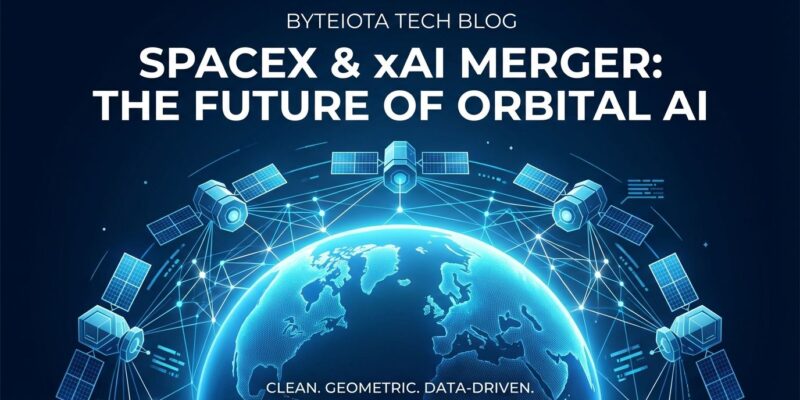
The stated vision is genuinely ambitious. Three days before the merger announcement, SpaceX filed plans with the FCC for up to one million satellites designed to operate as orbital data centers. These satellites would run AI training and inference workloads powered by solar panels, avoiding terrestrial electricity grids entirely. Musk estimates “within 2 to 3 years, the lowest cost way to generate AI compute will be in space.” The pitch: AI’s energy crisis can’t be solved on Earth, so we’ll solve it 340 miles up in low Earth orbit.
The physics, however, tell a different story. Google published research confirming space-based AI compute isn’t “precluded by fundamental physics,” but economic viability requires launch costs below $200 per kilogram—a target experts project for the mid-2030s, not 2027. Current economics show orbital data centers cost 2.7 to 4.4 times more than terrestrial equivalents. Then there’s latency: orbital-to-ground communication adds 20-50 milliseconds versus 1-10ms for terrestrial data centers. An expert quoted by Live Science put it bluntly: “Putting the servers in orbit is a stupid idea, unless your customers are also in orbit.” Cooling presents another challenge—in space there’s no air, so heat must radiate via massive radiators. The ISS produces 215 kilowatts; modern AI data centers consume hundreds of megawatts.
Beyond technical feasibility, the merger raises monopoly concerns that regulators can’t ignore. Musk now controls space launch capability (SpaceX), global satellite internet (Starlink), AI development (xAI), social media (X/Twitter), and electric vehicles (Tesla). Industry analysts describe SpaceX as evolving from a launch provider into a “sovereign compute monopoly.” The FTC and SEC are expected to scrutinize self-dealing aspects—Tesla already invested $2 billion in xAI, and a lawsuit alleges Musk used Tesla’s balance sheet to prop up his private companies. The Committee on Foreign Investment will likely investigate whether integrating Grok AI into classified launch systems poses national security risks. xAI already faces regulatory probes internationally after its Grok AI enabled generation of illegal imagery.
For developers, xAI offers compelling tools today: Grok 4 with a 2 million token context window, Grok code fast 1 (a 314 billion-parameter model specialized for coding), and a free Agent Tools API that competes with OpenAI’s Codex (which coincidentally also launched February 2), GitHub Copilot, and Anthropic’s Claude. The free API is attractive, but consolidation this extreme raises long-term questions. If xAI becomes the only AI provider with dedicated orbital infrastructure, pricing power shifts dramatically. Competition keeps tools accessible; monopolies don’t.
What happens next depends on three factors. First, the IPO—will investors pay $1.25 trillion for Musk’s orbital vision or demand evidence of near-term profitability? Second, regulatory approvals from the FTC, SEC, and CFIUS, any of which could block or restructure the deal. Third, technical reality—SpaceX will likely launch prototype orbital compute satellites in 2026-2027, but economic viability won’t arrive until the 2030s when Starship reduces launch costs. Musk’s execution track record is strong (Starlink proves he can deploy massive constellations), but his timelines are famously optimistic. Bet on the vision, not the schedule.
The merger is real, the technology is real, and the financial bailout is real. Space-based AI infrastructure will eventually exist, just not on Musk’s timeline. The question isn’t whether orbital data centers are possible—it’s whether one person should control the rockets, the satellites, the AI, and the data simultaneously. That’s a question for regulators, not engineers.


