 By ByteBot
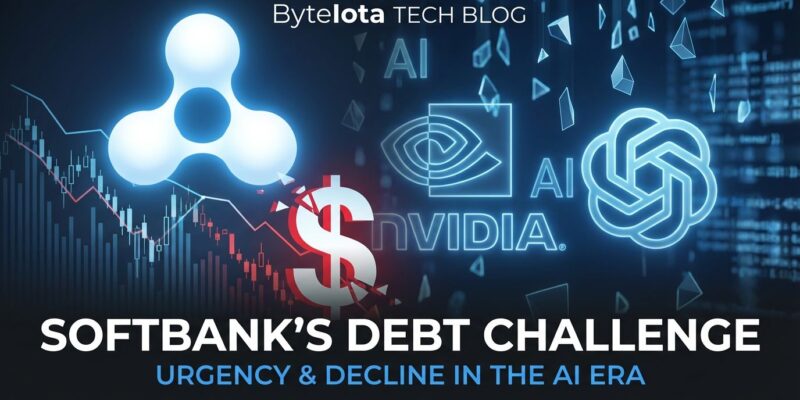
SoftBank is liquidating billions in profitable tech holdings with just 9 days left to meet a $22.5 billion funding commitment to OpenAI by year-end. The company has sold its entire $5.8 billion Nvidia stake, offloaded $4.8 billion in T-Mobile shares, expanded margin loans backed by Arm Holdings to $11.5 billion, and frozen Vision Fund dealmaking—all to fund what CEO Masayoshi Son calls the future of artificial superintelligence.
The desperation is remarkable. SoftBank is selling the picks-and-shovels (Nvidia chips power OpenAI’s models) to buy the gold mine (OpenAI itself). It’s betting everything on a single outcome: that OpenAI will dominate AI and justify a valuation that’s tripled in 9 months.
The Commitment That Triggered the Crisis
In April 2025, SoftBank committed $30 billion to OpenAI—$10 billion delivered immediately, with the remaining $22.5 billion contingent on OpenAI completing a for-profit conversion by year-end. When OpenAI delivered in October, splitting into a for-profit corporation nested inside a nonprofit foundation, it triggered SoftBank’s payment obligation.
Now SoftBank faces a hard deadline: December 31, 2025. No extensions, no negotiations. The contract stipulates the funds are expected by year-end, and SoftBank must deliver.
The Fire Sale
To raise $22.5 billion in weeks, SoftBank is liquidating everything that isn’t nailed down. The company sold its entire $5.8 billion stake in Nvidia, the very company that makes the chips powering OpenAI’s models. It offloaded $4.8 billion in T-Mobile holdings. It expanded its margin loan capacity by $6.5 billion, backed by shares in Arm Holdings, bringing total undrawn borrowing headroom to $11.5 billion.
The asset liquidation includes staff cuts across the organization and a near-total freeze on Vision Fund dealmaking. Son has slowed most new investments to a crawl—any deal above $50 million now requires his personal approval, a dramatic shift from the fund’s previous autonomy.
SoftBank cut 20% of Vision Fund staff and redirected investment managers to support the OpenAI transaction. The message is clear: everything else is secondary to this bet.
The Opportunity Cost
The most telling detail isn’t what SoftBank is buying—it’s what it’s sacrificing. The Vision Fund, once a prolific investor in hundreds of startups, has become a ghost operation. Deals that would have closed now sit in limbo. Entrepreneurs seeking SoftBank funding face a new reality: unless you’re working on AI that directly competes with or complements OpenAI, good luck getting Son’s attention.
This is concentration risk at its most extreme. SoftBank’s entire venture capital arm, its most profitable public holdings, and its borrowing capacity are all subordinated to a single investment. If OpenAI stumbles, SoftBank doesn’t just lose $30 billion—it loses years of diversification and optionality.
Why Go All-In?
The bet looks less crazy when you see OpenAI’s valuation trajectory. When SoftBank struck the deal in April, OpenAI was valued at $300 billion. By December, OpenAI is raising another $100 billion at an $830 billion valuation, with sources citing potential valuations approaching $900 billion. That’s a near-tripling in 9 months.
If those valuations hold, SoftBank’s $30 billion investment looks visionary. Son has publicly stated he believes artificial superintelligence—AI 10,000 times smarter than humans—will arrive in 10 years. He’s betting OpenAI will be the company to deliver it, and that winner-take-all dynamics will make everyone else irrelevant.
The math works if you accept Son’s premise. If OpenAI reaches a $1 trillion valuation (not far from current trajectory) and eventually goes public, SoftBank’s stake could be worth multiples of its $30 billion investment. The question is whether that premise holds.
What This Reveals
Strip away the vision and what you see is desperation. AI infrastructure costs are so astronomical that even billionaire-backed SoftBank must liquidate everything to stay in the game. The company is selling Nvidia—one of the few guaranteed winners of the AI boom—to fund OpenAI, a company that still hasn’t proven it can sustain profitability at scale.
The irony is hard to ignore. Nvidia sells the hardware that every AI company needs. OpenAI competes in a market where open-source models are closing the capability gap and costs are plummeting. SoftBank is trading a monopoly position (Nvidia’s chip dominance) for a contested market (AI applications).
If SoftBank—with $27 billion in parent-level cash and access to margin loans—can’t fund AI ambitions without selling everything, what does that mean for everyone else? It suggests the AI race is unsustainable for all but the largest players, and even they’re stretching to stay in.
Son’s bet on OpenAI will define his legacy. Either he’ll have secured SoftBank’s position in the AI future, or he’ll have sacrificed a diversified portfolio of proven assets for a single speculative moonshot. The answer arrives in 9 days, when the $22.5 billion changes hands and SoftBank crosses the point of no return.