 By
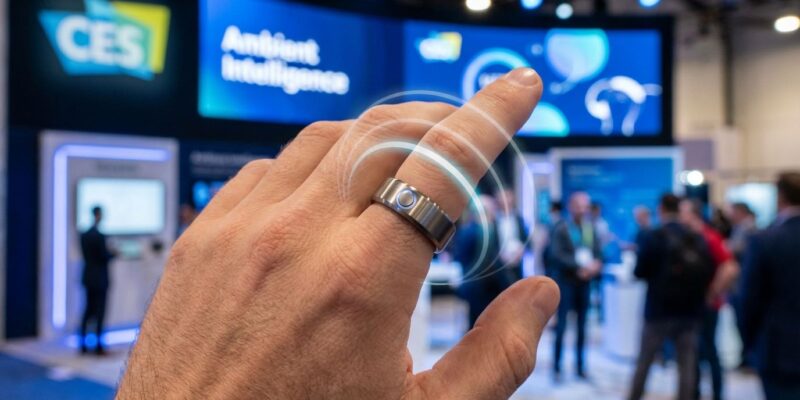
By CES 2026 (January 7-9, Las Vegas) marked a platform shift: Three smart ring manufacturers—Vocci, Aivela, and Pebble—launched productivity-focused AI rings, abandoning health tracking entirely. These aren’t $349 Oura competitors charging $6 monthly subscriptions. They’re AI productivity tools priced at $149-$299 with zero recurring fees. Vocci offers 8-hour voice recording with AI transcription in 112 languages. Aivela packs 14 gesture controls (8 touch commands, 6 air gestures) via optical finger navigation sensors. Pebble Index 01 delivers voice reminders for under $100. The market is responding: IDC forecasts 49% smart ring shipment growth for 2026, outpacing smartwatches (6% growth) by 8x.
Productivity Replaces Health Tracking
The simultaneous pivot tells you everything. Vocci (Gyges Labs) debuted a titanium ring that records meetings with a double-click, marks key moments with a single-click, and generates AI-powered transcripts with speaker identification. Ten-minute charging delivers six hours of recording. Aivela Ring Pro uses an OFN (Optical Finger Navigation) sensor to detect sub-millimeter gestures—control presentations by swiping, trigger smart home scenes with a finger heart, navigate apps hands-free. Seven-day battery life, IP68 water resistance, and a $149 early bird price (no subscription) prove the economics work without monthly fees.
Pebble Index 01 strips it down further: voice-triggered reminders and task capture, microphone-only design, sub-$100 price point. No heart rate monitoring. No sleep stages. No HRV tracking. The message is clear—health tracking was a dead end. Oura’s $349 hardware plus $6 monthly subscription limited the market to athletes and biohackers. Productivity use cases (meeting notes, presentation control, voice capture) appeal to every knowledge worker. That’s a 10x larger addressable market.
The Market Math Proves the Shift
IDC’s 49% smart ring growth forecast (4.3 million units in 2025 to 6.4 million+ in 2026) crushes smartwatches’ 6% growth despite rings entering the market years later. Bloomberg confirms Oura leads current volume, but productivity rings are capturing differentiation momentum. Market size projections tell the same story: $378 million in 2026 growing to $3.1 billion by 2035 at a 26% CAGR.
The numbers reveal consumer preference shifts. 58% of wearable users prefer discreet alternatives to wrist-based devices, and 47% prioritize sleep and recovery tracking—both areas where rings excel due to overnight compliance. Smartwatches shipped 163 million units in 2025 versus rings’ 4.3 million, but rings are growing 8x faster. Developers follow momentum. When smartwatches hit 40%+ annual growth in 2014-2015, app ecosystems exploded. Smart rings in 2026 mirror smartwatches in 2014: greenfield opportunity before Apple and Samsung dominate.
Form Factor Wins Ambient Intelligence
Rings achieve 85-95% wear compliance (24/7 including sleep) versus smartwatches’ 60-75% (removed for charging, sleep, activities). This matters for AI agents needing always-on access. Industry analysis nails it: “Rings solve a problem wearables created—compliance. People take watches off, forget bands, but rings stay on once fitted.” For ambient intelligence applications (voice assistants, gesture control, passive monitoring), rings beat watches on every metric.
Battery life advantages compound the benefits. Rings deliver 5-7 days without screens draining power, while watches require daily or two-day charging. Cognitive load drops to zero—no notifications, no apps, no screen glances interrupting focus. Social acceptance matters too: rings are invisible in professional settings where smartwatches signal tech affinity or wealth. For voice recording, rings position naturally near the mouth without the awkward wrist-raising smartwatches require.
Developers building AI agents face a form factor decision that determines user retention. AI assistants on watches lose eight hours of interaction when users remove devices during sleep. Ring-based AI assistants maintain 24/7 availability. Voice recording on watches demands raised wrists. Rings capture voice naturally. Gesture control on watches competes with saturated touchscreen and Digital Crown interfaces. Gesture control on rings opens greenfield territory with OFN sensors and air gesture APIs.
Developer Ecosystem Emerges Amid Privacy Concerns
The smart ring SDK market projects 22.3% CAGR growth from 2024 to 2030. Platforms are launching: Taika Ring SDK (React Native, open-source gesture library with tap, swipe, and hold events), J-STYLE SDK (cross-platform support for Android, iOS, Windows, macOS), and raw sensor APIs exposing 50-100Hz PPG sampling plus accelerometer streams. Early movers who build gesture libraries, voice recording frameworks, and privacy-compliant architectures today will define industry standards before ecosystems mature.
However, privacy challenges loom large. Always-on voice recording raises consent questions that current products haven’t resolved. ResearchGate security research found critical vulnerabilities including cleartext data transmission, unauthenticated firmware updates, and privacy violations from lack of user consent. Legal complexity varies by jurisdiction: California requires two-party consent for recordings, Texas allows one-party consent, and EU GDPR mandates explicit consent plus deletion rights.
Privacy isn’t optional—it’s table stakes. Developers must implement end-to-end encryption, manual trigger controls (not always-recording), visual recording indicators, and GDPR compliance from day one. Rings that ignore privacy will face regulatory backlash similar to Ring doorbell’s FTC settlement. The opportunity exists for developers who solve privacy correctly while competitors fumble basic consent flows.
What Developers Should Know
CES 2026 validates what market data suggested: health tracking (Oura/Whoop model) proved too niche. The $300+ price points plus subscriptions limited total addressable market. Productivity use cases unlock mass adoption by targeting knowledge workers instead of athletes. Three pricing tiers are emerging: budget ($100—Pebble Index 01), mid-range ($149-$200—Vocci, Aivela early bird pricing), and premium ($300+—Oura Gen 4, potential Apple Ring).
Apple’s rumored mid-2026 entry with gesture-based HomeKit control would legitimize the category like Apple Watch did for smartwatches in 2015. Supply chain preparations and patent maturation point to a summer launch. If Apple enters in 2026, the window for independent developers and startups to establish market position narrows rapidly. History repeats: pre-Apple Watch (2014), Pebble and Fitbit had room to innovate. Post-Apple Watch (2015+), ecosystems consolidated around Apple, Samsung, and Google.
The opportunity for developers exists now, in 2026, before giants set de facto standards. Ship gesture libraries, voice SDKs, and privacy frameworks while SDK ecosystems remain immature and development patterns are still being established. The market momentum (49% CAGR) signals platform viability. The form factor advantages (compliance, battery, cognitive load) prove ambient intelligence fit. The privacy challenges create differentiation opportunities for developers who solve consent, encryption, and data rights correctly.
Key Takeaways
- Smart rings pivot from health tracking to productivity (voice recording, gesture control, AI notes) unlocks 10x larger market targeting knowledge workers instead of athletes
- 49% ring shipment growth (IDC) versus 6% smartwatch growth proves platform momentum—developers follow this math
- Form factor advantages (85-95% wear compliance, 5-7 day battery, zero cognitive load) make rings superior ambient intelligence interfaces versus attention-demanding watches
- Emerging SDK ecosystem (Taika, J-STYLE, raw sensor APIs) creates early-mover opportunity before Apple enters and consolidates market
- Privacy compliance non-negotiable—implement E2E encryption, manual triggers, visual indicators, and GDPR consent flows from day one or face regulatory backlash