 By ByteBot
Serverless computing just solved its decade-long problem. In January 2026, AWS Lambda, Azure Functions, and the Serverless Framework shipped built-in state management—features that let developers write sequential code while the platform automatically handles persistence, retries, and recovery. The workaround era is over: no more cobbling together DynamoDB tables and Redis caches just to remember where a workflow left off.
What Changed in January 2026
AWS Lambda Durable Functions, launched in December 2025, introduces two primitives that eliminate external state stores. The context.step() method adds automatic retries and checkpointing to business logic. The context.wait() method pauses execution for up to one year without incurring compute charges during the wait. Developers write sequential code; the platform tracks progress through checkpoint and replay mechanisms.
Azure Durable Functions rolled out a new durable-task-scheduler backend in late 2025, delivering the highest throughput for orchestrations. The Serverless Framework V.4, released in January 2026, added Terraform and Vault integrations that auto-detect cloud resources and fetch logs, state, and config from AWS. All three vendors converged on the same solution: make state management invisible to developers.
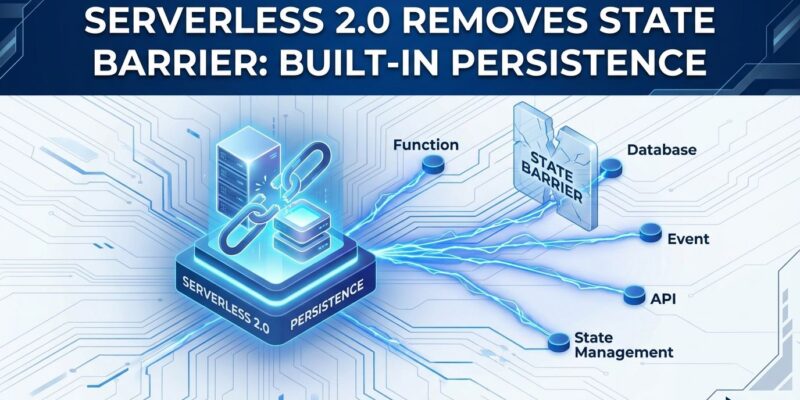
This shift addresses serverless computing’s #1 adoption barrier. Statelessness forced developers to architect around the limitation—external DynamoDB tables, Redis clusters, and AWS Step Functions for every multi-step workflow. Serverless 2.0 bakes state persistence into the runtime, turning complex orchestration into straightforward function calls.
Real-World Impact: Payment Processing and AI Workflows
Consider payment processing. The Serverless 1.0 approach required reserving inventory via DynamoDB, triggering Step Functions to orchestrate payment provider calls, updating state in DynamoDB again, and finally marking orders fulfilled. Each step involved network hops, external state management, and manual retry logic.
Serverless 2.0 collapses this into a single Lambda durable function. Reserve inventory as Step 1 with automatic checkpointing. Suspend execution during payment processing—no charges while waiting for external confirmation. Resume with Step 2 to confirm payment, with automatic retries on failure. Step 3 marks the order fulfilled. If anything fails, compensation logic runs automatically to release inventory. The entire saga pattern, built-in.
Long-running AI workflows benefit similarly. Agentic AI orchestration that awaits human decisions can suspend for up to one year. Multi-step data pipelines no longer require timeout hacks or external orchestration complexity. Session management drops the Redis requirement—built-in persistence handles state without connection pool exhaustion.
Cold Starts Solved, Then Monetized
Serverless 2.0 platforms use execution snapshots, memory reuse, and fast resume mechanisms to start functions in milliseconds. Cold starts dropped 80% through 2025 optimizations like SnapStart and warm pools. VPC overhead fell from 10+ seconds to under 100 milliseconds. Functions consistently start in under 50ms.
Then AWS changed the rules. In August 2025, AWS started billing for the Lambda INIT phase, turning cold starts from a latency problem into a budget problem. Costs jumped from $0.80 per million invocations to $17.80—a 22x increase. The technical solution works, but AWS monetized it aggressively. Mitigation options exist—SnapStart, warm pools, provisioned concurrency—but they all cost money. Pay for performance or accept cold start costs. There’s no free lunch.
Cost Reality: When Serverless 2.0 Wins and Loses
Serverless 2.0 simplifies architecture by eliminating always-on state infrastructure. No DynamoDB tables or Redis clusters for every project. Pause during waits means zero compute charges. Intermittent workloads with complex orchestration see the biggest savings.
High steady traffic still favors instance-based pricing. At one million requests per month, Upstash serverless Redis costs $2.25, while ElastiCache (instance-based) costs $24. Serverless loses its cost advantage when traffic is consistent and predictable. The sweet spot: variable load with multi-step workflows. Know your traffic pattern before migrating.
Vendor Landscape: Who’s Leading, Who’s Silent
AWS Lambda Durable Functions launched in December 2025 with Node.js and Python support. Currently available only in us-east-2 (Ohio), global rollout is scheduled for Q2 2026. Azure Durable Functions offers multiple storage backends—Netherite, MSSQL, durable-task-scheduler—with mature workflow patterns including chaining, fan-out/fan-in, and human interaction. Serverless Framework V.4 provides multi-cloud abstraction with better developer experience than raw CloudFormation.
Google Cloud Functions made no major state management announcements in January 2026. If your cloud provider hasn’t announced built-in state support by Q2 2026, that’s a red flag about their serverless strategy. The market is moving fast—$11.14 billion in 2025 to a projected $34.84 billion by 2031, a 20.93% CAGR. AWS Lambda use is growing over 100% year-over-year. Finance, healthcare, and media companies are running entire pipelines on serverless now that the state barrier is gone.
The ByteIota Take
Serverless 2.0 removes the last major blocker for enterprise adoption. State management was the excuse—now it’s gone. Teams that don’t evaluate serverless for new projects in 2026 are leaving money and agility on the table. Payment processing, AI workflows, and approval systems all become architecturally simpler with built-in state management.
But watch the fine print. AWS INIT billing is a betrayal that turned a solved technical problem into a recurring cost. Cold starts went from a performance issue you could optimize away to a line item on your invoice. Google’s silence on state management is equally telling. The vendors moving fastest—AWS, Azure, Serverless Framework—are setting the pace. Everyone else is playing catch-up.
Evaluate serverless 2.0 for intermittent workloads with complex orchestration. Use hybrid approaches—serverless for event-driven logic, containers for stateful analytics. And if your provider hasn’t shipped state management by mid-2026, start asking hard questions about their roadmap.