
 By ByteBot
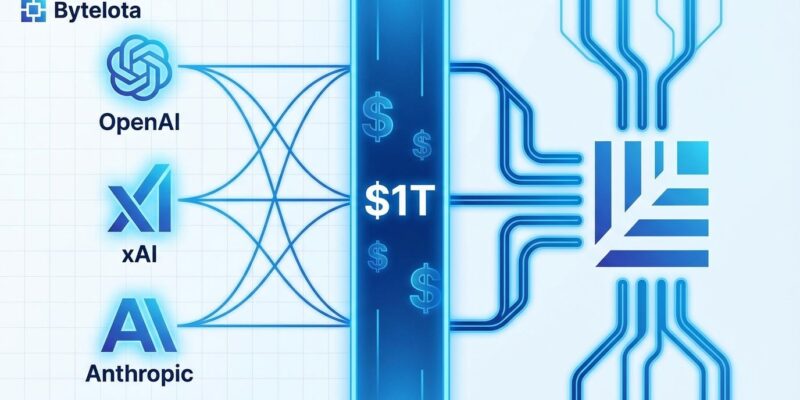
Sequoia Capital announced yesterday it’s joining Anthropic’s $25 billion funding round at a $350 billion valuation—despite already backing both OpenAI and Elon Musk’s xAI. The move breaks a longstanding Silicon Valley taboo: venture firms historically refuse to invest in directly competing companies. Sequoia’s bet-on-everyone strategy signals either brilliant hedging or a troubling lack of conviction in the AI market, where combined valuations for the three rivals now exceed $1 trillion.
From Finix Walkaway to Backing Three AI Rivals
Sequoia’s ethics flip is dramatic. In 2020, the firm walked away from a $21 million investment in payments company Finix to avoid competing with Stripe, forfeiting the entire investment including board seat, information rights, and shares. Fast forward to 2026: Sequoia now backs three companies locked in direct competition for the enterprise large language model market—OpenAI (ChatGPT, $500B valuation), xAI (Grok, $230B+ valuation), and Anthropic (Claude, $350B valuation).
Sam Altman himself stated that investors with access to OpenAI’s confidential information would lose access “if they made non-passive investments in OpenAI’s competitors.” Yet Sequoia is doing exactly that. The contradiction isn’t subtle: Sequoia once sacrificed $21 million to protect portfolio company trust, now risks information barriers across $1 trillion in competing investments. The AI arms race has fundamentally rewritten VC ethics.
Anthropic’s $350B Valuation: More Than Hype
Anthropic isn’t just riding funding momentum—it’s executing. The company’s valuation doubled from $170 billion to $350 billion in four months (September 2025 to January 2026). Revenue growth is even sharper: from $5B annualized run rate in August 2025 to $9B by December, targeting $26B for 2026. That’s more than double OpenAI’s projected 2025 earnings.
Here’s where Anthropic proves its worth: 32% enterprise LLM market share, overtaking ChatGPT’s 25%. Claude isn’t winning in consumer brand recognition—ChatGPT still dominates with 800 million weekly users—but Anthropic captured paying customers where revenue actually lives. The 300,000+ business and enterprise customers represent sustainable revenue, not just VC speculation. A potential IPO as early as late 2026 would provide public market validation.
Related: DeepSeek R1: Open Source AI Matches OpenAI o1 at 27x Lower Cost
When $1 Trillion Isn’t Enough
AI companies raised $47 billion in just the first two weeks of January 2026. The funding war’s scale is unprecedented: OpenAI ($500B), Anthropic ($350B), and xAI ($230B+) combine for $1.08 trillion in private market value. Anthropic’s current round includes GIC and Coatue at $1.5B each, plus Microsoft and Nvidia committing up to $15B combined.
This is unsustainable. Three companies with trillion-dollar combined valuations, all building enterprise LLM platforms, cannot all justify their pricing. Consolidation is inevitable—through acquisitions, IPOs, or failures. Sequoia’s bet-on-everyone strategy guarantees the firm wins regardless of which platform survives. Developers don’t have that luxury.
Sequoia’s justification is equally shaky. Anonymous sources told the Financial Times that “OpenAI and Anthropic will head in different directions, catering to different aspects of the AI market.” The “different markets” argument has a shelf life of 12 months before feature convergence erases differentiation. ChatGPT already launched enterprise features, Claude targets consumers with free tiers, and xAI is building enterprise APIs. Product roadmaps show convergence, not divergence.
What This Means for Developers
Sequoia’s bet-on-everyone strategy makes developer platform selection harder, not easier. All three platforms have massive funding, eliminating the “pick the best-funded” heuristic. Developers must now evaluate on nuances: ChatGPT dominates consumer (800M weekly users, strongest brand), Claude leads enterprise (32% market share, coding excellence), and Grok competes on price (subsidized by Musk, real-time Twitter/X data).
The smart move: build platform-agnostic architectures. Use abstraction frameworks like LangChain or LiteLLM that enable easy switching between providers. Don’t lock yourself into API-specific implementations when consolidation is coming. When VCs backing all three platforms can’t predict the winner, developers betting their company’s future on Sequoia’s judgment are gambling with borrowed confidence.
Developers multi-platforming reflects the reality: “I have ChatGPT, Gemini, Claude, and Grok accounts, and I’ll rotate between them depending on what I need.” No single platform dominates across all use cases. The real winner from Sequoia’s hedging strategy isn’t OpenAI, Anthropic, or xAI—it’s the multi-LLM integration tools that benefit from developer lock-in anxiety.
Key Takeaways
- Sequoia broke VC taboos: Walking away from $21M (Finix) to protect Stripe, now backing three $1T+ competing AI platforms—ethics shift reflects unprecedented AI market scale
- Anthropic’s execution matters: $350B valuation justified by 105% growth in 4 months, 32% enterprise market share (vs ChatGPT’s 25%), and $26B revenue target for 2026
- Consolidation is inevitable: $1.08T combined valuations are unsustainable—expect M&A, IPOs, or failures within 12-24 months
- Build platform-agnostic: When top VCs can’t predict the AI winner, developers must avoid deep lock-in—use LangChain, LiteLLM, or similar frameworks
- “Different markets” won’t last: Product roadmaps show feature convergence across OpenAI, Anthropic, and xAI—platforms will compete directly within 12 months


