 By
By Switzerland’s financial system is settling 220 billion Swiss francs daily on infrastructure almost nobody outside Switzerland knows exists. Since November 2021, Swiss banks have been running production traffic on SCION—a secure alternative to BGP developed at ETH Zürich that provides cryptographic path validation and sub-millisecond failover. While the tech industry spent the last four years debating BGP’s security problems, Switzerland went ahead and solved them. The twist: the rest of the world isn’t following.
The BGP Problem Switzerland Actually Fixed
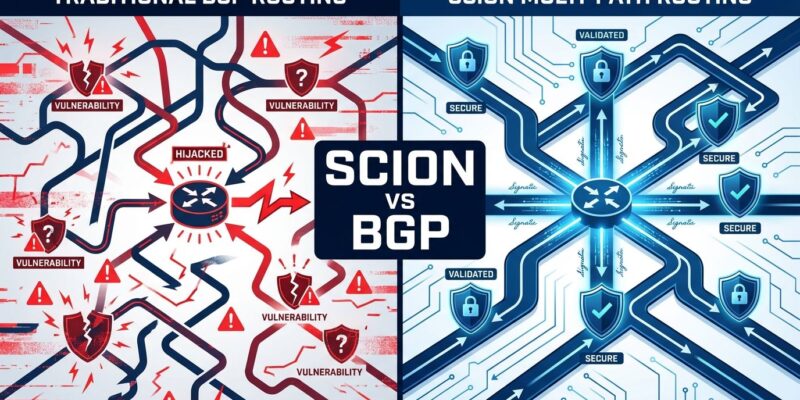
BGP has a fundamental flaw that’s persisted for 40 years: there’s no way to verify that a network claiming to own IP addresses actually does. Up to 72% of domains remain vulnerable to basic route hijacks. RPKI, the most deployed patch, only covers 6.5% of ASes effectively—protecting just 261 million users from route leaks. BGPsec, the more comprehensive fix, is 70 times slower than regular BGP and requires an unbroken path of capable routers. Real-world deployment remains “limited for the foreseeable future.”
SCION doesn’t patch BGP—it replaces it architecturally. Three core mechanisms handle what BGP can’t: multi-path routing establishes hundreds of parallel paths simultaneously instead of failover routes, isolation domains create regional trust roots that prevent cascading failures, and cryptographic path validation signs every hop with symmetric crypto (AES validation in 10 nanoseconds per packet). Every packet follows cryptographically verified paths. Rerouting through unauthorized networks gets rejected at the protocol level, not detected after the fact. The SCION architecture documentation explains how path-based forwarding differs fundamentally from BGP’s route-based approach.
Real Money on Real Infrastructure
The Secure Swiss Finance Network (SSFN), operated by SIX Group, handles Switzerland’s Interbank Clearing System—220 billion Swiss francs daily across 120 financial institutions. This replaced a 20-year-old MPLS network that Swiss banks trusted implicitly. SIX Group’s testing showed carrier failover below one millisecond. BGP typically takes 3-4 minutes for detection, failover, and reconnection.
SCION isn’t confined to finance. Health Info Net runs a secure network for 30,000+ Swiss doctors. AXPO Systems operates the first SCION-powered Security Operations Center. Swisscom, Sunrise, and VTX offer SCION as a premium service. In Benelux, customers are switching ISPs specifically to get SCION access through Odido, Proximus, and Varity. As The Register reported in March 2026, this is production infrastructure that’s been running reliably since 2021—not a pilot project waiting for validation.
The Four Barriers Keeping BGP Broken
Despite four years of proven deployment, SCION remains confined primarily to Switzerland. The barriers aren’t technical—they’re market-driven and systemic.
First, Anapaya Systems is the sole commercial vendor. When approached, Cisco reportedly told stakeholders they’d need “$20 billion business” scale before investing engineering resources. It’s a perfect catch-22: enterprises won’t adopt without multi-vendor support, vendors won’t invest without scale.
Second, standardization remains incomplete. BGP is an IETF RFC standard. SCION has an Independent Stream RFC but hasn’t entered the working group standardization process. Enterprises that require standardized protocols see this as a blocker.
Third, there’s no forcing function. Organizations see BGP’s problems as “known and bearable”—they’ve built workarounds and monitoring systems. Kevin Curran, a cybersecurity professor at Ulster University with 27 years of teaching networks, offered a stark prediction: “If we see nation-states doing attacks which reroute traffic and take down national infrastructure…it will quickly be adopted.” Translation: we need a catastrophic failure before inertia breaks.
Fourth, infrastructure psychology works against fundamental changes. As one observer noted in The Register’s reporting: “Nobody renews a house foundation without being forced to.” Network operators have 40 years of BGP tooling, training, and institutional knowledge. Replacing it requires not just technical migration but organizational transformation.
The Governance Model That Won’t Scale
Switzerland’s success comes partly from factors that can’t easily replicate elsewhere. SIX Group operates its own certificate authority—commercial CAs declined the risk of financial settlement networks. They issue 3-day validity certificates, enabling rapid expulsion of compromised members. Building this governance took six years (2015-2021) before full production launch.
This “trust community” model works in Switzerland’s cohesive financial sector. It struggles in fragmented global markets without shared governance structures. Fritz Steinmann, a SIX Group network engineer with 30 years in finance, noted the dual-use concern: “It could also be misused as a weapon against a free internet.” Path control enables both security from attacks and potential censorship by authorities.
What Developers Should Watch
Switzerland proved secure routing works at massive scale. The technology isn’t theoretical—it’s settling 220 billion Swiss francs daily with sub-millisecond failover. Pilot deployments are expanding to South Korea, Singapore, and the EU. Adrian Perrig, SCION’s principal architect at ETH Zürich’s Network Security Group, predicts the protocol will be embedded in fundamental network libraries within three to five years.
But pilot projects aren’t production commitments. Without additional commercial vendors or an IETF standardization breakthrough, adoption will remain incremental. BGP stays vulnerable—72% of domains exposed to hijacks—because the market hasn’t demanded better and no crisis has forced change.
The bigger question: when technical excellence meets systemic inertia, who wins? Switzerland built the alternative. The rest of the world is watching route hijacks happen while debating whether to follow.