 By ByteBot
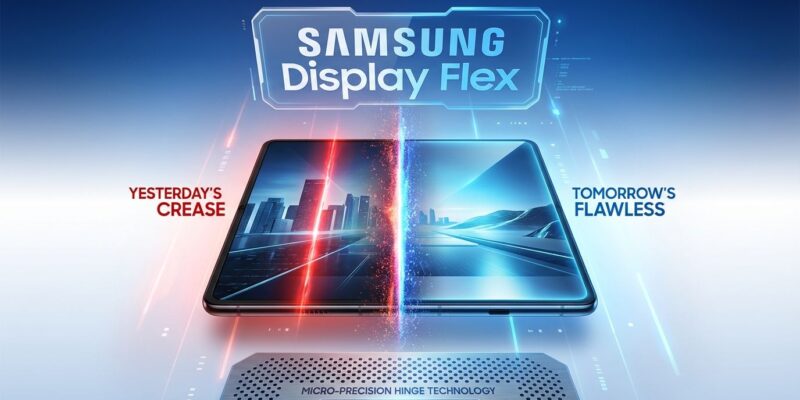
Samsung Display unveiled a completely creaseless folding OLED panel at CES 2026 last week (January 6-7), eliminating the visible crease that has plagued foldable smartphones since their 2019 debut. The breakthrough uses a laser-drilled metal plate that distributes folding stress across micro-perforations rather than concentrating it on a single fold line. In side-by-side comparisons with the Galaxy Z Fold 7, CES attendees confirmed they could neither see nor feel any crease—a “night-and-day” difference that tech outlets declared “won CES 2026.”
Laser-Drilled Metal Plate Distributes Stress
The engineering breakthrough lies in a laser-drilled metal plate manufactured by South Korean supplier Fine M-Tec. The plate sits between the OLED layer and the hinge mechanism, with laser-created micro-perforations that distribute folding stress across multiple points instead of concentrating it on a single line. Consequently, this prevents the permanent deformation that creates visible creases.
Samsung Display branded the technology “Mont Flex” and described it as “mechanically flat.” Multiple CES 2026 attendees ran their fingers across the display and confirmed no visible crease, even off-axis. Furthermore, this contrasts sharply with earlier foldables that used chemically etched microstructures, which only minimized—never eliminated—the crease.
The difference isn’t subtle. TechRadar noted it’s “a night-and-day difference versus the Galaxy Z Fold 7, whose crease is quite visible as soon as you go off-axis.” This isn’t incremental improvement—it’s a fundamental shift from hiding the problem to solving it.
Samsung and Apple Get Same Creaseless Display
Both Samsung’s Galaxy Z Fold 8 (expected H2 2026) and Apple’s iPhone Fold (expected Fall 2026) will use identical creaseless displays from Samsung Display, with the same Fine M-Tec laser-drilled metal plate components. Supply chain analyst Ming-Chi Kuo confirmed this, estimating iPhone Fold pricing at $2,000-$2,500.
Here’s the irony: Samsung Display (the manufacturing division) supplies both Samsung Mobile and Apple. Apple’s rigid September launch cycle could mean the iPhone Fold gets the creaseless display before Samsung’s own Galaxy Z Fold 8, despite Samsung Display being a Samsung subsidiary. Moreover, this mirrors Samsung Display’s longstanding role as an iPhone OLED supplier—helping competitors beat Samsung Mobile products.
Apple’s entry into foldables has been the “when, not if” question for years. This creaseless technology arriving simultaneously for both companies suggests 2026 is when foldables hit mainstream. IDC projects the foldable market will grow 30% YoY in 2026, with Apple capturing 22% unit share and 34% market value in its first year. The creaseless display is what makes that timing possible.
Seven Years of “Good Enough” Just Became Unacceptable
The foldable industry downplayed the crease for seven years, insisting it was “barely noticeable” or “you get used to it.” However, the crease was a psychological barrier: a permanent visual reminder of fragility, a durability concern (does it indicate weakening?), and an aesthetic dealbreaker for professionals who saw it as “cheap-looking.”
User research from PhoneArena found the crease was a major purchase barrier. Foldables currently represent just 1.6% of the total smartphone market despite being available since 2019. The crease wasn’t just cosmetic—it was psychological.
Now that complete elimination is possible, “good enough” looks outdated. Therefore, this is the “you can’t unsee it” moment for the industry. For seven years, we accepted the crease as an unavoidable trade-off. Samsung just proved that was false. Developers and tech professionals who held out for “true” foldables without compromises now have their device.
2026: When Foldables Go Mainstream
The foldable market is forecast to grow 30-50% YoY in 2026 (IDC: 30%, Omdia: 50%), up from just 6% in the prior forecast. This acceleration is driven by two catalysts: Apple’s entry and the creaseless breakthrough. In fact, Samsung expects to sell 40 million Galaxy Z Flip7 units, and foldables are projected to represent 15% of the premium smartphone segment in 2026.
Current foldables cost $1,800+, yet still ship with visible creases and durability concerns. The creaseless technology removes one barrier (aesthetics) while Apple’s entry removes another (ecosystem trust). Europe saw 37% YoY foldable growth in 2024, but still accounts for only ~2% of total smartphone sales. Nevertheless, 2026 is the year that shifts.
For mobile app developers and UX designers, this means foldables are no longer niche. Optimizing for foldable form factors—split-screen multitasking, adaptive layouts, fold-aware UI—becomes a mainstream concern, not an early-adopter experiment. Additionally, the addressable market is about to get much larger.
Key Takeaways
- Samsung Display’s creaseless OLED eliminates, not minimizes, the fold line using laser-drilled metal plate technology from Fine M-Tec
- Galaxy Z Fold 8 (H2 2026) and iPhone Fold (Fall 2026) both get the same creaseless display—Apple might launch first despite Samsung Display being a Samsung subsidiary
- The crease was always a psychological barrier, not just a minor aesthetic compromise. Now that elimination is possible, “good enough” crease minimization looks outdated
- 2026 foldable market forecast: 30-50% YoY growth, driven by Apple’s entry (22% first-year share) and creaseless technology removing adoption barriers
- For developers: foldable optimization is now a mainstream concern. The addressable market shifts from 1.6% to potentially 10%+ of smartphones by 2029
Seven years after foldables launched, the “it’s not that bad” era just ended. Samsung Display proved the crease was never inevitable—just unsolved until now.