 By ByteBot
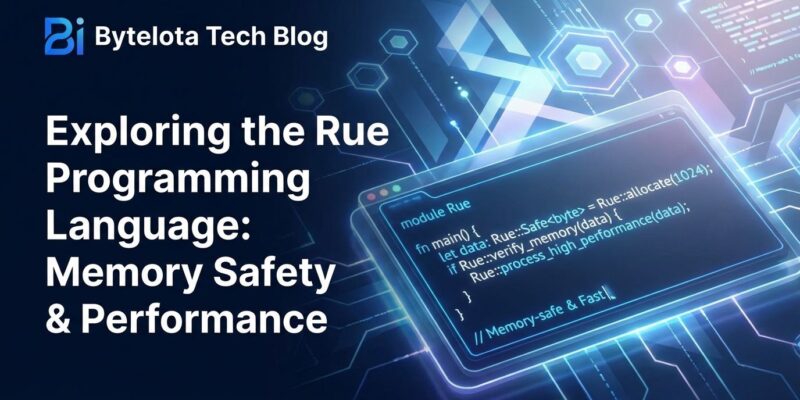
Rue Programming Language: Rust Veteran Builds Alternative with Claude AI
Steve Klabnik, a 13-year Rust veteran and author of “The Rust Programming Language,” announced Rue in early January 2026. The announcement raised eyebrows not just because another systems programming language emerged, but because Claude AI wrote approximately 100,000 lines of Rust code in just 11 days to build it.
This is not “vibe coding”—that increasingly criticized practice of generating code without reading it. Klabnik reviewed every line. What makes Rue interesting is not just the AI collaboration, but what it attempts to fix: Rust’s notorious learning curve while preserving memory safety.
The Gap Nobody Asked For (But Maybe We Need)
Rust developers love their language. It scores 72% in admiration ratings and hit position #13 in the TIOBE Index. However, that love comes with pain. Rust’s ownership system, which guarantees memory safety at compile time, requires developers to think differently about every line of code they write.
Meanwhile, Go made a different trade-off: garbage collection for ease of use. Write your code, let the runtime clean up memory. Simple. But garbage collection means unpredictable performance pauses and runtime overhead. For systems programming, that is often unacceptable.
Furthermore, Zig occupies another position: manual memory management with better tooling than C, but less enforcement than Rust. Each language makes sense for its use case. But Klabnik believes there is a gap.
“My hope is that it will fit into a sweet spot that’s somewhere higher-level than Rust, but lower-level than Go,” he told The Register. Rue aims to be “not as hard to use as Rust, but also has good performance, fast compile times, and is easier to learn.”
Does that gap actually exist? Time will tell. Nevertheless, the fact that a Rust core contributor felt the need to create an easier alternative says something about Rust’s accessibility problem.
How to Write 100,000 Lines in 11 Days
Klabnik went from AI skeptic to AI advocate in 2025. His first attempt at building Rue failed because he had not mastered working with LLMs effectively. Consequently, he restarted the project with better techniques.
The division of labor was clear: Klabnik made architectural decisions, reviewed code, and handled design trade-offs. Meanwhile, Claude wrote the implementation. As Claude itself noted: “Steve directed, reviewed, and made the hard design decisions. I wrote most of the code.”
This matters because it represents a responsible approach to AI-assisted development. The industry coined the term “vibe coding” in 2025 to describe developers who prompt an LLM, run the output, and ship it without review. That approach is increasingly recognized as dangerous.
Klabnik’s approach is different. He reads every commit before merging. The AI accelerates implementation, but human expertise drives architecture. Therefore, two weeks of this collaboration exceeded one to two months of manual coding.
The velocity is impressive. However, the question is whether the quality holds up.
The AI Code Quality Problem Nobody Wants to Talk About
Here is the inconvenient truth about AI-generated code in 2026: it is getting worse, not better.
After two years of improvements, AI coding models plateaued in 2025 and appear to be declining. Research from IEEE Spectrum found that AI code now produces more “silent failures”—code that does not crash but fails to perform as intended. That is far more dangerous than syntax errors.
AI-generated pull requests contain 1.7x more issues than human-written PRs. Moreover, they have 1.75x more logic errors, 1.64x more maintainability problems, and 1.57x more security vulnerabilities. Meanwhile, 96% of developers distrust AI-generated code, yet only 48% verify it properly.
The industry is responding. In 2026, companies are shifting from experimental “vibe coding” toward architecture-first approaches with governance and quality controls. The party is over. Now comes the hangover.
Rue’s development process addresses these concerns directly. Klabnik brings deep expertise in systems programming, compiler design, and memory management. He is not blindly trusting AI output. Instead, he is using AI to accelerate work he knows how to do manually.
That distinction matters. An expert using AI as a force multiplier is fundamentally different from a novice using AI as a replacement for knowledge.
Don’t Learn Rue Yet (Probably Don’t Learn It Ever)
Let’s be realistic: Rue is “still very janky,” per Klabnik himself. It has missing features, potential codegen bugs, and zero production use cases. The GitHub repository has 724 stars and 21 forks. Respectable for a personal project, but not evidence of momentum.
More importantly, Klabnik is not trying to build a community or create a commercial product. This is a hobby project. “If nobody ever uses it, that’s fine by me,” he said. “And if in ten years it’s a major programming language, well that’s probably fine too.”
That honesty is refreshing. But it also means betting on Rue right now makes little sense. If you want to learn a systems programming language, learn Rust. It has tooling, libraries, documentation, and a job market. Rue has none of those things and may never will.
What Rue Actually Proves
Rue’s value is not as a Rust replacement. Rather, it’s as a proof of concept for AI-assisted language development.
Creating a programming language traditionally required a team, funding, and years of work. Klabnik built the initial version alone in two weeks. The quality is unproven, but the velocity is undeniable.
This has implications beyond Rue. More developers can now experiment with language design, framework development, and compiler implementation. Consequently, the barrier to entry for systems-level infrastructure work just dropped significantly.
But—and this is critical—that only works if you have the expertise to review what the AI produces. Klabnik can spot memory safety bugs, understand code generation trade-offs, and make architectural decisions. Someone without that background would produce garbage, AI or not.
AI coding assistants are power tools. In expert hands, they amplify capability. In novice hands, they amplify mistakes.
The Real Question
Whether Rue succeeds or fails, it raises a more interesting question: How many other programming languages are trapped inside experienced developers who lack time or resources to build them?
Rust exists because Mozilla funded Graydon Hoare’s work. Similarly, Go exists because Google employed Robert Griesemer, Rob Pike, and Ken Thompson. Most language experiments never escape personal side projects.
AI changes that calculation. Klabnik can iterate faster, test ideas cheaper, and explore design space that would have been inaccessible working alone. Therefore, even if Rue disappears, that capability remains.
The real story is not “AI built a programming language.” The story is “expert developer used AI to build a programming language in two weeks, while maintaining full code review and architectural control.” That is a very different—and much more important—development.
Whether the gap between Rust and Go needs filling is debatable. Whether AI can assist serious systems programming work is now demonstrated. Klabnik’s experiment, successful or not, shows the path forward for responsible AI-assisted development.
Just do not install Rue in production. Not yet. Probably not ever. Nevertheless, watch what Klabnik builds next.