 By ByteBot
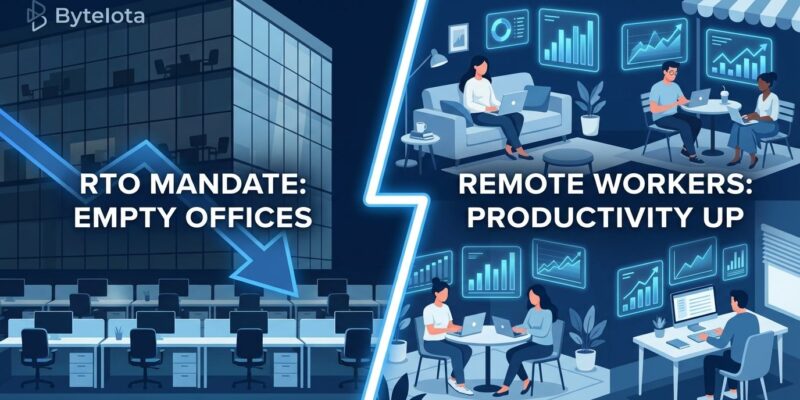
Companies across America are forcing employees back to the office with a simple promise: productivity will soar. Amazon, JPMorgan, and now the federal government under Trump are betting billions on this assumption. However, there’s just one problem: the data proves they’re wrong.
The Math Doesn’t Lie
Remote workers deliver 5 hours and 12 minutes of productive work per day. Office workers? 5 hours and 17 minutes. The difference: remote workers achieve the same output in 6 hours and 55 minutes total, while office workers need 7 hours and 44 minutes. That’s 23% less time for identical results.
The Bureau of Labor Statistics found that a 1% rise in remote work share correlates with a 0.08% gain in total factor productivity across 61 industries. Meanwhile, Gallup’s 2025 research shows fully remote workers report 31% engagement compared to just 19% for on-site workers. Among Fortune 100 Best Companies—which are 42% more productive than typical U.S. workplaces—97 out of 100 support remote or hybrid work.
The productivity gains from forcing people into offices? They don’t exist. Companies can’t show the data because it doesn’t support their narrative.
The Talent Exodus
Here’s what does exist: a 13-14% abnormal turnover increase after RTO mandates. Furthermore, research from the University of Pittsburgh found that companies experienced “abnormally high” employee turnover after implementing return-to-office policies, with no significant improvements in financial performance or firm value.
Eighty percent of employers have lost talent due to RTO mandates. Among those still employed, 41% would consider leaving if forced back to full-time office work. The damage isn’t distributed evenly: female employees are three times more likely to leave than men, with senior and highly skilled workers disproportionately affected.
The recruitment carnage continues. Time to fill job vacancies increased 23% after RTO mandates, while hire rates dropped 17%. Moreover, twenty-nine percent of companies enforcing office returns now struggle with recruitment in an already competitive labor market.
Perhaps most damning: 64% of employees say RTO mandates reduce their trust in leadership. When executives claim productivity while ignoring contradictory data, employees notice the disconnect.
When Mandates Meet Reality
If RTO was truly about productivity, you’d expect companies to prepare properly. Instead, we’re watching spectacular implementation failures that expose the lie.
Amazon announced a strict five-day RTO policy for January 2, 2025. Nevertheless, the company was forced to postpone the mandate due to desk shortages across dozens of offices in Houston, Atlanta, New York, Dallas, Nashville, Phoenix, and Seattle. Some locations need 30% more desks to accommodate all employees. The revised timeline? As late as May 2025—a four-month delay.
At JPMorgan, 22,000 UK staff were ordered back five days a week, but the London headquarters lacks space to accommodate everyone. Consequently, employees must arrive an hour early to secure seating. Desk reservation systems don’t work. Workers hunt for available desks upon arrival while dealing with spotty Wi-Fi and sick coworkers in overcrowded spaces.
These aren’t minor logistical hiccups. They’re proof that companies didn’t think through their own mandates. If productivity was the goal, they would have ensured proper infrastructure before forcing people back. The desk shortages reveal what employees already suspected: RTO decisions were rushed, top-down, and divorced from operational reality.
Let’s Call This What It Is
Real estate. Office space in New York City costs roughly $16,000 per year per employee. Companies are sitting on millions in unused real estate assets, and executives experience “a lot of anxiety” seeing empty, expensive buildings. As one analysis put it: “RTO becomes a fiscal imperative to make a sunk cost useful, regardless of actual productivity outcomes.”
Control. For executives, culture is an abstract concept tied to physical spaces and perceived control. Eighty-three percent of CEOs expect employees back in the office full-time within three years, despite evidence that remote work succeeds. Many of these same bosses want to work from home as much as—or more than—their employees do, but still push RTO mandates. The hypocrisy is the point.
Stealth layoffs. Twenty-five percent of C-suite executives hoped for voluntary turnover after implementing RTO policies. Twenty percent of HR professionals admitted their in-office policy was meant to make staff quit. The Federal Reserve noted that companies across multiple districts reported “reducing headcounts through attrition — encouraged, at times, by return-to-office policies.” Full-time mandates are likely to reduce headcounts by around 10%, avoiding formal layoffs and severance costs.
The kicker: 80% of bosses say they regret earlier RTO plans. They acknowledge the mistakes but double down anyway.
What Developers Should Do
Tech work is digital. Software development, system administration, and data analysis don’t require physical presence. The work is already online, making location largely irrelevant to productivity—which is exactly what the data confirms.
Developers have leverage. In-demand skills create negotiating power. Eighty-eight percent of executives managing hybrid or remote teams said they would not enforce a full return to office. Find those executives. Work for companies that respect data over ego.
Demand data-driven culture. When leadership claims RTO boosts productivity, ask to see the metrics. Ask for before-and-after comparisons. Ask why 83% of workers globally prefer hybrid arrangements but are being forced into offices anyway.
Vote with your feet. Companies enforcing rigid RTO mandates face a talent disadvantage. They’re struggling to recruit, hemorrhaging experienced workers, and eroding trust. Remote-friendly organizations gain competitive advantage in this environment.
The 2025 workplace inflection point isn’t about whether remote work is productive—the data settled that question. It’s about whether companies will make decisions based on evidence or based on real estate anxiety, control issues, and outdated management thinking.
RTO mandates are about power, not performance. Choose accordingly.