
 By ByteBot
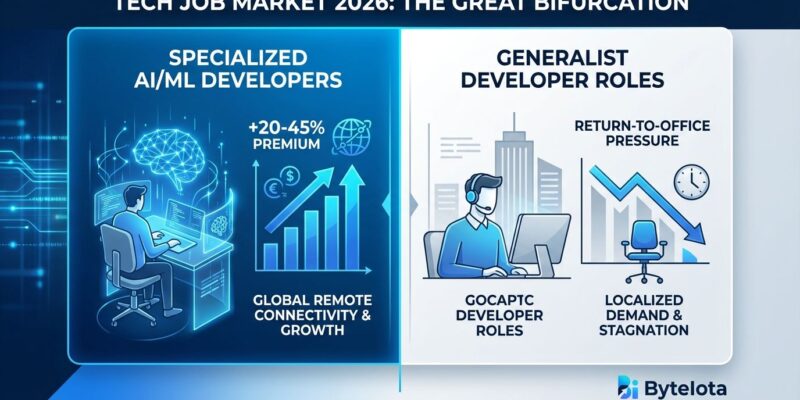
The remote developer job market presents a stark paradox in late 2025. While headlines scream “remote work is dying” and Amazon enforces a 5-day-per-week return-to-office mandate starting January 2025, FlexJobs’ Q4 2025 index shows remote job postings increased 3% and 80% of eligible employees work hybrid or fully remote. The binary “remote is dying versus thriving” debate misses the real story. The market has bifurcated into two tiers: specialized remote developer roles (AI/ML, backend, DevOps) command 20-45% salary premiums and grew 32% year-over-year, while generalist roles face return-to-office pressure and global competition.
For developers planning 2026 career moves, the question isn’t “Is remote work ending?” but “Which remote jobs are thriving and which are disappearing?”
Specialized Remote Roles Command 20-45% Premiums While Generalists Face RTO
The remote developer job market split into two distinct tiers in 2025. Specialized roles saw explosive growth, with AI/ML remote hiring jumping 32% year-over-year. Meanwhile, generalist frontend and junior roles face return-to-office pressure and salary compression.
The salary gap is significant. ML/AI Software Engineers earn $243,863 in total compensation, while Python AI/ML developers command $136,905 compared to $112,382 for general Python developers—a 22% premium. Specific skills drive even higher premiums: LLM fine-tuning adds 40%, RAG architecture 30%, AI agents 25%, and MLOps 20%. Moreover, 65% of AI positions offer remote flexibility, giving specialized developers leverage to demand both premium pay and location independence.
FlexJobs’ Q4 2025 data confirms this bifurcation. Remote job postings increased 3% overall after mid-year declines, but growth concentrated in specialized roles. The takeaway is clear: generalist skills lead to RTO mandates and global competition, while specialized AI/ML/DevOps skills unlock remote opportunities with premium compensation.
Related: Software Engineer Salary Stagnation: AI Premium vs Junior Market Collapse 2025
67% of Small Companies Offer Full Remote vs 10% of Fortune 500
While Big Tech enforces strict return-to-office mandates, small companies use remote flexibility as a competitive weapon. Amazon requires all 350,000+ corporate employees to return 5 days per week starting January 2025. Instagram follows with a 5-day mandate from February 2, 2026 for U.S. employees with assigned desks. Google and Meta enforce 3-day-per-week policies, though Meta’s Instagram division is the exception.
The numbers tell the story: 67% of companies under 500 employees offer full remote work compared to only 10% of Fortune 500 firms. Small companies leverage flexibility to attract talent from better-funded Big Tech competitors.
RTO mandates carry real costs. Companies enforcing return-to-office take 23% longer to fill positions, and 80% lost talent due to RTO policies. Microsoft and Apple saw 4-5 percentage point declines in senior employees post-RTO. Developers face a strategic choice: target Big Tech for maximum total compensation but accept reduced flexibility, or target small companies for full remote flexibility with potentially lower compensation.
83% Want Hybrid, But Only 44% Would Accept 5-Day RTO
Worker preferences reveal a significant disconnect with corporate mandates. Eighty-three percent of workers choose hybrid as their ideal work model, and 85% say remote work matters more than salary when evaluating jobs. Currently, 80% of eligible employees work hybrid (52%) or fully remote (26%).
Resistance to full RTO runs deep. Only 44% would comply with a 5-day return-to-office mandate. Forty-one percent would look for another job immediately, and 14% would quit on the spot. Additionally, 82% of workers report better mental health with flexible work arrangements.
Productivity research supports hybrid work. Stanford’s study of 1,600+ workers found hybrid employees equally productive and promotable as office workers, with 33% lower resignations. The disconnect between worker preferences (83% want hybrid) and Big Tech mandates (Amazon 5 days) creates talent market opportunities for developers who prioritize flexibility.
Government and Peer-Reviewed Research Debunks Remote Productivity Myths
Official research contradicts the “remote workers are less productive” narrative driving RTO mandates. U.S. Bureau of Labor Statistics research finds a 1% increase in remote work correlates with a 0.05% increase in total factor productivity. TFP growth over 2019-2022 is positively associated with rising remote worker percentages across 61 industries in the private business sector.
Stanford’s peer-reviewed study shows hybrid workers at Trip.com (1,600+ participants) are equally productive and promotable as office workers, with 33% lower resignations. McKinsey’s 2025 analysis finds hybrid teams 5% more productive than fully remote or office teams. Gallup data adds nuance: fully remote workers report the highest engagement (31%) versus hybrid (23%) and on-site (19%), though remote workers also report higher stress, anger, and loneliness.
Developers can counter RTO mandates by citing authoritative productivity research. BLS government data, Stanford peer-reviewed studies, and McKinsey analysis provide evidence-based arguments for flexible work. This data also informs which employers to target—those using outcome-based versus activity-based management.
Geographic Arbitrage: 68% Negotiated Higher Salaries, 7-12 Years Faster FI
Sixty-eight percent of remote workers successfully negotiated higher salaries by leveraging geographic arbitrage, earning Silicon Valley compensation while living in lower-cost regions. Remote software engineers average $141,205 in salary. This strategy can reduce the path to financial independence by 7-12 years.
The math is compelling. A Senior Network Engineer earning $100,000 in the U.S. costs $67,000 when hired in Colombia—a 33% cost savings. Developers earning U.S. salaries can achieve luxury lifestyles for $1,500/month in lower-cost cities versus $8,000+ in major U.S. metros.
The catch: 71% of companies use location-based pay adjustments to counter geographic arbitrage. Setup costs run $5,000-10,000 for visa, deposits, travel, and legal/tax consultation. Critical negotiation advice: never mention “lower cost of living” in salary discussions. This signals willingness to accept lower pay. The window for geographic arbitrage may be narrowing as remote work normalizes, but it remains viable for developers willing to relocate strategically.
Four Paths for Developers Navigating the 2026 Market
Developers planning 2026 careers have four strategic paths, each with distinct trade-offs.
Path 1: Upskill into specialized high-value roles. Focus on LLM fine-tuning (+40% premium), RAG architecture (+30%), AI agents (+25%), or MLOps (+20%). Platforms like Coursera, Deeplearning.AI, and fast.ai offer training. Full-stack developers with AI skills see 25-30% salary increases. This path maximizes remote opportunities with premium compensation.
Path 2: Target small companies. Sixty-seven percent of companies under 500 employees offer full remote work. Use RemoteOK, FlexJobs, or Remoteroles.in to find opportunities. Small firms value flexibility as a competitive edge and move faster than Big Tech. Trade-off: potentially lower total compensation for better work-life balance.
Path 3: Leverage geographic arbitrage. Secure remote roles with U.S.-based companies, then relocate to lower-cost regions. Budget $5,000-10,000 for setup. Research location-based pay policies before negotiating. Avoid mentioning cost savings. This path accelerates financial independence by 7-12 years but requires navigating tax and legal complexity.
Path 4: Accept Big Tech RTO reality. Amazon (5 days), Google (3 days), and Meta (3 days) offer higher total compensation, career advancement, and prestige in exchange for reduced flexibility. Best for developers prioritizing maximum earnings over lifestyle flexibility.
The binary “remote versus office” debate is over. The market has split into specialized (remote viable) and generalist (RTO pressure) tiers. Choose your tier and execute the appropriate strategy. Inaction leads to getting caught in the shrinking generalist tier.
Key Takeaways
- The remote developer job market has bifurcated: specialized roles (AI/ML, DevOps) command 20-45% premiums with remote flexibility (+32% YoY growth), while generalist roles face RTO pressure and salary compression
- Small companies (67% offer full remote) use flexibility as a competitive weapon against Big Tech (10% full remote), with RTO companies taking 23% longer to fill positions and losing 80% of talent
- Worker preferences (83% want hybrid, 85% prioritize remote over salary) conflict sharply with Big Tech mandates, creating opportunities for developers who target remote-friendly employers
- Government research (BLS), peer-reviewed studies (Stanford), and McKinsey analysis debunk remote productivity myths, providing evidence-based arguments for flexible work arrangements
- Four strategic paths exist for 2026: upskill into specialized roles, target small companies, leverage geographic arbitrage (68% success rate, 7-12 years faster FI), or accept Big Tech RTO for maximum total compensation


