 By ByteBot
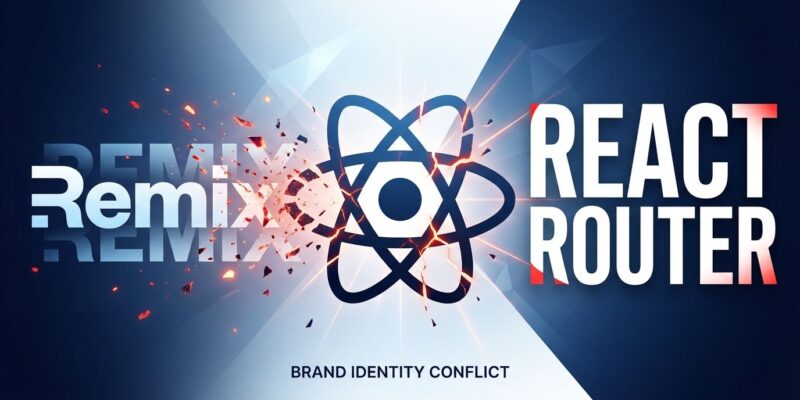
In November 2024, the Remix team merged their framework into React Router v7, abandoning the Remix brand for a numbered version bump. Two months later, the damage is clear. Developers choose Next.js because explaining “Remix is now React Router” to stakeholders is too complicated. Documentation fragmented across two brands. SEO value destroyed. This wasn’t consolidation—it was brand suicide. The team had three options: keep both brands (like Vue Router/Nuxt), merge under Remix, or merge under React Router. They chose the worst one.
The Brand Value They Destroyed
Remix wasn’t just code. It was momentum. Growing 35% year-over-year with 15% adoption increase, positioning as the modern alternative to Next.js. The brand carried meaning: progressive enhancement, web fundamentals, developer experience. It had credibility—Shopify’s adoption, Ryan Florence’s reputation. Years of blog posts, tutorials, Stack Overflow answers pointed to “Remix.” Mental model: Remix is a modern React framework.
React Router carried baggage. Migration fatigue from v4 to v5 to v6 to v7, each with breaking changes. Perception: “just a router,” not a framework. The name doesn’t convey framework capabilities—it sounds like a utility library. Developers hear “React Router” and think routing logic, not server-side rendering.
From GitHub Discussion #10333: “I feel like this decision isn’t appreciating the value of the name ‘Remix’ and the ecosystem.” That’s community signal, not noise.
ByteIota’s take: Brands aren’t codebases. Remix brand was more valuable than React Router brand. Choosing React Router over Remix is like WordPress rebranding as “PHP Framework v7” because “the codebase is 90% PHP.” Technically accurate, strategically disastrous.
Who Benefits? Next.js
The main beneficiary of Remix confusion is their biggest competitor. Next.js dominates with 68% adoption in State of JavaScript 2024. Clear brand. Vercel backing. Mental model: “the React framework.”
Remix had momentum to become a credible Next.js alternative. Different philosophy—web-first, progressive enhancement, less vendor lock-in. The positioning battle mattered as much as technical comparison. Now? Developers choose Next.js because “explaining React Router 7 to stakeholders is too hard.”
From the GitHub discussion: Multiple developers report abandoning Remix adoption because stakeholder communication about “Remix’s successor being React Router 7” became too complicated. Brand confusion isn’t minor—it’s strategic failure.
Next.js didn’t compete. Remix self-destructed.
Three Paths Not Taken
The Remix team had better options. They chose the worst one.
Path A: Keep Both Brands (The Vue Router Model)
Vue Router stayed a routing library. Nuxt became the framework. Clear separation. No confusion. Both brands thrived. Developers know what each does. Documentation doesn’t collide. SEO doesn’t fragment.
Why didn’t Remix follow this model? Code consolidation felt more elegant than ecosystem maintenance.
Path B: Merge Under Remix Brand
Stronger brand. Growing brand. Position as “Remix v3 now includes all of React Router.” Maintains momentum. Preserves ecosystem. Mental model stays clear: Remix equals framework, React Router is underlying tech (like Next.js built on React).
This acknowledges market reality: Remix had better positioning than React Router for framework competition.
Path C: Merge Under React Router (What They Did)
Weakest option. Inherits baggage. Destroys momentum. Creates maximum confusion. Developers ask: “React Router is a framework?” Brand dilution, not building.
The team chose architectural purity—consolidate code, reduce maintenance—over ecosystem health. Prioritizing maintainer convenience over user experience loses users.
The Practical Damage Is Real
Documentation chaos: Search “Remix” and find outdated content. Search “React Router” and find old routing mixed with new framework guidance. One developer: “Spent time moving to createBrowserRouter [promoted in v6], now v7 docs ignore it.”
Migration issues: Navigation bugs. Issue count “ballooned” after v7 release. Breaking changes despite “compatibility” claims. Pattern of rewrites creates adoption hesitation. From Hacker News: “React Router rewritten 5+ times with breaking changes.”
Enterprise adoption blocked: Three companies on HN where “nobody uses latest versions” due to churn. Stakeholder confusion prevents organizational buy-in. Brand clarity matters when non-technical decision makers control budget and roadmap.
Community sentiment: Reddit thread “React Router v7 has to be a psyop.” Some developers migrating to TanStack Router. The New Stack reports developer unhappiness, describing it as “self-sabotage” affecting documentation, branding, SEO.
The Team Chose Code Over Community
What they optimized for: Code consolidation (90% same), maintainer convenience (one project), architectural purity (eliminate wrapper).
What they ignored: Brand equity. Ecosystem investment. Documentation findability. Developer trust. Adoption friction. Stakeholder communication. Competitor positioning.
The arrogance: GitHub Discussion #10333 raised genuine concerns. The response minimized them. Technical correctness assumed to override market reality. Community input treated as noise.
Open source isn’t just code—it’s community, documentation, brand recognition, trust. The Remix team treated this like refactoring when it was strategic decision affecting thousands of projects and careers.
Lessons for Open Source
Framework branding matters. Developers invest in brands—not codebases. When teams adopt your framework, they bet careers, project timelines, company resources. Brand stability is part of that bet.
Code consolidation is a maintainer problem. Brand fragmentation is a user problem. Optimizing for the former at the expense of the latter loses market share to competitors who understand positioning.
The Remix team had the better technical product by many metrics. Better issue-to-stars ratio than Next.js. Strong developer experience. Growing adoption. They threw it away for architectural purity. Next.js didn’t beat Remix technically—Remix beat itself strategically.
If your response to “this brand has value” is “but the code is 90% the same,” you’ve lost the argument. Brands aren’t code. Ecosystems aren’t repositories. Markets aren’t determined by internal architecture elegance.
The merger wasn’t wrong because consolidation is bad. It was wrong because they chose the weaker brand, ignored ecosystem fragmentation, and prioritized maintainer convenience over user experience. That’s not pragmatism—that’s brand suicide.
— **Final Content Metrics**: