 By ByteBot
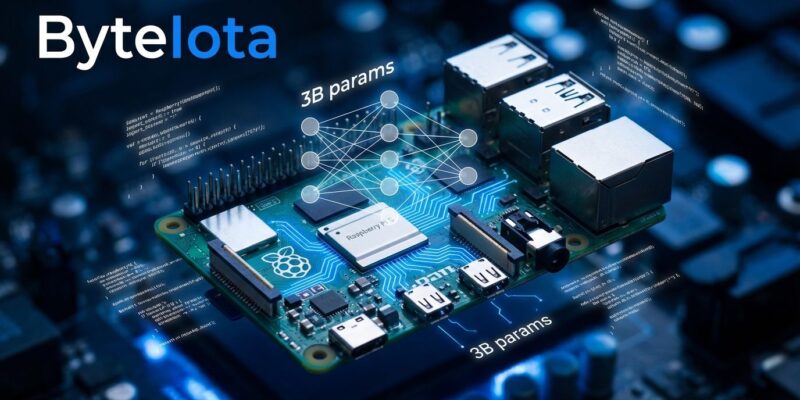
A 3 billion parameter Qwen language model now runs at 15-21 tokens per second on an $80 Raspberry Pi 5—fast enough for real-time chat and voice interaction. This isn’t a tech demo. It’s an economic disruption that makes local AI accessible to students, makers, and small teams who previously couldn’t afford cloud GPU bills.
Trending on Hacker News today with 131 points, this breakthrough represents the convergence of three technologies: Qwen’s efficient model architecture, INT4 quantization that slashes memory requirements by 75%, and Raspberry Pi 5’s 2-3× performance jump. The result: AI deployment costs drop from $378/month (cheapest AWS GPU instance) to $80 one-time. Privacy-first applications, offline AI assistants, and cost-sensitive deployments are no longer theoretical—they’re practical on credit card-sized hardware.
The Economics Are Brutal
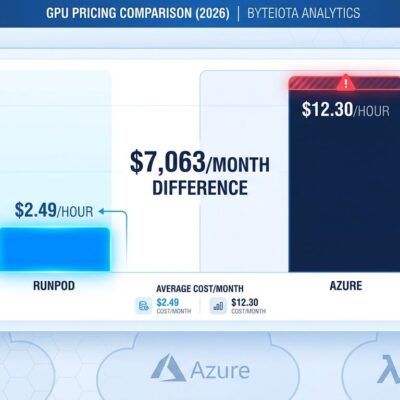
Let’s do the math. A Raspberry Pi 5 with 8GB RAM costs $80. Add a case, power supply, and SD card for another $40-70, and you’re at $120-150 total. Compare that to AWS G4dn.xlarge, the cheapest GPU instance suitable for inference, at $0.526 per hour. Run it 24/7 for continuous inference and you’re paying $378 per month. The break-even point? Less than one month.
Cloud GPUs designed for training are even worse. AWS P3.2xlarge costs $24.48 per hour, or $17,625 per month continuous. For developers running local chatbots, voice assistants, or privacy-sensitive applications, the cloud doesn’t just lose on cost—it fundamentally misaligns with the use case.
Edge AI wins when you need continuous inference without elastic scaling, when data can’t leave your premises due to privacy regulations, or when internet connectivity isn’t guaranteed. However, cloud still wins for training large models, batch processing at scale, or elastic traffic patterns. Nevertheless, for a healthcare clinic deploying a patient intake chatbot that must comply with HIPAA, or a remote industrial site running predictive maintenance, a $150 Raspberry Pi beats $378/month every time.
Three Breakthroughs Made This Possible
First, INT4 quantization. This technique reduces model memory footprint by roughly 75% compared to FP16 precision, with minimal accuracy degradation for chat and generation tasks. Qwen2.5-3B drops from 6GB to 1.5GB, enabling it to run comfortably within Raspberry Pi 5’s 8GB RAM alongside the operating system and other processes. The quantized versions come in GGUF Q4, AWQ, and GPTQ-Int4 formats, all compatible with modern inference frameworks.
Second, the Raspberry Pi 5 itself delivers exceptional edge AI performance. Its ARM Cortex-A76 quad-core processor at 2.4GHz delivers 2-3× the CPU performance of Raspberry Pi 4, with Geekbench 6 showing roughly 3× multi-core improvement. Moreover, the LPDDR4X-4267 RAM provides better bandwidth than the previous generation. This isn’t marginal—it’s the difference between “technically possible” and “actually usable.”
Third, ARM-optimized inference tools like Ollama and llama.cpp have matured into production-ready runtimes. Ollama, built on llama.cpp with over 1,200 contributors, auto-detects CPU features and applies ARM-specific optimizations without manual configuration. Setup is literally one command: ollama run qwen2.5:3b. The friction of local AI deployment has dropped dramatically since 2024.
Real-world performance backs this up. Qwen2.5-0.5B (398MB) hits 19-21 tokens per second. Furthermore, Qwen2.5-3B achieves 15+ tokens/sec while using 5.4GB of the available 8GB RAM. Qwen3-0.6B reaches 21 tokens/sec with under 1.3GB memory consumption. For comparison, 15-20 tokens per second feels instant to humans in conversational interfaces—well above the threshold for real-time interaction.
Use Cases That Just Became Viable
Privacy-first applications are the obvious winners. Healthcare chatbots handling patient intake can now run entirely on-premises, keeping HIPAA-regulated data local. Additionally, legal document analysis tools avoid exposing attorney-client privileged information to cloud providers. Personal AI assistants operate without telemetry flowing to big tech companies. Meanwhile, financial advisors processing sensitive client data never touch external servers.
Offline environments suddenly make sense. Remote oil rigs, ships at sea, disaster response scenarios with network outages, airgapped government installations, and rural schools without reliable internet can all deploy AI assistants. Consequently, autonomous vehicles can’t afford to depend on cloud latency for critical decisions—edge inference is mandatory.
Cost-sensitive projects scale differently now. Startups prototyping AI features avoid burning thousands per month on cloud compute during development. Similarly, students learning LLM development don’t need AWS credits. Small businesses can deploy customer service bots for a one-time $150 instead of subscription fees. Hobby projects and research labs with constrained budgets have access to capabilities that were previously locked behind paywalls.
IoT edge intelligence goes from concept to commodity. Smart home automation runs locally without cloud dependencies. In addition, industrial sensors process data on-site rather than transmitting terabytes for centralized analysis. Security cameras analyze footage in real-time without exposing feeds to third parties. Agricultural IoT on remote farms operates regardless of connectivity.
Where It Falls Short
Be honest: this isn’t replacing cloud GPUs for every workload. The 8GB RAM ceiling limits model size—Qwen2.5-3B fits comfortably, Qwen2.5-7B is pushing it, anything larger requires the 16GB Raspberry Pi model that isn’t yet widely available. Inference speed, while real-time for chat, lags cloud GPUs that can deliver 50-100+ tokens per second. Scaling is manual—one device typically serves one concurrent user unless you architect around distributed inference.
Thermal throttling becomes a concern under sustained load. Raspberry Pi 5 runs hot, and continuous inference without active cooling will eventually throttle performance. Context windows are constrained by available RAM, typically limiting you to 4K-8K tokens. Quantization introduces small accuracy tradeoffs, which matter more for reasoning and math tasks than conversational applications.
You should still use cloud for training or fine-tuning models (you need powerful GPUs), serving hundreds to thousands of concurrent users (you need horizontal scaling), batch processing large datasets (you need parallelization), or when you simply want a managed service without hardware maintenance. This is about expanding what’s possible, not replacing what already works.
What Happens Next
Smaller models are getting smarter faster than large models are getting cheaper. Qwen3 in 2025 shows measurable improvements over Qwen2.5 from 2024, with 1.7 billion parameter models approaching the quality of older 7B models. Efficiency gains compound annually as researchers optimize architecture and training techniques.
Hardware evolution will accelerate this trend. Raspberry Pi 6 will likely integrate a dedicated NPU (neural processing unit), further accelerating inference while reducing power consumption. The 16GB variant of Raspberry Pi 5 will enable comfortable deployment of 7-13B parameter models. Furthermore, ARM chips continue improving performance per watt, and specialized AI accelerators are entering the sub-$100 price range.
Developer opportunities are obvious. Build offline-first AI applications for underserved markets. Create privacy-focused products for healthcare, legal, and financial sectors where regulatory compliance mandates local processing. Integrate LLMs with IoT for smart home and industrial automation. Develop educational platforms that teach edge AI deployment. Build management tools for monitoring, updating, and orchestrating distributed edge inference.
By 2027, local AI inference on $100 hardware will be as unremarkable as running a web server. The bottleneck isn’t technology anymore—it’s developer awareness and tooling maturity. The cloud/edge hybrid architecture is becoming the default: train centrally in the cloud, infer locally at the edge. Privacy regulations like GDPR and HIPAA accelerate this trend by penalizing centralized data collection.
The economic moat around AI deployment just collapsed. Anyone with $80 and a willingness to learn can now deploy real-time language models. That’s not hype—that’s hardware reality meeting software maturity. The question is what developers choose to build with it.