 By ByteBot
Python has become the most desired programming language among developers in the Stack Overflow 2025 Developer Survey, overtaking JavaScript’s decade-long dominance in that category. While JavaScript retains its position as the most-used language overall (66% vs Python’s 57.9%), Python’s 7 percentage point year-over-year jump represents the largest single-year increase in its modern history. The survey—49,009 responses from 177 countries conducted May-June 2025—attributes Python’s explosive growth to AI and machine learning adoption: 85% of developers now use AI tools regularly, and 91% of AI/ML job listings require Python as the primary language.
What “Most Desired” vs “Most Used” Actually Means
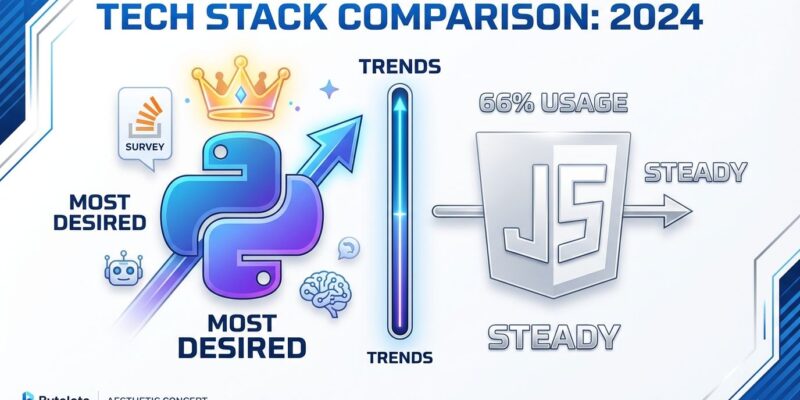
JavaScript is still the most-used language at 66%, but Python has become what developers want to learn next. This distinction matters more than the headlines suggest. “Most used” reflects today’s reality—web dominance means JavaScript everywhere. “Most desired” predicts tomorrow’s jobs and where developers see career growth.
The gap between the two shows the industry transformation underway. Developers are betting their careers on Python’s AI/ML/data science future even as JavaScript continues to dominate web development. According to the Stack Overflow technology rankings, JavaScript leads at 66% usage, followed by HTML/CSS (61.9%), SQL (58.6%), and Python (57.9%). However, when asked what language they want to work with next, Python takes the top spot.
This isn’t “Python vs JavaScript”—it’s “Python for AI careers vs JavaScript for web careers.” The JetBrains State of Developer Ecosystem 2025 survey (24,534 developers across 194 countries) confirms this trend: 7% of developers want to adopt Python, while TypeScript shows “the most dramatic rise in real-world usage over the past five years.”
AI and Machine Learning Drive Python to #1
AI tool adoption is the primary driver of Python’s rise to most desired language. Stack Overflow’s 2025 survey shows 85% of developers now use AI tools, up from 76% in 2024. Additionally, 62% rely on AI coding assistants daily, and 41% of all code written globally in 2026 is AI-generated or AI-assisted. Python dominates this ecosystem: 91% of AI and machine learning job listings in the US list Python as the primary required language.
The job market tells the story. LinkedIn shows 1.19 million job listings requiring Python skills. Machine Learning Engineer remains the most in-demand AI job title, and the US Bureau of Labor Statistics projects 20% job growth for computer and information research roles between 2024-2034. Moreover, 41% of Python developers specifically work on machine learning, according to Stack Overflow data. Data-related jobs are expected to double by 2026, with Python remaining the core skill.
This isn’t about Python being “better” than JavaScript. Python is positioned for the highest-growth, highest-demand sector in tech. Developers voting Python as “most desired” are making a rational career bet: learn the language that unlocks AI roles with 20% job growth and premium salaries. JavaScript remains essential for web development—a mature market with 66% usage at steady state—but Python represents career upside.
The AI Trust Paradox: 84% Use, 46% Distrust
The same Stack Overflow survey revealing explosive AI tool adoption also exposes a critical contradiction. More developers actively distrust AI tool accuracy (46%) than trust it (33%), yet 84% use AI tools anyway. Only 3.1% “highly trust” AI output, and 66% cite “AI solutions that are almost right, but not quite” as their biggest frustration.
This paradox directly affects Python’s “most desired” status as the AI-first language. Developers adopt AI tools not because they trust them, but because they’re too useful to ignore. The JetBrains survey reveals nearly 9 in 10 developers save at least one hour weekly using AI tools, with 20% saving eight or more hours. Daily AI tool usage sits at 47.1% despite widespread distrust.
Related: Developer AI Trust Paradox: 84% Use It, 46% Distrust It
Python’s dominance in AI/ML means it benefits from this forced adoption—even as developers remain skeptical. The takeaway: Python skills are valuable DESPITE, not because of, blind faith in AI. Developers using AI tools need human expertise to verify “almost right” output, making Python expertise more valuable, not less.
Should You Learn Python or JavaScript in 2026?
The Python vs JavaScript choice isn’t about which language is “better”—it’s about matching language to career goal. Python wins for AI/ML/data science careers with 91% of job listings, 20% projected growth, and high salaries. JavaScript wins for web development careers with 66% usage and meta-frameworks like Next.js and Remix as “industry standard” in 2026. Full-stack AI engineers need both: Python for ML model training and deployment, JavaScript for real-time AI user experiences.
Choose Python if you’re targeting AI/ML/data science roles, building backend APIs with modern frameworks (FastAPI saw a +5 percentage point increase—”one of the most significant shifts in the web framework space”), or pivoting into a high-growth sector. Choose JavaScript if you’re focused on full-stack web development, frontend work (React with TypeScript is mandatory), real-time systems where Node.js excels, or staying with the #1 most-used language that’s not going anywhere.
Full-stack AI engineers represent the emerging middle ground. Most AI SDKs—including OpenAI and Anthropic—support both Python and JavaScript first. Use Python for model training and backend ML pipelines, JavaScript for frontend interfaces and real-time AI-driven user experiences. This combination addresses the full stack of modern AI applications.
The practical advice: “Most desired” doesn’t mean “abandon JavaScript.” It means developers see Python as the language of career opportunity in the AI era. However, JavaScript’s 66% usage and web dominance aren’t threatened. Choose based on problem domain (AI/data = Python, web = JavaScript, full-stack AI = both), not hype.
What This Means for JavaScript Developers
JavaScript’s 66% usage proves it’s not being “replaced” by Python—it’s evolving. The JavaScript ecosystem in 2026 has consolidated around meta-frameworks (Next.js, Remix, Nuxt), TypeScript standardization, and React Server Components. While Python takes the AI/ML sector, JavaScript owns web development, real-time systems, and edge computing. The JetBrains survey confirms TypeScript’s “most dramatic rise in real-world usage over the past five years”—it’s no longer optional.
Meta-frameworks have become the “standard entry points for most professional web projects” in 2026, handling routing, data fetching, caching, rendering strategies, and API layers as one-stop solutions. React Server Components (RSC) are stable in Next.js 14+, with React 19 and Next.js 15 “becoming the industry standard.” FastAPI’s +5 percentage point growth signals Python competing for backend API work versus Node.js, but JavaScript retains strengths in edge computing, serverless, and real-time workloads.
The narrative “Python overtakes JavaScript” is misleading. Python became most desired for AI careers, but JavaScript’s web dominance remains unchallenged. Developers choosing JavaScript careers should focus on meta-frameworks (Next.js expertise), TypeScript proficiency (mandatory), and edge computing strengths—not worry about Python “replacing” JavaScript. Different languages solve different problems, and both remain essential.
Key Takeaways
- Python is the most desired language (career trajectory), but JavaScript is still the most used (current jobs)—”most desired” predicts future opportunity, “most used” shows today’s reality
- AI/ML adoption drives Python’s rise: 85% of developers use AI tools (up from 76% in 2024), 91% of AI/ML job listings require Python, and data-related jobs are doubling by 2026
- The trust paradox is real and affects Python’s AI positioning: 84% use AI tools despite 46% actively distrusting their accuracy—Python expertise is valuable for verifying “almost right” AI output
- Career decisions require matching language to domain: Python for AI/ML/data (20% job growth, high demand), JavaScript for web (66% usage, meta-frameworks mandatory), both for full-stack AI engineering
- JavaScript isn’t threatened—it’s evolving through TypeScript standardization (mandatory), meta-frameworks (Next.js, Remix as industry baseline), and React Server Components, while Python claims the AI/ML sector