 By ByteBot
Project Patchouli, an open-source electromagnetic drawing tablet hardware implementation, hit the top of Hacker News today with 339 points—and for good reason. For the first time, the technology inside $300-500 Wacom tablets is fully documented: complete schematics, RF front-end designs, and signal processing algorithms for building DIY tablets using off-the-shelf components. No proprietary chips required.
This isn’t just another hardware project. It’s a democratization milestone. Wacom’s core EMR patents have expired, legally opening the door for implementations like Project Patchouli. Makers can now build custom tablets, integrate pen input into projects, or simply learn how electromagnetic resonance technology works through hands-on building. The black box is open.
Professional-Grade Hardware from Off-the-Shelf Parts
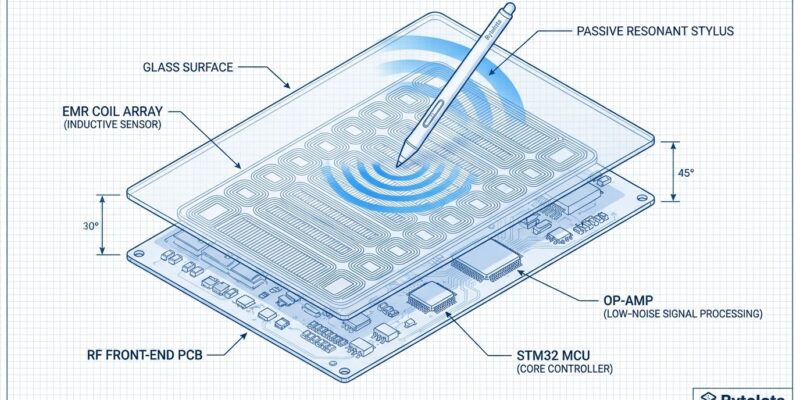
Project Patchouli achieves sub-millimeter accuracy and ultra-low latency using entirely commercial RF components—no specialized vendor chips needed. The RF front-end uses standard operational amplifiers (COS8054 or similar), an STM32G431 microcontroller, and a coil array design that rivals professional tablets. Performance specs match Wacom’s 2540 lines per inch resolution standard.
Even more impressive: the system works with commercial pens from multiple vendors—Wacom, XP-Pen, Huion, and Veikk. This breaks the ecosystem lock-in that’s defined drawing tablets for decades. Buy any pen, use any tablet. The hardware doesn’t care about branding.
What does this prove? Wacom’s monopoly pricing wasn’t about specialized hardware necessity—it was patent protection. Now that those patents have expired, makers can achieve professional results with commonly available electronics. The emperor has no proprietary chips.
Inside the Technology: Battery-Free Pen Magic
Electromagnetic Resonance (EMR) technology is the professional standard Wacom pioneered and competitors now use. It enables battery-free, wireless pen input through clever two-phase electromagnetic induction. Understanding how it works reveals why Project Patchouli is genuinely impressive—this is complex RF electronics and signal processing, not simple hobby circuitry.
The system operates in a rapid cycle, repeating hundreds of times per second. First, the tablet’s sensor grid—an array of alternating vertical and horizontal wire coils—generates a 750kHz electromagnetic field extending about 5mm above the surface. This field wirelessly powers the pen’s copper coil through resonance, similar to how a tuning fork makes a piano wire vibrate without touching it.
Then the system switches to receive mode. The pen modulates its resonant damping to transmit pressure levels (from a piezoelectric sensor) and button press data back to the tablet. The tablet triangulates the pen’s position across the coil array while decoding the pressure information. The result: 2540 lines per inch resolution with 8192-16384 pressure sensitivity levels, depending on which commercial pen you’re using.
This isn’t just “build a drawing tablet” territory. You’re learning RF sensing, digital signal processing, and wireless power transfer concepts applicable far beyond tablets. The educational value extends to any electromagnetic sensing application.
Why Now? Patent Expirations Open the Door
Timing matters. Wacom held the original EMR patents for decades, creating a monopoly that kept prices high and innovation constrained. Those core patents expired around 2020-2023, which explains two things: why XP-Pen and Huion suddenly flooded the market at one-third to one-quarter of Wacom’s prices, and why Project Patchouli can legally exist as open-source hardware right now.
From a Hacker News commenter: “Wacom’s key patents did expire which is why there’s such strong competition in the tablet space now.” Before 2020, $400+ Wacom tablets were the only professional option. After patent expiration, competition drove prices down dramatically. By 2024-2026, open-source implementations became legally viable. Project Patchouli launched in January 2024, completed its first prototype in March 2024, and just migrated its documentation to Read the Docs in January 2025.
This is a legal milestone similar to 3D printing after key patents expired. Patent walls fall, innovation floods in. Expect more open-hardware implementations as other proprietary technologies lose patent protection in coming years. Patchouli represents the beginning of EMR democratization, not a one-off curiosity.
Building Your Own: What It Takes
Project Patchouli enables impressive custom builds—laptop retrofits, oversized artist tablets, integrated signature pads—but requires realistic expectations about complexity. This is an intermediate electronics project, not a weekend beginner build. Estimated costs range from $50-150 depending on component choices and PCB fabrication decisions, with 20-40 hours for first-time builds.
You’ll need PCB assembly experience (or willingness to outsource fabrication to JLCPCB, PCBWay, or similar), basic embedded programming skills for STM32 microcontrollers, and standard tools: soldering station, multimeter, optionally an oscilloscope. The firmware development uses VSCode with STM32 plugins and CubeMX code generator. For driver integration, OpenTabletDriver supports custom tablet definitions, so you don’t need to write drivers from scratch.
The project’s GitLab repository provides complete design files. The Hackaday.io project page (659 views, 8 followers as of January 2026) serves as the community hub. Documentation quality has been praised repeatedly—one HN commenter called the production quality “almost too good to be true,” referring to the accompanying YouTube video demonstrating a Panasonic laptop retrofit.
When does DIY make sense versus buying commercial? If you value learning RF electronics hands-on, need a custom form factor impossible with commercial products, or philosophically align with open-source hardware principles, Patchouli offers unique value. If you need a drawing tablet working this week or lack intermediate electronics skills, buy XP-Pen or Huion at $100-200. Professional artists depending on tool reliability should stick with commercial options that include support and warranties.
Part of a Larger Trend
Project Patchouli uses the CERN Open Hardware Licence (CERN-OHL-S strongly reciprocal variant), positioning it within the broader open-hardware movement doing for electronics what open-source software did for code. The project has institutional backing from NLnet Foundation NGI Zero Core Fund and Modos sponsorship, indicating this isn’t just a hobbyist side project.
The licensing structure is thoughtfully layered: hardware uses CERN-OHL-S (modifications must be shared), firmware uses GPLv3 (standard open-source software), and documentation uses Creative Commons Attribution 4.0 (freely shareable with attribution). This ensures improvements benefit the community while allowing commercial use—you can sell Patchouli-based products if you share your modifications.
CERN created the Open Hardware Licence in 2011 (refined to v2.0 in 2020) specifically to promote collaboration between academia, industrial research, and grassroots makers. Projects like littleBits electronics modules and CERN lab equipment designs use the same licensing framework. As more hardware patents expire and maker culture grows, expect more projects like Patchouli. The future of hardware innovation is collaborative, documented, and accessible.
Key Takeaways
Project Patchouli proves that professional drawing tablet technology—sub-millimeter accuracy, ultra-low latency, commercial pen compatibility—is achievable with off-the-shelf RF components. Wacom’s historical monopoly was patent protection, not hardware magic. Now that core EMR patents have expired, open-source implementations are legally viable and technically competitive.
The educational value extends beyond drawing tablets. Building Patchouli teaches RF electronics, digital signal processing, electromagnetic sensing, and wireless power transfer—applicable to countless other applications. The comprehensive documentation (mechanism, circuits, algorithms, pen protocols) makes this a learning platform, not just a build guide.
Is this for everyone? No. You need intermediate electronics skills, 20-40 hours, and $50-150. But if you value learning, need custom integrations, or philosophically support open hardware, Patchouli offers something commercial products can’t: complete understanding and infinite customization. Check the documentation, assess your skill level, and decide if DIY or commercial makes sense for your use case.
As more proprietary hardware patents expire in coming years, expect similar democratization stories. Patent walls are falling. The makers are inheriting the hardware world.