 By ByteBot
Platform engineering adoption hits critical mass in 2026. Gartner predicts 80% of software engineering organizations will have platform teams by year’s end, up from 45% in 2022. However, here’s the shift that separates survivors from casualties: Successful platform teams must now measure and communicate ROI in business terms—revenue enabled, costs avoided, profit center contribution—not just technical metrics like deployment frequency or MTTR. CFOs don’t care about your deployment frequency. Show them dollars or lose your budget.
The ROI Translation Problem: From MTTR to Money
Platform teams face a brutal reality in 2026. Technical metrics alone won’t justify your budget when finance comes asking questions. Moreover, the gap between “we deployed 50% faster” and “we enabled $2M in additional revenue” determines which teams survive budget cuts and which don’t.
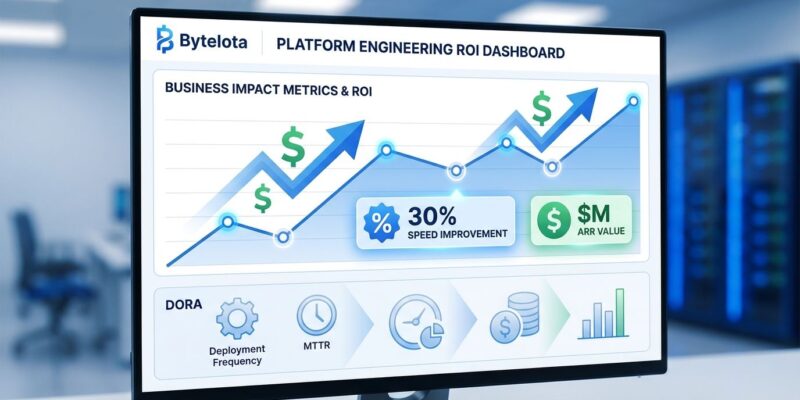
The translation framework is straightforward: Engineers waste less time on non-value-add tasks. For instance, if each developer wastes 4 hours per week (10% of a 40-hour week) on administrative post-PR tasks, they could support $1.1M ARR (~10% of $1M ARR per developer). Improve your DORA metrics, and the real value to the business becomes $2M ARR. That’s the language CFOs understand.
Here’s a concrete example: A 100-person engineering team wasting 4 hours per week on environment setup represents $1.5M in annual value lost. At $150K per developer, a 10% productivity gain equals $15K per developer annually. Consequently, multiply that across your team, and suddenly you’re speaking the CFO’s language. Organizations implementing platform engineering deliver software 30% faster according to Gartner, and companies using IDPs deliver updates 40% faster while cutting operational overhead nearly in half. Those aren’t vanity metrics—that’s measurable business impact.
FinOps Integration: From Reactive Dashboards to Preventive Controls
FinOps will move from reactive dashboards to preventive controls in 2026, and this shift is non-negotiable. Furthermore, platforms implementing pre-deployment cost gates that block services exceeding unit-economic thresholds before they impact the bottom line aren’t being cautious—they’re being realistic about cloud spend spiraling out of control.
Cloud cost is now a DORA metric equal to speed and stability. Engineers see real-time cost impact in pull requests, dashboards, and git blame. As a result, cost stops being something you review after deployment and becomes part of everyday engineering decisions. DevOps pipelines in 2026 include cost guardrails as standard: budget alerts, environment TTLs (time-to-live), right-sizing checks, and cost regression detection before changes hit production.
The AI cost pressure amplifies this urgency. Without tighter alignment between line of business, finance, and platform engineering ROI measurement, enterprises risk turning AI from an innovation catalyst into a financial liability. Platforms are introducing AI-specific budgets for token and inference costs because generic cloud budgets can’t handle the new frontier of compute expense. Therefore, platform teams without cost gates will face budget overruns, and overruns mean lost funding.
DIY Platforms Are Dead—Vendor Consolidation Wins
The question for engineering leaders has shifted from “why do we need platform engineering?” to how to mature the practice without getting stuck in endless portal maintenance. In fact, DIY platforms aren’t bad—they’re just maintenance burdens no one has time for anymore.
Backstage holds roughly 89% market share among organizations that have adopted an internal developer platform, but self-hosting provides maximum flexibility at significant cost. The initial setup is complex, ongoing maintenance demands specialized expertise, and organizations are discovering that flexibility costs more than vendor lock-in. Meanwhile, commercial platforms like Humanitec, Port, and Cortex cost money upfront but get teams to value faster and reduce operational overhead.
The hybrid approach is winning. Port’s self-service portal integrated with Humanitec’s orchestration engine demonstrates the pattern: developers get to coding faster while platform engineers maintain control over infrastructure at scale. Humanitec provides the core configuration engine, Port provides the intuitive UI developers actually use, and the combination delivers speed without sacrificing governance. Additionally, the 2026 trend is clear—organizations are moving away from pure DIY toward managed services or commercial platforms that reduce operational overhead while providing customization capabilities.
Fortune 500 Proof: Real ROI in Business Terms
Fortune 500 companies aren’t hypothesizing about platform engineering ROI—they’re proving it with measurable business outcomes. For example, a software company with a dedicated platform team of 250-280 members focusing on compute, runtime, CI/CD, tools, observability, and cost efficiency uses DORA metrics plus surveys to assess effectiveness. The result: cost optimization measurable at enterprise scale.
A Fortune 500 food manufacturer with $9B in annual sales and 14,000 employees transitioned 40+ automations to a more stable platform. The measurable benefits: reduced dependency on specialized expertise and improved ability to identify issues quickly through centralized logging and metrics. Similarly, Adidas went from vendor-dependent operations to internal developer platform excellence using a 50/50 effort allocation strategy—balancing platform development with user enablement. The key insight: business-focused metrics guided platform evolution and demonstrated value.
These case studies share a common thread: they translated technical improvements into business language executives understand. That’s not a nice-to-have in 2026—it’s survival.
The New Measurement Frameworks: DX Core 4 and SPACE
Two frameworks are emerging for translating technical metrics to business value: DX Core 4 and SPACE. The DX Core 4 framework provides balanced measurement across four dimensions—Speed (DORA delivery metrics plus perceived productivity), Effectiveness (Developer Experience Index), Quality (DORA stability metrics plus code quality perceptions), and Business Impact (ROI and value creation). That fourth dimension is the new requirement.
The SPACE framework breaks measurement into five areas: Satisfaction (developer happiness via NPS), Performance (code quality and system reliability), Activity (code reviews and deployments), Communication (knowledge sharing and collaboration), and Efficiency (workflow smoothness and reduced context switching). Implementation follows a sequential strategy: start with DORA deployment frequency and lead time measurement, add DevEx survey capabilities, then incorporate SPACE productivity elements. Baseline establishment requires 4-8 weeks of data collection, but comprehensive ROI measurement requires 6-12 months of adoption data across teams and technical workflows.
This balanced measurement strategy helped more than 360 organizations achieve measurable results: 3-12% efficiency gains, 14% increases in R&D focus, and 15% improvements in developer engagement. Without a framework, platform teams can’t systematically prove value. These frameworks provide the structure to translate technical wins into business ROI.
What This Means for Platform Teams
The era of “build it and they will come” is over. Platform engineering has matured from competitive advantage to fundamental requirement, and with that maturity comes accountability. Technical excellence remains necessary, but it’s no longer sufficient. DORA metrics provide essential baselines, but CFOs demand translation into revenue impact and cost avoidance.
FinOps integration isn’t optional—it’s table stakes. Pre-deployment cost gates prevent budget disasters before they happen. DIY platforms served their purpose, but managed services and commercial vendors now deliver faster time-to-value without the maintenance burden. The Fortune 500 companies proving ROI in business terms aren’t early adopters experimenting with platform engineering—they’re setting the standard every platform team must meet.
If you can’t translate MTTR to money, your platform team won’t survive 2026 budget reviews. The organizations thriving are those that embraced the shift from technical vanity metrics to business accountability. Platform teams must speak CFO language now, or they won’t have a platform to engineer.