Platform engineering just crossed the 80% adoption threshold among large software organizations, completing a remarkable surge from 45% in 2022. This isn’t just DevOps rebranded—it’s a fundamental shift in how enterprise tech infrastructure works, complete with seven new specialized roles, a metrics revolution that ditches deployment frequency for revenue enabled, and a harsh reality: 40.9% of platform teams that can’t prove business value within 12 months face defunding.
The 80% Milestone: From Experimental to Essential
Gartner predicts 80% of large software organizations will run platform teams by the end of 2026, a jump from 45% in 2022. This isn’t gradual adoption—it’s enterprise tech moving at cloud-migration speed. The State of Platform Engineering Report V4, surveying 518 practitioners, confirms the shift: budgets are doubling, and 55.9% already operate multiple platforms, not just one.
What changed? ROI validation. Organizations that implemented platform engineering proved it works, and the rest are scrambling to catch up. Internal Developer Platforms (IDPs) transitioned from “nice to have” to “nearly universal” in four years. Leading organizations are investing $5-10M for comprehensive capabilities. If your organization isn’t in the 80%, you’re measurably behind—and developers are noticing.
The Metrics Revolution: Revenue Enabled, Not Deployment Frequency
Here’s the existential pressure: platform teams are pivoting from technical metrics (deployment frequency, MTTR) to business metrics (revenue enabled, costs avoided, profit contribution). The gap between “we deployed 50% faster” and “we enabled $2M in additional revenue” determines which teams survive budget cuts.
The data is brutal. According to The Register’s platform engineering analysis, 40.9% of platform teams cannot demonstrate measurable value within 12 months and face defunding. Meanwhile, 35.2% deliver value within six months. The difference? Measurement strategy, not resources.
Quantified business cases are replacing vanity metrics. Calculate cloud savings at 30% of annual Kubernetes spend—for a $2M annual bill, that’s $600K/year. A 50-developer team saving four hours per week equals 10,000 hours annually, or $1M/year in recovered capacity at a $100/hour blended rate. Reducing feature delivery from eight weeks to three weeks means 2.5x more features shipped annually—a competitive advantage measured in quarters, not percentages.
Platform teams are becoming profit centers. Those quantifying business impact get budgets and influence. Those stuck on DORA metrics alone are vulnerable.
Seven Specialized Roles: Your Career Decision Is Now
The generic “platform engineer” title is fragmenting into seven specialized roles with formalized career ladders and industry certifications. This isn’t future-gazing—career data from platform engineering surveys shows it’s happening now.
The seven roles emerging in 2026:
- Head of Platform Engineering (HOPE) – Strategic leadership; 32.9% of platform engineers now report to HOPE roles
- Platform Product Manager (PPM) – Only 21.6% of organizations have dedicated PPMs, creating a massive opportunity gap
- Infrastructure Platform Engineer (IPE) – Scalability, reliability, backend orchestration
- DevEx Platform Engineer (DPE) – Developer workflows, adoption strategies, intrinsic value delivery
- Security Platform Engineer (SPE) – Governance-by-default, policy-as-code, embedded security controls
- Observability Platform Engineer (OPE) – Reliability standards, FinOps integration, cost guardrails
- AI-focused Platform Engineers – NEW role for dual mandate: AI-powered platforms and platforms for AI workloads
Compensation reflects the specialization. Platform engineers in North America average $160K USD, compared to traditional DevOps roles that plateau at $140K-$150K. The market is growing at over 25% CAGR, from $10.4B in 2024 to a projected $25.5B by 2028.
But here’s the non-negotiable: AI literacy. 94% of platform engineering practitioners view AI integration as critical to the field’s future, according to 2026 platform engineering predictions. The recommendation is stark—reserve 20% of your time for AI skill development. Without AI integration, platforms will seem obsolete by 2028. That’s not hyperbole; that’s career planning.
The Bimodal Distribution: Fast Movers vs. Slow Movers
Platform teams are splitting into two trajectories, and the gap is widening. Fast movers use MVP approaches, establish metrics early (even if imperfect), and deliver measurable value within six months. Slow movers pursue “big bang” transformations, can’t demonstrate value within 12 months, and face defunding.
Here’s the pattern: 35.2% of teams prove value in six months. 40.9% fail to prove value in 12 months. Measurement strategy beats budget size. Organizations with built-in observability compress the timeline from 12-18 months to six months or less. Directionally correct measurements beat waiting for perfect data.
Organizations without mature platforms accumulate what the report calls “organizational debt”: frustrating developer experience drives talent flight, sluggish feature delivery reduces market responsiveness, and security gaps create exposure. Platform maturity isn’t a technical checkbox—it’s a talent retention and competitive agility differentiator.
What This Means for You
If your organization isn’t in the 80%, you’re behind. If you’re a developer or DevOps engineer with 5+ years of experience, platform engineering offers stronger compensation and clearer career progression. But the career decisions are happening now, not in 2028.
The seven specialized roles mean you need to pick a direction: product management, developer experience, security, observability, or AI integration. Generalist platform engineering is ending. Specialization with multidisciplinary capabilities is the new standard. Communication and influence skills matter as much as technical depth—platform adoption depends on developers choosing to use your infrastructure, not being mandated.
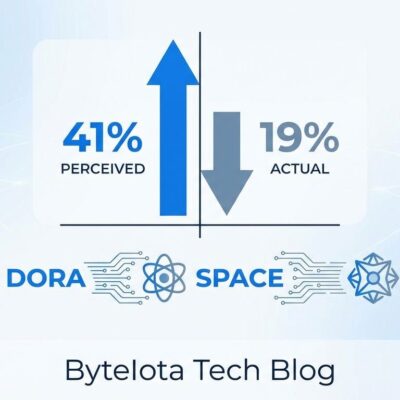
For organizations, the measurement crisis is the blocker. 29.6% of platforms still don’t measure success at all. Start with DORA metrics (40.8% adoption rate), time-to-market tracking (31.0%), or SPACE framework (14.1%), but measure something immediately. Establish metrics early, even imperfectly, and tie platform capabilities to business outcomes: revenue enabled, costs avoided, profit contribution.
The AI integration deadline is tighter than you think. 75% of platforms are already hosting or preparing AI workloads. The barrier isn’t technology—it’s skill gaps (57% cite this as the primary challenge). Dual mandate is clear: build AI-powered platforms (intelligent troubleshooting, automated scanning, agentic orchestration) and platforms for AI (ML workflow infrastructure, model serving, GPU cost management).
Platform engineering crossed the threshold from emerging practice to infrastructure standard. The 80% adoption milestone, seven specialized career paths, and metrics revolution demanding business value aren’t predictions—they’re the state of enterprise tech in 2026. Whether you’re a developer eyeing a $160K role or a CTO justifying platform investment, the inflection point is here.