 By ByteBot
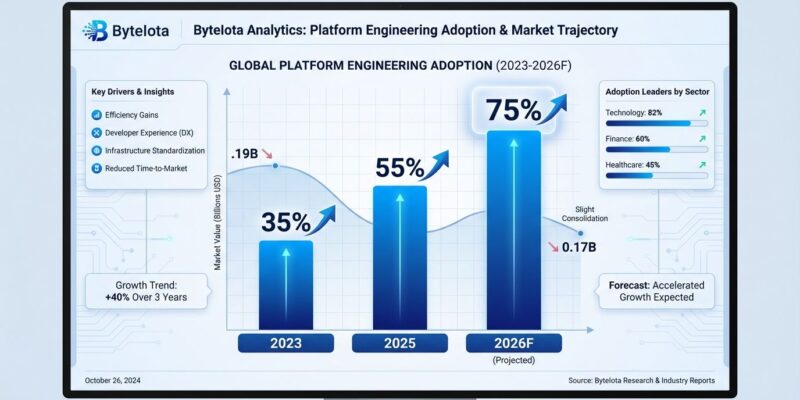
Platform engineering has hit 55% adoption across global organizations in 2025, according to Google Cloud research—up from just 35% in 2023, with projections reaching 75% by 2026. This isn’t gradual evolution. It’s a market surge driven by a developer productivity crisis that’s costing organizations billions: 75% of developers lose more than 6 hours weekly to tool fragmentation, spending only half their time actually coding. The Platform Engineering Services Market, valued at $7.19 billion in 2024, is exploding to $40.17 billion by 2032 at a 23.99% compound annual growth rate. Consequently, this is the industry solving a $40 billion problem—how to make developers productive again.
The adoption velocity is remarkable. A 20-percentage-point jump in two years signals that platform engineering has crossed from “emerging practice” to “industry standard.” Moreover, the question isn’t whether to adopt platform engineering anymore. It’s when, and how to avoid the common pitfalls that sink 40% of implementations.
Platform Engineering Adoption: Why Now? The Developer Productivity Crisis
The driver behind platform engineering adoption isn’t technical curiosity—it’s existential necessity. Seventy-five percent of developers lose more than 6 hours weekly to tool fragmentation, according to CIO surveys across multiple organizations. However, only 50% of developer time goes toward actual coding. The rest? System maintenance, technical debt, updating tickets, and project management overhead.
DevOps promised to solve this with “you build it, you run it.” For small teams, it worked. In contrast, at scale it created a different problem: operational burden that scaled linearly with team size. Furthermore, tool sprawl across cloud providers, dependencies, and custom scripts turned infrastructure management into a full-time job. Platform engineering solves this by abstracting complexity without removing context. As a result, Internal Developer Platforms (IDPs) provide self-service capabilities—developers can provision resources, deploy applications, and manage environments without waiting for operations teams. The industry calls this eliminating “TicketOps.”
The impact is measurable. Seventy-one percent of mature platform engineering adopters report significantly accelerated time-to-market, compared to just 28% of less mature adopters. Therefore, when developers reclaim 6 hours weekly and double their productive coding time, velocity compounds.
Platform Engineering Adoption Velocity Reveals Market Maturity
The numbers tell a story about timing. Forty-nine percent of platform teams are less than two years old, according to the State of Platform Engineering survey. That’s not slow organic growth—it’s a 2023-2025 explosion. Moreover, organizations aren’t experimenting anymore; they’re committing. Ninety percent of platform engineering adopters plan to expand its reach to more developers. Additionally, eighty-five percent of companies report that developers rely on the platform to succeed.
Gartner predicts 80% of large software engineering organizations will have platform teams by 2026, up from 45% in 2022. That’s a projected 35-percentage-point increase in four years. More interesting: platform engineering is currently in Gartner’s “trough of disillusionment”—the phase where hyped technologies crash and burn. Nevertheless, adoption is accelerating anyway.
This suggests platform engineering has proven valuable enough to survive the hype correction phase that kills most tech trends. Consequently, the organizations expanding their platform investments aren’t chasing buzzwords. They’re seeing ROI that justifies continued investment despite implementation complexity.
Platform Engineering vs DevOps: Evolution, Not Replacement
The “platform engineering is just rebranded DevOps” critique misses the point. DevOps is the cultural philosophy—break down silos, automate everything, developers own operations. In contrast, platform engineering is the product implementation: dedicated teams building Internal Developer Platforms that operationalize those principles at scale.
The relationship is evolutionary, not competitive. DevOps excels at establishing agile release cycles and cultural change. However, platform engineering appears later to provide long-term, product-like solutions when DevOps practices become too fragmented. Therefore, the winning approach in 2025 is hybrid: DevOps philosophy plus platform structure.
Here’s the practical distinction. DevOps distributes responsibility across teams, with individual tool choices and shared ownership. In contrast, platform engineering creates dedicated teams that treat developers as customers, providing standardized central toolsets and true self-service without operations involvement. As Red Hat explains, it’s “platform engineering is how you scale DevOps.”
Adidas demonstrates this in practice. Their platform engineering transformation moved the company from vendor-dependent operations to internal capabilities using Team Topologies principles. Their 50/50 effort allocation strategy—balancing platform development with user enablement—treats the platform as a product requiring ongoing investment, not a one-time infrastructure project.
Tool Ecosystem and The AI Catalyst
Backstage dominates with 89% market share, but that dominance comes with costs. The open-source framework from Spotify offers deep customization and the largest plugin ecosystem, but requires “substantial engineering investment” for deployment and configuration. Consequently, many organizations follow a pattern: start with Backstage (it’s the market leader), then switch to commercial alternatives when maintenance burden exceeds value.
Port holds 8% market share with easier onboarding and a $60 million Series C raise in 2024. Meanwhile, Cortex, at 5% market share, positions itself as “more refined and polished” than Backstage, offering service ownership, standards enforcement, and engineering metrics. Gartner’s 2025 Market Guide for Internal Developer Portals notes that organizations are favoring turnkey commercial IDPs that “simplify initial deployment, ease ongoing maintenance, and provide out-of-box functionality” for faster return on investment.
The build-versus-buy tension is settling. Backstage wins when you have dedicated platform engineering resources and need maximum customization. In contrast, commercial alternatives win when you need time-to-value and can trade flexibility for reduced maintenance.
Meanwhile, AI integration is accelerating platform adoption. Seventy-five percent of platform professionals use AI daily for code generation. Moreover, eighty-six percent believe platform engineering is essential to realizing full AI business value. As a result, platforms provide the standardized infrastructure AI agents need to be effective. As the Cloud Native Computing Foundation noted, “Backstage is a great example of the kind of work that’s going to be needed to make AI agents even more effective.”
Implementation Reality: The 30-50 Engineer Sweet Spot
Platform engineering has an optimal adoption window, and most organizations miss it. The sweet spot is 30-50 engineers—large enough to justify the investment, small enough to avoid accumulated technical debt. However, below 20 engineers, platform engineering is premature. Above 100 engineers, you’ve already accumulated inconsistent practices that make standardization exponentially harder.
Nevertheless, team size isn’t the only challenge. Forty percent of platform engineering implementations fail due to lack of product mindset. Teams treat the platform as a technical project instead of a product with customers. Consequently, when platform teams forget they’re building for developers—not dictating to developers—adoption craters.
Forcing adoption backfires spectacularly. Making the platform mandatory breeds resentment and “malicious compliance,” where developers blame the platform every time something goes wrong. Therefore, successful platform teams compete for developer attention by making their platform so good that developers choose it voluntarily.
Other common failure modes include overengineering (trying to reinvent Heroku without the budget), cultural resistance (success requires cultural shift, not just technology), and platform stagnation (treating the platform as “finished” after initial deployment).
Yet despite these challenges, 90% of adopters are expanding their platform investments. Moreover, the pain of the status quo—6 hours lost weekly, only 50% productive coding time—outweighs the pain of transformation. As a result, platform engineers command premium salaries ($172,038 average, 20% higher than DevOps roles) because their expertise is rare and valuable. Finding skilled platform engineers is difficult, but organizations are willing to pay because the productivity returns justify the investment.
What This Demonstrates
Platform engineering adoption crossing 55% in 2025 marks an inflection point. This is no longer an early-adopter practice—it’s becoming industry standard infrastructure. Furthermore, the projected 75% adoption by 2026 and $40 billion market by 2032 show that organizations aren’t just experimenting. They’re committing long-term resources to solving the developer productivity crisis.
The success formula is clear: treat your platform as a product, not an IT project. Moreover, invest when you hit 30-50 engineers, before technical debt accumulates. Choose tools based on your engineering capacity—Backstage if you have dedicated resources, commercial alternatives if you need faster time-to-value. Additionally, don’t force adoption; make your platform so valuable developers choose it. Finally, recognize that platform engineering is how you scale DevOps, not replace it.
Organizations that get this right see 71% faster time-to-market and developers who spend 50% more time coding instead of wrestling with infrastructure. Those are the returns that justify a $40 billion market.