 By ByteBot
Platform engineering adoption will hit 80% by end of 2026, up from 55% in 2025. This isn’t gradual evolution—it’s an industry reckoning. Organizations aren’t enhancing DevOps anymore; they’re replacing it entirely with internal developer platforms that shift operational complexity down to dedicated platform teams instead of left onto already overwhelmed developers. Traditional DevOps, with its “shared responsibility” philosophy, officially becomes obsolete this year.
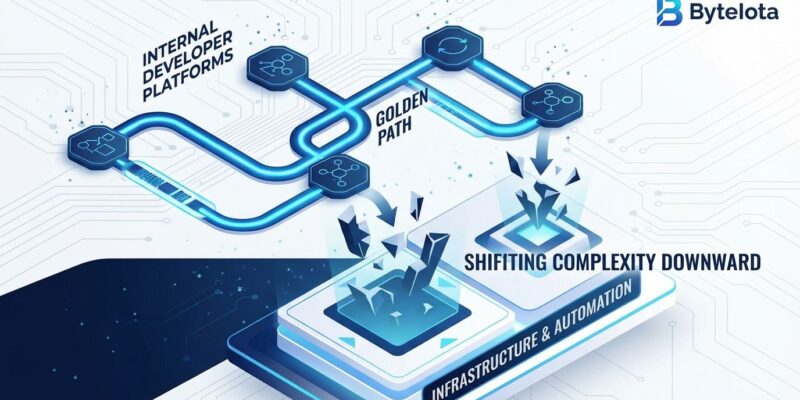
The difference isn’t semantic. The “shift left” philosophy that defined DevOps for a decade is giving way to “shift down“—moving operational complexity away from application developers entirely. For developers, this means golden paths, self-service portals, and dramatically reduced cognitive load. For organizations, it’s a structural response to complexity that reached breaking point.
The 80% Tipping Point: Adoption Becomes Standard
Gartner forecasts 80% of software engineering organizations will host dedicated platform teams by year-end, jumping from 55% in 2025. That 25-percentage-point surge in twelve months represents platform engineering’s transition from optional practice to mandatory infrastructure. Consequently, when four out of five organizations adopt something, it stops being a trend and becomes the operating model.
The investment follows the adoption. CNCF’s survey of 518 platform engineering practitioners shows median platform budgets expected to double in 2026, with leading organizations investing $5-10 million. Organizations typically allocate 2-6% of total engineering headcount to centralized developer productivity—an average of 4.7%, translating to roughly one platform engineer per 17-50 developers. Moreover, technology companies lead at 4.89% allocation, while large enterprises lag at 3.32%.
Shifting Down vs Shifting Left: Why This Isn’t DevOps 2.0
Platform engineering doesn’t enhance DevOps—it solves the problem DevOps created at scale. The issue: DevOps’ “shift left” philosophy pushed tasks earlier in the development lifecycle, loading developers with security testing, infrastructure configuration, observability setup, and deployment orchestration. Each “shift left” initiative added cognitive load. As a result, multiply that across cloud-native complexity, and you get overwhelmed teams drowning in YAML.
“Shifting down” takes the opposite approach. Instead of pushing complexity onto developers, platform teams absorb it entirely, exposing simple interfaces. Richard Seroter from Google Cloud explains: “The shift from ‘shifting left’ to ‘shifting down’ represents platform engineering’s evolution from DevOps 2.0 to a truly distinct discipline.” Furthermore, the 2026 maturity metric captures this: mature platforms are measured by how much toil they eliminate, not redistribute.
The responsibility model changes fundamentally. However, DevOps preached shared responsibility—”you build it, you run it”—but as one analysis notes, “when everyone owns something, no one truly does.” Platform engineering introduces explicit ownership: platform teams are accountable for lifecycle, reliability, usability, and evolution, just like product teams.
The AI Mandate: 94% View Integration as Critical
Platform engineering maturity in 2026 is measured by AI integration, specifically a dual mandate: augmenting platforms with AI capabilities while simultaneously building platforms that enable AI workloads at scale. This isn’t a nice-to-have feature—it’s the litmus test separating mature platforms from basic tooling.
The numbers explain the urgency. CNCF survey data reveals 94% of organizations view AI as critical or important to platform engineering’s future, with 86% believing platform engineering is essential to realizing AI’s business value. Additionally, 75% are already hosting or preparing AI workloads on their platforms. AI requires specialized infrastructure: GPU scheduling, model deployment pipelines, ML experiment tracking, vector database management.
The catch: 57% cite skill gaps as the primary barrier to AI integration. This explains why adoption (80%) vastly outpaces maturity. Therefore, most organizations are building platforms, but few are building platforms that can handle 2026’s AI workload demands or use AI to improve the platform itself.
Golden Paths: What Self-Service Actually Looks Like
Golden paths make the “shift down” concept tangible. The CNCF defines them as “templated compositions of well-integrated code and capabilities for rapid project development.” In practice: a developer runs a single CLI command or clicks a button in a self-service portal. Immediately, a new repo appears with folder structure configured, a working CI/CD pipeline attached, observability baked in, and security guardrails enforced. Zero tickets filed.
Gartner reports 75% of platform teams now provide these self-service developer portals. The workflow collapses from days to seconds: one command produces everything a developer needs to start building, with organizational standards and best practices encoded into the template itself. Moreover, this is how governance works without bureaucracy—security, compliance, and cost controls get built into the golden path. Developers don’t fight governance; they get it automatically.
The Measurement Crisis: 30% Still Fly Blind
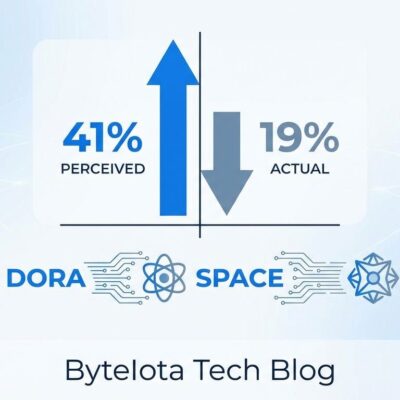
Despite explosive growth, 29.6% of organizations don’t measure platform success at all—down from 45% in 2024 but still unacceptably high. Additionally, another 24.2% don’t know if their metrics improved. Only 40.8% use DORA metrics, 31.0% track time to market, and just 14.1% use SPACE metrics.
The performance distribution gap is widening, not closing. While 35.2% deliver measurable value within six months, 40.9% cannot demonstrate value within twelve months. Furthermore, adoption patterns reveal problems: only 28.2% report intrinsic value pulling users to their platforms, while 36.6% depend on mandates and extrinsic push.
Investment remains systematically underfunded. Nearly half (47.4%) operate in the sub-$1M budget range—inadequate for building serious platforms. This creates zombie platforms: infrastructure that exists but nobody uses. Consequently, the winners in 2026 will be organizations that measure time to first deploy, onboarding duration, platform adoption rates (voluntary uptake), and frequency of manual interventions.
Key Takeaways
- Platform engineering hits 80% adoption in 2026, marking the year it becomes mandatory infrastructure. Organizations without dedicated platform teams operate at structural disadvantage.
- “Shifting down” replaces “shifting left.” DevOps pushed complexity onto developers; platform engineering moves it onto dedicated teams that eliminate toil rather than redistribute it.
- AI integration is the maturity litmus test. Can your platform support GPU scheduling, model deployment pipelines, and ML workloads? If not, you’re building a 2024-grade platform in 2026. The 57% skills gap explains why adoption outpaces capability.
- Golden paths transform self-service from concept to reality. One CLI command produces configured repo, working pipeline, and integrated observability. Governance happens automatically through template encoding.
- Measurement separates winners from losers. Nearly 30% still don’t measure success, and the gap between fast movers (value in 6 months) and slow movers (no value after 12 months) is widening.