 By ByteBot
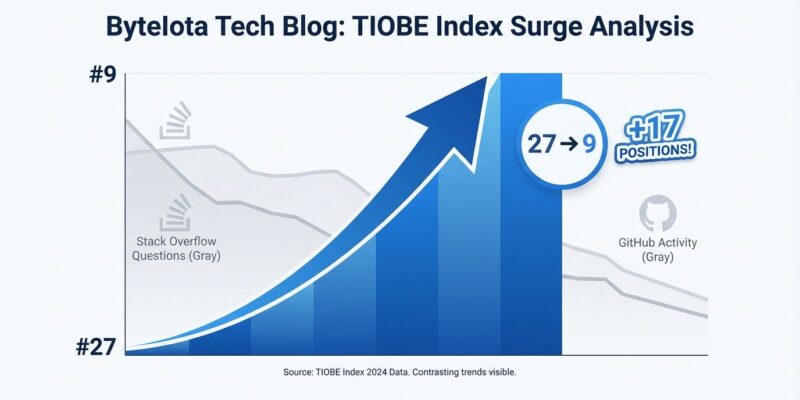
Perl jumped from 27th to 10th place in the September 2025 TIOBE Index—a 17-position surge that represents the most dramatic language ranking movement of the year. By December 2025, Perl sits at #9 with a 1.97% rating, maintaining its top-10 position with a +1.33% year-over-year increase. For a language declared “dead” for years, this comeback seems shocking. Before you dust off those O’Reilly Perl books, though, the reality is more nuanced than the rankings suggest.
What TIOBE Actually Measures
TIOBE’s ranking surge doesn’t measure actual code usage. TIOBE CEO Paul Jansen revealed the “technical reason” for Perl’s high ranking: Perl has four times more books on Amazon than PHP, and seven times more books than Rust. The methodology uses search engine popularity across 25+ sources—Google, Amazon, Wikipedia, Bing—to calculate ratings based on “skilled engineers, courses, third-party vendors.” Essentially, it measures documentation availability and historical accumulation, not current developer adoption.
This means Perl’s decades of O’Reilly books, 200,000+ CPAN modules, and accumulated technical documentation inflate its search visibility. The ranking reflects Perl’s legacy footprint, not a resurgence in actual usage. When methodology favors historical artifacts over current activity, statistical comebacks emerge without real developer growth.
Every Other Metric Tells a Different Story
While TIOBE shows Perl surging, every other metric contradicts the “comeback” narrative. Stack Overflow questions about Perl have declined steadily for nine years and “were never as big on Stack Overflow.” GitHub activity remains modest—the perl5 core repository has just 2,208 stars. Compare that to tens of thousands for modern languages. The last perl5 commit was November 2025, showing continued maintenance but not explosive growth.
Developer surveys rank Perl near the bottom. Index.dev and Stack Overflow 2025 note it’s “mostly holding on in legacy scripts and dusty enterprise setups.” The top Perl repositories by stars are utility tools—cloc (22K stars), FlameGraph (19K), diff-so-fancy (17K)—not frameworks or platforms. When one metric says “up” but all others say “down” or “flat,” the truth emerges: Perl isn’t experiencing a renaissance. It’s experiencing a measurement artifact.
Ecosystem Stabilization, Not Developer Growth
Three real factors contributed to Perl’s ranking stability, though not explosive growth. First, the ecosystem finally stabilized after the Perl 6/Raku split. When Perl 6 rebranded to Raku in 2019, it ended years of confusion about which version to use. By 2025, the community clearly embraces Perl 5 as the primary version, providing clarity that had been missing for half a decade.
Second, Perl 5.40 released in June 2025 brought genuine modernizations. Improved Unicode support and better concurrency features addressed long-standing criticisms. These updates aren’t revolutionary, but they signal that Perl development hasn’t stopped—it’s evolved into stable, incremental improvement rather than radical reinvention.
Third, enterprises are revisiting Perl for legacy system maintenance where rewriting in Go or Rust would be cost-prohibitive. This isn’t sexy, but it’s pragmatic economics. When critical banking systems, government infrastructure, or telecom platforms run on Perl, organizations choose maintenance over risky rewrites. The Perl community remains active too, with the Perl Community Conference Summer 2025 and Perl Toolchain Summit 2025 showing dedication, if not explosive growth.
Related: Python 3.15 Windows Performance: 15% Faster Interpreter
High Salaries, Narrow Niche
Perl developers command premium salaries—$140,000 average according to the Stack Overflow 2025 Survey—due to scarcity combined with the criticality of legacy systems. If you know Perl, you’re paid well to maintain ancient but mission-critical systems nobody dares touch. However, this is a narrow niche. Freelancing platforms like Upwork and Toptal still have Perl projects for automation, text processing, and system integration, but the market seeks developers who can “modernize legacy systems without breaking them”—bridging old and new, not pure Perl development.
The DevOps niche offers opportunities too. Perl serves as glue code between legacy infrastructure and modern systems. Companies value developers fluent in both tradition and transformation—those who can interface with old Perl scripts while building new Python or Go services around them. This creates a specific, lucrative career path, but it’s fundamentally different from learning trendy frameworks or chasing bleeding-edge languages.
The scarcity premium exists precisely because few new developers learn Perl. This creates opportunity for specialists willing to work in this space, but it’s not a signal to pivot your entire career toward Perl. It’s a signal that legacy expertise has monetary value when tied to critical systems.
The Lesson for Developers
Perl’s TIOBE “comeback” teaches a broader lesson about language lifecycles: statistical comebacks can happen without real developer adoption growth. “Dead” languages can persist in valuable niches for decades. Hacker News discussions note “Perl’s decline was cultural” with “certain features still obnoxious in 2025,” yet the language persists because it solves real problems for real systems that can’t easily migrate.
This challenges the developer tendency to chase trends and dismiss old technology. Perl’s story shows that languages remain valuable in specific contexts long after their peak popularity. Understanding this prevents making reactionary technology choices based on hype cycles or single-metric rankings. The bigger insight: measurement methodology matters. TIOBE uses search and books, Stack Overflow uses questions, GitHub uses stars and commits. Each tells a partial story. Triangulating data sources reveals truth that single metrics obscure.
Key Takeaways
- Perl’s TIOBE ranking surge reflects methodology artifacts (book availability, historical documentation) rather than actual developer adoption growth—cross-reference multiple metrics before making technology decisions
- Stack Overflow questions declined for 9 years, GitHub activity remains modest (2,208 stars), and developer surveys rank Perl near bottom—the “comeback” narrative doesn’t match usage reality
- Ecosystem stabilization (Perl 6/Raku split resolved, Perl 5.40 modernization) and legacy maintenance economics drive current Perl relevance, not new greenfield adoption
- Premium salaries exist ($140K average) due to scarcity and system criticality, but opportunities are narrow—learn Perl for legacy specialization, not as a general career path
- Language “death” is nuanced: Perl isn’t dying or surging—it’s settled into a stable, lucrative niche where pragmatism matters more than trend-chasing
Rankings tell partial stories. Before pivoting your career or dismissing “old” technology based on a single metric, triangulate your data. Perl’s story is a reminder that legacy doesn’t mean worthless—it often means stable, necessary, and well-compensated.