 By ByteBot
Oracle executed one of the largest layoffs in its history today, March 31, 2026, terminating between 20,000 and 30,000 employees—roughly 18% of its global workforce—via cold 6 a.m. emails with zero warning. Employees across the United States, India, Canada, Mexico, and other countries woke to impersonal termination notices from “Oracle Leadership,” with company system access immediately revoked.
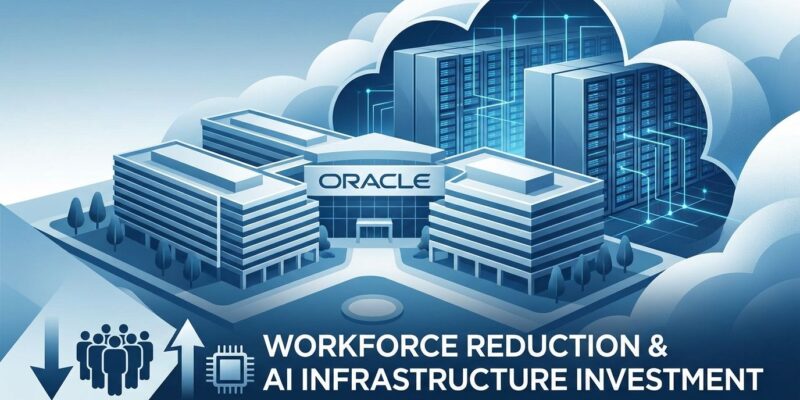
This isn’t a struggling company cutting costs to survive. Oracle posted a 95% jump in net income to $6.13 billion last quarter and grew its remaining performance obligations by 433% to $523.3 billion. The brutal math: analysts estimate the cuts will free up $8-10 billion in cash flow—money Oracle desperately needs to fund a $50 billion AI data center buildout despite already carrying $124 billion in debt.
Record Profits, Mass Layoffs: The Economics Don’t Add Up
Oracle’s Q4 fiscal 2025 numbers tell a story of explosive growth. Net income surged 95% to $6.13 billion. Cloud revenue climbed 14% to $11.7 billion. Oracle Cloud Infrastructure (OCI) revenue jumped 66% to $4.1 billion, with GPU-related revenue up 177% year-over-year. The company secured $523.3 billion in remaining performance obligations—contracts already signed and waiting to be fulfilled—representing a staggering 433% increase.
Yet despite this profitability, Oracle’s balance sheet reveals a cash crunch. Total debt ballooned from $89 billion to $124 billion in just one year. Q2 free cash flow turned negative at $10 billion. The problem isn’t lack of business; it’s an inability to fund the infrastructure required to deliver on massive AI contracts with Meta, OpenAI, Nvidia, xAI, TikTok, and AMD without sacrificing human capital.
TD Cowen analysts calculated that eliminating 20,000-30,000 employees frees $8-10 billion annually—approximately $333,000-400,000 per employee in salary, benefits, and overhead. That cash goes directly to Oracle’s $50 billion fiscal 2026 capital expenditure plan, up $15 billion from prior forecasts. This isn’t cost-cutting. It’s capital reallocation: human spending becomes infrastructure spending.
How It Happened: The 6 a.m. Email Massacre
The execution was brutally impersonal. At approximately 6 a.m. local time on March 31, employees across multiple time zones received identical termination emails from a generic “Oracle Leadership” sender. No prior warning from HR. No manager conversations. The emails informed recipients their roles were eliminated due to “organizational change,” their final working day was that same day, and their system access was already cut.
Affected departments included sales, engineering, and security. On Blind, Oracle’s anonymous employee forum, firsthand accounts poured in. One engineer wrote: “Woke up at 6:04 a.m. to an email saying I’m done. 11 years, gone in 90 seconds.” A Hacker News discussion drew 680 points and 564 comments, with the community split: some defended it as “business is business,” while others condemned the cold efficiency as inhumane.
The method reveals Oracle’s priorities: speed and immediacy over employee dignity. Terminating 30,000 people in a single morning eliminates severance drag and provides instant cash flow relief. For Oracle’s remaining workforce, the message is clear: profitability no longer guarantees job security when capital allocation priorities shift.
The AI Infrastructure Bet: $523B in Contracts, $50B in Capex
Oracle is raising $45-50 billion in debt and equity in 2026 to build data centers capable of fulfilling its massive AI backlog. The company’s remaining performance obligations surged to $523.3 billion, driven by hyperscale contracts with Meta, OpenAI, Nvidia, and others. Oracle delivered 400 megawatts of data center capacity in a single quarter and increased GPU capacity 50% versus Q1 to meet AI training and inference demand.
The capital intensity is staggering. Oracle’s fiscal 2026 capex target of $50 billion—up $15 billion from its previous forecast—exceeds the GDP of dozens of countries. The company needs this infrastructure to convert its $523 billion backlog into revenue. However, Oracle’s balance sheet can’t sustain both workforce costs and infrastructure spending without taking on unsustainable debt levels.
Here’s the paradox: Oracle won so much AI business it can’t afford to deliver it without cutting people. AI infrastructure is capital-intensive, not labor-intensive. The $8-10 billion saved from layoffs funds data centers, GPUs, power, and networking—not salaries. Massive AI contracts destroy jobs rather than create them.
Related: Meta $375M Verdict: Section 230 Cracks on Child Safety
The Industry-Wide Pattern: 60,000 Tech Jobs Cut for AI
Oracle isn’t an outlier; it’s a bellwether. Tech companies cut 60,000 jobs in Q1 2026 across 200+ companies, with 23% explicitly citing AI automation or restructuring—up from 14% in Q4 2025. Profitable companies lead the cuts. Meta is spending $135 billion on AI capital expenditure while planning 15,000+ layoffs. Atlassian cut 1,600 employees despite 26% cloud revenue growth. Amazon eliminated 16,000 jobs while committing $200 billion to AI infrastructure.
Collectively, Amazon, Microsoft, Alphabet, Meta, and Oracle are spending $660-690 billion on AI infrastructure in 2026, nearly double 2025 levels. The pattern is consistent: redirect cash from payroll to data centers. Block cut 4,000 jobs—40% of its workforce—citing AI automation explicitly. McKinsey projects data center spending will reach $6.7 trillion globally by 2030, with $5.2 trillion dedicated to AI-specific infrastructure.
The “AI paradox” is now undeniable: massive AI contracts don’t create tech jobs—they eliminate them. Companies are betting that AI infrastructure ROI will justify sacrificing human capital. If the $700 billion annual spending doesn’t generate returns, the industry faces a reckoning far worse than past tech bubbles. For developers, job security is now tied to capital allocation cycles, not company profitability.
Key Takeaways
- Oracle’s 30,000 layoffs (18% of workforce) free $8-10 billion annually to fund $50 billion in AI data center capital expenditures, demonstrating that profitability no longer guarantees job security when infrastructure spending takes priority.
- The brutal 6 a.m. email execution with zero warning and immediate system access revocation reveals how companies prioritize operational efficiency over employee dignity when capital constraints force difficult choices.
- Oracle’s $523 billion backlog of AI contracts with Meta, OpenAI, and Nvidia created an infrastructure funding crisis that its balance sheet—already carrying $124 billion in debt with negative $10 billion Q2 free cash flow—couldn’t sustain without workforce reductions.
- Tech industry layoffs hit 60,000 in Q1 2026, with 23% explicitly AI-driven, as companies collectively spend $660-690 billion on infrastructure while cutting payroll costs—a pattern led by Oracle, Meta ($135B capex, 15K cuts), and Amazon ($200B capex, 16K cuts).
- The AI infrastructure paradox is now clear: hyperscale AI contracts are capital-intensive, not labor-intensive, eliminating jobs rather than creating them as companies bet uncertain future ROI justifies sacrificing human capital today.
Oracle’s next 6-12 months will test whether this gamble pays off. If Q3 and Q4 fiscal 2026 earnings show Oracle converting its $523 billion backlog into revenue with 18% fewer employees, expect copycat strategies across tech. If execution falters or AI revenue disappoints, Oracle—and the broader industry—faces a catastrophic scenario: gutted workforce, crushing debt, and canceled contracts. The result will shape tech employment for years.