 By ByteBot
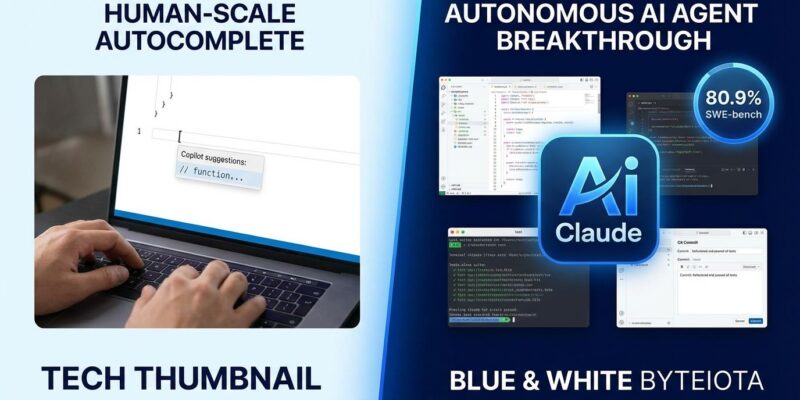
Claude Opus 4.5 just crossed the usefulness threshold for AI coding agents. Released November 24, 2025, it hit 80.9% on SWE-bench Verified—the first model above 80%—testing real GitHub issues that require multi-step reasoning across entire codebases. A Google engineer admitted this week that Claude Code built in 60 minutes what her team spent a year iterating on. Hacker News is buzzing with 582 comments, and developers are calling it the moment AI agents became genuinely useful for real-world engineering.
The 80% Threshold: Why This Time Is Different
SWE-bench Verified isn’t autocomplete. It’s real bug reports and feature requests from production codebases. Opus 4.5 reached 80.9%, beating Gemini 3 Pro (76.2%) and GPT 5.1 Codex Max (77.9%)—a 65% jump from Claude 3.5 Sonnet’s 49%. Moreover, it scored higher than human candidates on Anthropic’s internal engineering exams.
The threshold matters because it marks where agents can work on “longer time horizons.” Below 80%, models required constant steering. Above 80%, they handle complex, multi-day tasks autonomously. Jaana Dogan, Principal Engineer at Google leading the Gemini API team, gave Claude Code a three-paragraph prompt describing a distributed agent orchestration system. The result? “It generated what we built last year in an hour.” Not perfect, she clarified, but comparable to Google’s year-long iteration.
This is the shift from copilot assistance to autonomous execution. Previous models helped while you coded. Opus 4.5 does the coding while you focus on architecture.
Slower But Ultimately Faster: The Counterintuitive Win
Opus 4.5 introduces an “effort” parameter that flips conventional wisdom. Set to medium effort, it matches Sonnet 4.5 performance while using 76% fewer tokens. At high effort, it exceeds Sonnet 4.5 by 4.3 percentage points while still using 48% fewer tokens. This is counterintuitive: a “slower” model that thinks more deeply upfront requires fewer iterations, saving time overall.
Boris Cherny, creator of Claude Code at Anthropic, uses “Opus 4.5 with thinking for everything.” His reasoning: “Even though it’s slower, it’s ultimately faster because it requires less steering.” Developers using Cursor with Opus 4.5 report build time cut almost in half, with most tasks working on the first try. When something fails, fixes are fast with less back-and-forth.
The trade-off is simple: spend tokens thinking (high effort) or spend time iterating (low effort). For complex refactoring and critical bugs, high effort wins. Consequently, for quick fixes, low effort is sufficient.
# Low effort: Quick iteration, daily coding
response = client.messages.create(
    model="claude-opus-4-5",
    messages=[{"role": "user", "content": "Fix this bug"}],
    effort="low"  # Fast, good enough
)

# High effort: Complex refactoring, critical bugs
response = client.messages.create(
    model="claude-opus-4-5",
    messages=[{"role": "user", "content": "Refactor auth system"}],
    effort="high"  # Slower, thinks deeper
)
Copilots vs Agents: Different Tools for Different Jobs
Copilots help you think. Agents help you delegate. The distinction matters because they’re optimized for fundamentally different workflows.
Copilots (GitHub Copilot, Cursor assist mode) provide line-by-line suggestions. They’re reactive—you write a comment, they suggest code. They excel at autocomplete, explaining existing code, and generating boilerplate. Productivity boost: 5-10%. Furthermore, their use case includes creative work, exploratory coding, and learning new concepts.
Agents (Claude Code, Devin) execute entire tasks end-to-end. You describe the goal, they figure out how to achieve it. They write multi-file changes, run tests automatically, fix failures, manage git, and submit PRs. Productivity boost: 20-50% with proper setup. Use case: refactoring with test coverage, adding unit tests, implementing well-specified features, debugging multi-file issues.
Boris Cherny runs five Claude instances in parallel. One runs tests, another refactors legacy code, a third drafts documentation. He uses a /commit-push-pr command dozens of times daily—agents handle the git bureaucracy while he focuses on architecture. That’s not replacing developers. That’s changing what developers do.
This reconciles ByteIota’s “vibe coding hangover” piece from January 5. Agents work when tasks are well-defined with test coverage. They fail when used for greenfield architecture or deployed without testing discipline. The tool matters less than when you use it.
The Vibe Coding Trap: When Agents Still Fail
Opus 4.5 crossed the usefulness threshold, but it’s not 100%. Agents predictably fail on complex enterprise systems without documentation, security-critical code without expert review, and large-scale refactoring without test coverage. The data backs this up: 70% of AI-generated code fails basic security scans, and 90%+ contains “code smells”—hard-to-pinpoint maintainability issues.
Security is the obvious risk. Agents default to key-based authentication over modern identity solutions. They generate code that works but introduces vulnerabilities. Additionally, 63% of developers report spending more time debugging AI-generated code than writing from scratch at least once, and 40% of junior developers admit to deploying AI code they don’t fully understand.
The fix is straightforward but non-negotiable: test coverage. Agents without tests = vibe coding risks. Agents with tests = guardrails that catch failures before production. Consequently, testing becomes more critical in 2026, not less. Code review shifts from writing to verifying agent output—a different skill, but equally valuable.
What This Means for Developers in 2026
AI agents aren’t replacing developers. They’re changing what developers do. The shift: from execution (writing code, running tests, managing git) to architecture (designing systems, making trade-offs, strategic decisions).
Boris Cherny’s workflow shows the future. Five parallel agents handle execution while he focuses on design. Google’s Jaana Dogan saw 60 minutes of agent work match a year of iteration. The magnitude of execution acceleration is real. However, the architect still makes critical decisions: system design, API contracts, security models, performance requirements.
The practical takeaways for 2026:
- Focus on architecture and design – Agents execute, you architect. Delegate implementation to agents with clear specifications.
- Invest in test coverage – Tests are guardrails for agent work. Without them, you’re vibe coding.
- Master code review – Verifying agent output is a different skill than writing code. Learn to spot security issues, performance bottlenecks, and maintainability problems quickly.
- Know when to delegate – Use agents for well-defined tasks with test coverage. Use copilots for creative work and exploratory coding. Code yourself for greenfield architecture and complex system design.
- Run agents in parallel – Don’t wait for one agent to finish. Launch multiple agents on independent tasks (Cherny’s 5-agent workflow).
Opus 4.5 crossed the usefulness threshold. For developers willing to adapt their workflow—adding test coverage, focusing on architecture, learning to delegate execution—the productivity gains are real. For those treating agents as magic without discipline, the vibe coding hangover continues. The tool changed. The requirement for engineering rigor did not.