 By
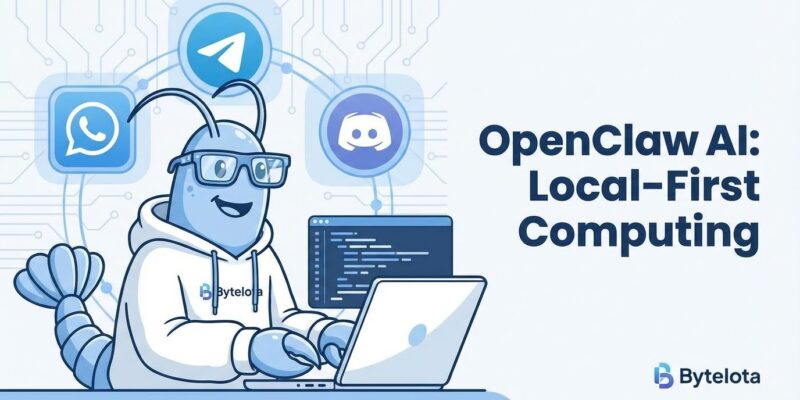
By OpenClaw has become the fastest-growing open-source project in GitHub history, surging from 9,000 to over 210,000 stars in just weeks. Created by Peter Steinberger (PSPDFKit founder, now at OpenAI), this local AI assistant runs entirely on your own hardware, connects to 25+ messaging platforms including WhatsApp and Telegram, and addresses growing privacy concerns while providing practical automation capabilities developers can implement immediately. Unlike cloud AI assistants that send all your data to corporate servers, OpenClaw keeps everything local—stored in simple Markdown files on your machine.
Local-First Architecture with Multi-Platform Integration
OpenClaw runs entirely on your own devices with a Gateway WebSocket control plane at its core. The gateway coordinates AI agent processing across 25+ messaging platforms including WhatsApp, Telegram, Discord, Slack, Signal, and iMessage. Consequently, all conversations, files, and memories stay on your hardware in simple Markdown files with zero corporate cloud lock-in.
The architecture splits into two layers. First, the gateway handles sessions, presence, config, cron jobs, and channel routing. Second, the execution layer provides a structured environment with proper session management, memory systems, and tool sandboxing. This local-first design means compliance-ready workflows for finance and healthcare, no training on your data, and full control over sensitive automation.
Installation takes 10-15 minutes with Node.js 22+ and an API key. Run npm install -g openclaw@latest && openclaw onboard --install-daemon to get started. OpenClaw is model-agnostic—works with OpenAI, Anthropic Claude (recommended default for cost-to-capability ratio), or local models like Llama and Mistral. For developers who want AI assistance but don’t trust cloud providers with their data, this is the answer.
Practical Automation: From Social Media to DevOps
OpenClaw enables real automation through 13,729 community-built AgentSkills, up from 5,700 in early February. Furthermore, developers report saving 10+ hours per week on social media alone—connecting blog RSS feeds to automatically generate platform-specific posts for X and LinkedIn. Newsletter writing is the second most popular use case, with OpenClaw researching topics, drafting content, and handling scheduling.
Developer workflows include PR monitoring, dependency management, and CI/CD automation. OpenClaw monitors repositories for new pull requests, fetches diffs via API, analyzes changes, and posts plain-English summaries as PR comments. Additionally, dependency management becomes automated: check for updates, identify security vulnerabilities, notify developers with prioritized recommendations.
Business operations benefit too. Automated client onboarding kicks off full workflows when new clients sign on—creating project folders, sending welcome emails, scheduling kickoff calls, and adding follow-up reminders. Every client gets a consistent experience without manual template copying. Moreover, some developers even let OpenClaw work overnight to create small apps or tools by providing high-level goals before sleep.
Related: AI Code Trust Crisis: 96% Distrust, 48% Don’t Verify
The ClawHub marketplace hosts 13,729 skills across 15+ categories, with 65% wrapping MCP servers. The ecosystem grew 2.4x in one month, showing strong community momentum beyond the hype.
Privacy Gains Come with Security Trade-offs
OpenClaw delivers on privacy promises but requires honest talk about security. However, the project has experienced 9+ CVEs in two months, including CVE-2026-25253 (CVSS 8.8, one-click remote code execution). SecurityScorecard found 135,000+ exposed instances on the public internet. Successful prompt injection attacks have tricked agents into uploading sensitive data—financial information, crypto wallet keys—and deleting code libraries.
Hacker News sentiment is divided. Some developers report “OpenClaw is changing my life” while others warn “OpenClaw is a security nightmare dressed up as a daydream.” Both perspectives are valid. The default install has a wide-open gateway compared to ChatGPT’s managed security team. In contrast, community audits suggest 20-26% of shared skills may contain vulnerabilities or malware. Enterprise faces shadow AI risks: 22% of employees run OpenClaw without IT approval on corporate machines connected to internal networks.
Nevertheless, the roadmap prioritizes hardening. Q1 2027 targets include WASM isolation and cryptographically signed skill registries to neutralize supply chain attacks. The trade-off is clear: you gain privacy and control by keeping data local, but you inherit security responsibility. This isn’t production-ready without proper sandboxing. NemoClaw and similar security layers emerged specifically to address these risks.
For developers concerned about privacy, this trade-off might be acceptable. For enterprise production use, wait for the security roadmap to mature.
Setup in 15 Minutes: Installation and First Steps
OpenClaw installation requires Node.js 22+ and an API key. Therefore, budget 10-15 minutes if you have prerequisites ready, 25-30 minutes if starting from scratch.
Use the one-line installer:
curl -fsSL https://docs.openclaw.ai/install.sh | bashOr standard npm install:
npm install -g openclaw@latest
openclaw onboard --install-daemon
The onboarding process walks through gateway setup, workspace configuration, channel integration, and skill installation. Furthermore, create a SOUL.md file to set agent personality and tone. Connect messaging platforms—WhatsApp and Telegram are most popular integrations, followed by Discord and Slack for developer workflows.
Claude Sonnet 4.6 via Anthropic is the recommended default for best cost-to-capability ratio. Consequently, API costs typically run $5-20/month, significantly less than GitHub Copilot’s $19/month subscription. Local models (Llama, Mistral) are an option for complete privacy with zero API costs, though performance varies.
The gateway must run continuously in a terminal for the agent to function. Without it, all commands fail silently. Additionally, deployment options include running on a laptop, VPS, or server with Tailscale for secure remote access. freeCodeCamp’s tutorial provides comprehensive getting-started guidance.
Unprecedented Growth and What’s Next
OpenClaw went from zero to 335,000 GitHub stars in four months, surpassing React to become the most-starred software project on GitHub. The metrics are staggering: 27 million monthly visitors, 2 million active users, 13,729 skills, 172 startups generating $361K/month combined, and 925% web traffic growth month-over-month (February to March 2026).
Geographic adoption spans USA (16.29%), India (12.16%), and China (12.08% with 1,436% growth). In fact, China’s “raise a lobster” phenomenon saw approximately 1,000 people queue for free install sessions at Tencent (Shenzhen) and Baidu (Beijing) in March. The movement is global.
In February 2026, creator Peter Steinberger announced he’s joining OpenAI to work on bringing agents to everyone. Sam Altman called him “a genius with a lot of amazing ideas about the future of very smart agents interacting with each other to do very useful things for people.” OpenClaw will move to a foundation model to stay open and independent. Steinberger’s next mission: build an agent that even his mother can use, which requires broader changes, more thought on safety, and access to the latest models and research.
Related: Claude Code GitHub Stars Surge: 7K in 24 Hours (2026)
The roadmap focuses on multi-agent systems where specialized sub-agents collaborate—one researches, another writes. Internal benchmarks show 40% accuracy boost compared to monolithic prompting. Moreover, future iterations target WebAssembly for local execution (30% latency reduction), WASM-based sandboxes to neutralize malware, and cryptographically signed skill registries.
Key Takeaways
- Fastest-growing project: 335,000 GitHub stars in four months, surpassing React
- Privacy-first architecture: All data stays local on your hardware, stored in Markdown files
- Multi-platform integration: Connects to 25+ messaging apps including WhatsApp, Telegram, Discord, Slack
- Real automation: 13,729 AgentSkills for social media, DevOps, business operations, personal productivity
- Security trade-offs: 9+ CVEs in two months, requires hardening for production use
- Strong momentum: 2 million users, Peter Steinberger joining OpenAI while keeping project independent
- Getting started: 15-minute install with Node.js 22+ and API key, $5-20/month typical costs
For developers seeking AI assistance without cloud data concerns, OpenClaw offers a compelling local-first alternative. However, the security challenges are real and documented—this isn’t production-ready without proper sandboxing. Nevertheless, the explosive growth, practical use cases, and rapidly expanding skills ecosystem signal a movement toward local-first AI. The privacy gains come with security responsibility. Choose accordingly.